
-
by sayum
26 August 2026 1:49 PM







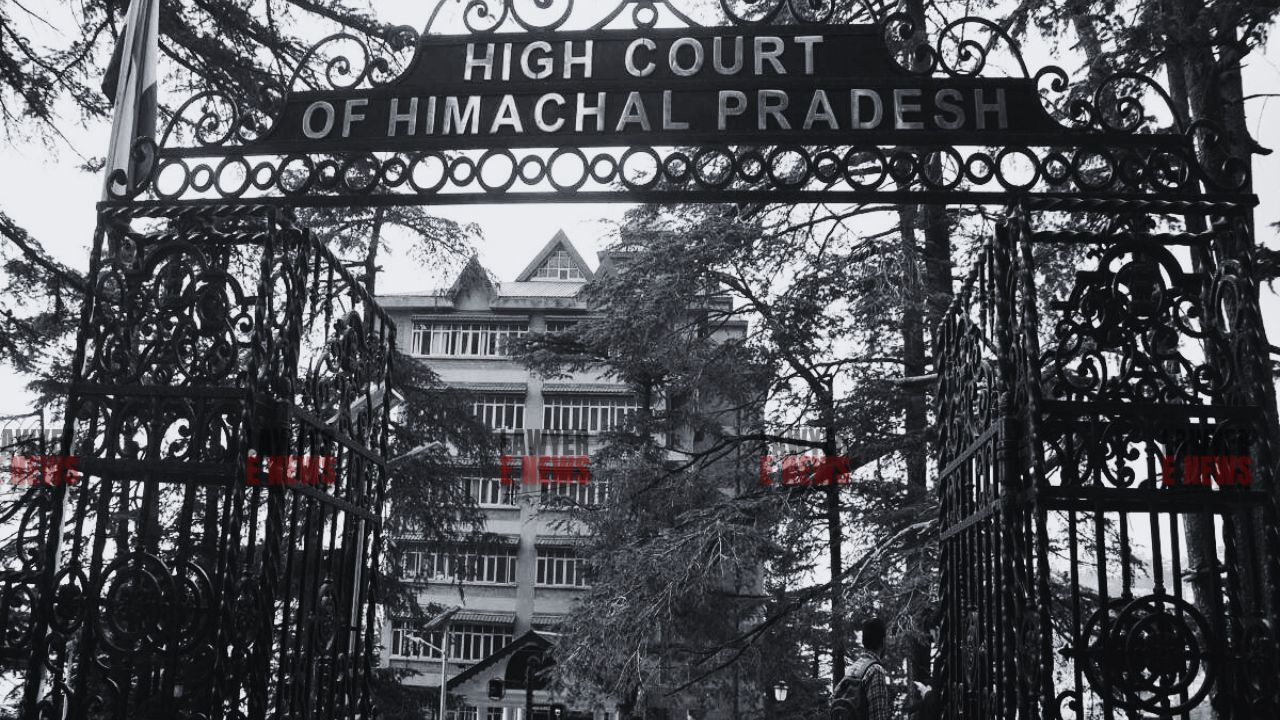
"A Tenant Is Precluded to Transfer Tenancy Rights by Way of a Will — Such a Will Is Void Ab Initio", Himachal Pradesh High Court dismissed a second appeal and upheld the rights of the legal heirs of a deceased tenant, holding that tenancy rights cannot be bequeathed by a Will under the Himachal Pradesh Tenancy and Land Reforms Act, 1972. Justice Rakesh Kainthla further held that a tenant under a widow landowner cannot acquire proprietary rights during her lifetime, and that civil courts have full jurisdiction to adjudicate disputes between two persons each claiming to be successors of a tenant.
The plaintiffs filed a civil suit seeking declaration that Mutation No. 185 dated May 14, 2002 — attested on the basis of a Will dated November 27, 1984 executed by a tenant named Panchi — was illegal and void. According to the plaintiffs, Panchi was recorded as a non-occupancy tenant under Ishru, a widow landowner, as per the Jamabandi for 1977-78. Panchi died issueless on February 1, 1992, leaving his widow Nimo, who died on July 27, 2001. The plaintiffs, being heirs of Panchi, claimed succession to the tenancy. The defendant, however, contended that Panchi had become the owner of the land upon commencement of the HP Tenancy Act and had validly bequeathed it by Will. The Trial Court accepted the defendant's position and dismissed the suit. The First Appellate Court reversed this, holding that Panchi could not have acquired ownership during Ishru's lifetime and that tenancy rights cannot be bequeathed. The defendant approached the High Court in a second appeal.
Tenant Under a Widow Cannot Acquire Ownership
The Court upheld the finding of the First Appellate Court on the foundational question. The Jamabandi for 1977-78 clearly showed Ishru — a widow — as the owner and Panchi as her non-occupancy tenant. Section 104(8) of the HP Tenancy and Land Reforms Act expressly excludes the operation of Sections 104(1) to 104(6) — which confer proprietary rights on tenants — in the case of a tenancy under a widow, during her lifetime.
The Trial Court had relied upon Daulat Ram v. State of Himachal Pradesh (1979) to hold that conferment of proprietary rights is automatic upon commencement of the Act. The High Court distinguished that precedent, noting it was decided under Section 104(3) and had no application where Section 104(8) expressly carves out an exception for tenancies under widows. Panchi, therefore, remained a tenant throughout and never became an owner.
Tenancy Rights Cannot Be Bequeathed: Will Is Void Ab Initio
On the central question, the Court held firmly that tenancy rights under the HP Tenancy Act cannot be transferred by way of a Will. Section 45 of the Act lays down an exclusive and absolute rule of succession to tenancy rights. Once a tenant dies, succession is governed solely by that provision — it cannot be displaced by a testamentary document.
The Court relied upon a consistent line of HP High Court judgments. In Devi Saran v. Lekh Ram (1992), the Court had observed:
"A tenant could not have transferred a tenancy right by way of a Will, and Section 45 of the Act puts a bar upon such transfer of the right of the tenant... a tenant is precluded to transfer his or her tenancy rights by way of a will. If that be so, then the will is void ab initio."
This position was affirmed in Bhola v. Jiwan Wati (1994), where it was held that "the rule of succession laid down under Section 45 of the Act is absolute and also exclusive. It cannot be sustained or modified on the grounds of the custom or personal law of the parties or at the will of the parties."
In Mansha Ram v. Tulsi Devi (1998), the Court had further cautioned that "a tenant cannot be permitted to bequeath his right of occupation by a Will in favour of someone who is not covered by the definition... once it is found that tenancy rights could not be passed on as such by any colourable transaction, it cannot be permitted to nullify the effect of the mandate by the legislature."
Applying these principles, the Court held that since Panchi remained a tenant throughout his life, the Will executed by him was void ab initio and could not confer any rights on the defendant.
Civil Court Has Jurisdiction: Dispute Between Successors of Tenant
On the question of civil court jurisdiction, the defendant argued that the suit was barred since the dispute related to tenancy rights, which fall within the exclusive domain of Revenue Courts under the HP Tenancy Act. The Court rejected this contention.
Relying on the Supreme Court's principles in Dhulabhai v. State of M.P. (1968) — which holds that exclusion of civil court jurisdiction is not to be lightly inferred — and this Court's earlier decisions in Babu Ram v. Pohlo Ram (1990) and Amar Chand v. Thakri Devi (2005), the Court held that the bar under Section 58 of the Act applies only where the landlord-tenant relationship itself is undisputed. Where two persons are each claiming to be the successor of a tenant, such a dispute does not fall within the cognizance of Revenue Courts, and the civil court's jurisdiction is not barred.
"A question which arises between two persons, each claiming to be tenant in respect of a given extent of land, cannot be said to be a dispute between the owner of the land and the tenant... to such matters, the provision of Section 112 of the Act barring the jurisdiction of the Civil Court is not attracted."
The bar under Sections 112 and 115 of the Act, the Court clarified, applies only when the validity of orders passed under Chapter X of the Act is called into question. Since no such order was involved in this case, the civil court had full jurisdiction.
Additional Evidence Application Dismissed
The defendant had also sought to lead additional evidence by way of a copy of the Pariwar Register to establish that Ishru had died before the commencement of the HP Tenancy Act — which, if proved, would have meant that Panchi became the owner. The Court dismissed the application on two independent grounds.
First, the defendant had never pleaded in the written statement that Ishru had died and that Panchi had consequently become the owner. Relying on the Supreme Court's recent ruling in Iqbal Ahmed v. Abdul Shukoor (2025 SCC OnLine SC 1787), the Court held that additional evidence cannot be permitted to prove a plea that was never taken in the pleadings.
Second, a copy of the Pariwar Register is not admissible to prove date of death. Relying on State of H.P. v. Janam Singh (2010) and State of H.P. v. Sunil Kumar (2011), the Court held that only an entry in the Register of Births and Deaths is admissible for this purpose. The Pariwar Register, not being a statutory register under the Registration of Births and Deaths Act, 1969, has no evidentiary value to prove such facts.
All three substantial questions of law were answered against the appellant-defendant. The High Court dismissed the second appeal and upheld the judgment and decree of the First Appellate Court, confirming that the plaintiffs — as legal heirs of the deceased tenant Panchi — are entitled to succeed to the tenancy under Section 45 of the HP Tenancy and Land Reforms Act.
Date of Decision: March 10, 2026





