
-
by sayum
26 August 2026 1:49 PM







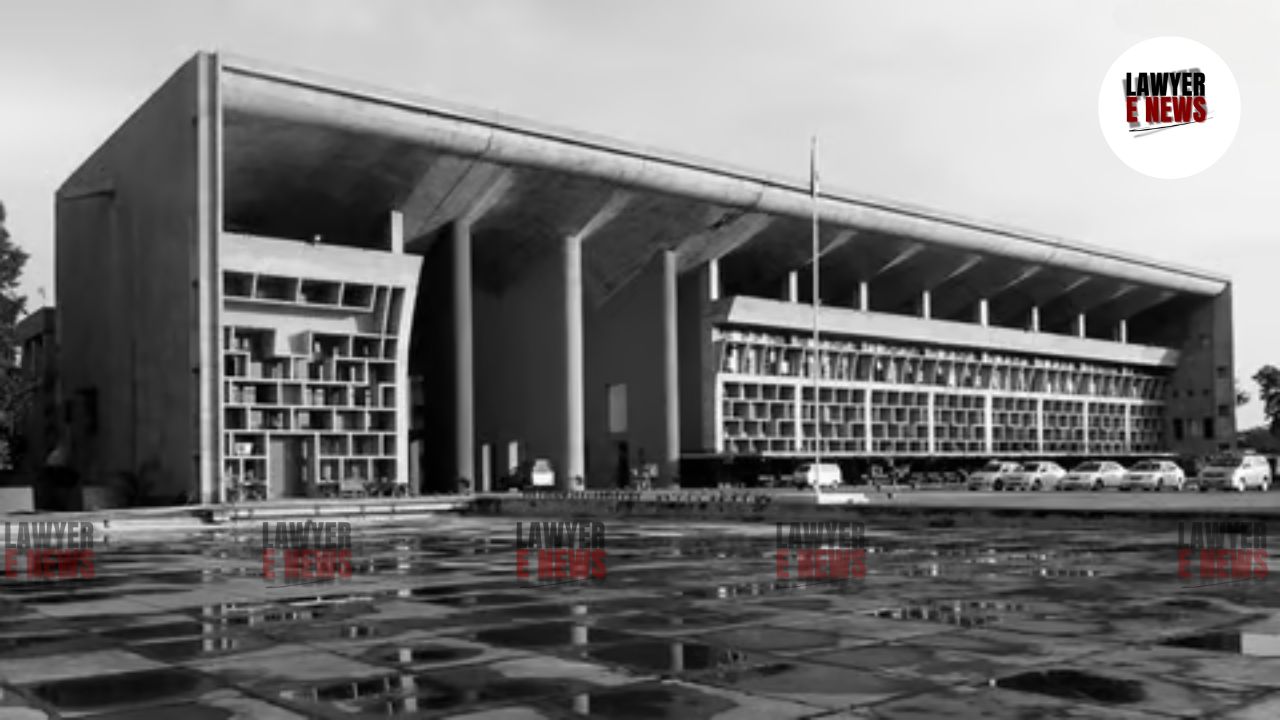
“The High Court cannot be used as a substitute appellate forum where the statute expressly bars appeal” — Punjab and Haryana High Court refusing to entertain a revision petition filed under Article 227 of the Constitution against an award of ₹21,380/- passed by the Motor Accident Claims Tribunal (MACT), Patiala. The Court held that where the statute prohibits an appeal for awards below ₹1 lakh under Section 173(2) of the Motor Vehicles Act, 1988, parties cannot sidestep this bar by invoking the High Court’s supervisory jurisdiction.
Justice Alka Sarin observed that Article 227 is not a backdoor for appeal and “the power of superintendence under Article 227 cannot be exercised to circumvent a legislative bar created under Section 173(2) of the MV Act”.
“Where the Legislature Says No Appeal Lies, Courts Must Respect That”: No Revision Maintainable If Award Is Below ₹1 Lakh
The petition arose from an award passed by the MACT on 28.09.2022, awarding a sum of ₹21,380/- in favour of the claimant, and holding the owner, driver, and insurer jointly and severally liable. The petitioners — the owner and driver — did not file an appeal under Section 173, knowing it would be statutorily barred due to the quantum being below ₹1 lakh. Instead, they invoked the extraordinary jurisdiction of the High Court under Article 227.
The legal argument advanced was that while Section 173(2) prohibits appeals, it does not explicitly bar a revision under Article 227. However, the High Court squarely rejected this approach.
Justice Alka Sarin relied on the amended language of Section 173(2) of the MV Act, which post-2022 states:
“No appeal shall lie against any award of a Claims Tribunal if the amount in dispute in the appeal is less than one lakh rupees.”
The Court noted that the purpose of raising the threshold from ₹10,000 to ₹1,00,000 was to reduce litigation over trivial compensation amounts, and that permitting revisions in such cases would frustrate legislative intent.
“High Court’s Supervisory Powers Cannot Be Used to Create a Parallel Appeal Mechanism”: Scope of Article 227 Reiterated
The Court cited two prior rulings by coordinate Benches of the same Court —
Bharti AXA General Insurance Co. Ltd. v. Sahab Singh [CR-6131-2016, decided on 19.09.2016], and
Shriram General Insurance Co. Ltd. v. Sandeep [CR-1727-2025, decided on 21.03.2025] —
to emphasize that Article 227 cannot be invoked where an appeal is explicitly barred by statute.
In Bharti AXA, it was held:
“Once statutory provisions prohibit the filing of the statutory appeal, the affected party cannot be permitted to circumvent the statutory provisions of law by invoking the power of superintendence under Article 227.”
The judgment also extensively quoted the Supreme Court’s decision in Shalini Shyam Shetty v. Rajendra Shankar Patil [(2010) 8 SCC 329], to summarize the core principles governing Article 227. Particularly relevant was the principle that:
“High Courts cannot, on the drop of a hat, in exercise of its power of superintendence under Article 227, interfere with the orders of tribunals or Courts inferior to it... where an alternative statutory mode of redressal has been provided, that would also operate as a restrain on the exercise of this power.”
Furthermore, the Court emphasized that Article 227 is a “reserve and exceptional power,” not meant to be invoked for correcting individual grievances where the statute has clearly ruled out a second look.
“Discretion Must Not Undermine Discipline”: Petition Dismissed for Misuse of Supervisory Jurisdiction
Justice Alka Sarin, while dismissing the petition, clarified that the discretion under Article 227 is not unfettered and must be used with “judicial discipline, restraint and only to maintain the purity of justice delivery”.
In her concluding remarks, the Court stated:
“The impugned award does not call for any interference by this Court while exercising its power under Article 227... the present revision petition being devoid of any merit, is dismissed.”
All pending applications were also disposed of.
The Punjab and Haryana High Court’s judgment reaffirms a foundational constitutional principle — where the legislature speaks clearly, courts must respect the statutory limits on jurisdiction. The ruling in Nirbhai Singh v. Darshan Singh serves as a strong judicial pronouncement against the misuse of Article 227 as a disguised appellate remedy, especially in motor accident claim cases involving nominal compensation amounts below ₹1 lakh.
By dismissing the revision as non-maintainable, the Court has reinforced that Article 227 is not an all-access pass, but a gatekeeping tool to ensure tribunals act within bounds — not a substitute for every rejected or unavailable appeal.
Date of Decision: 15 October 2025





