
-
by sayum
26 August 2026 1:49 PM







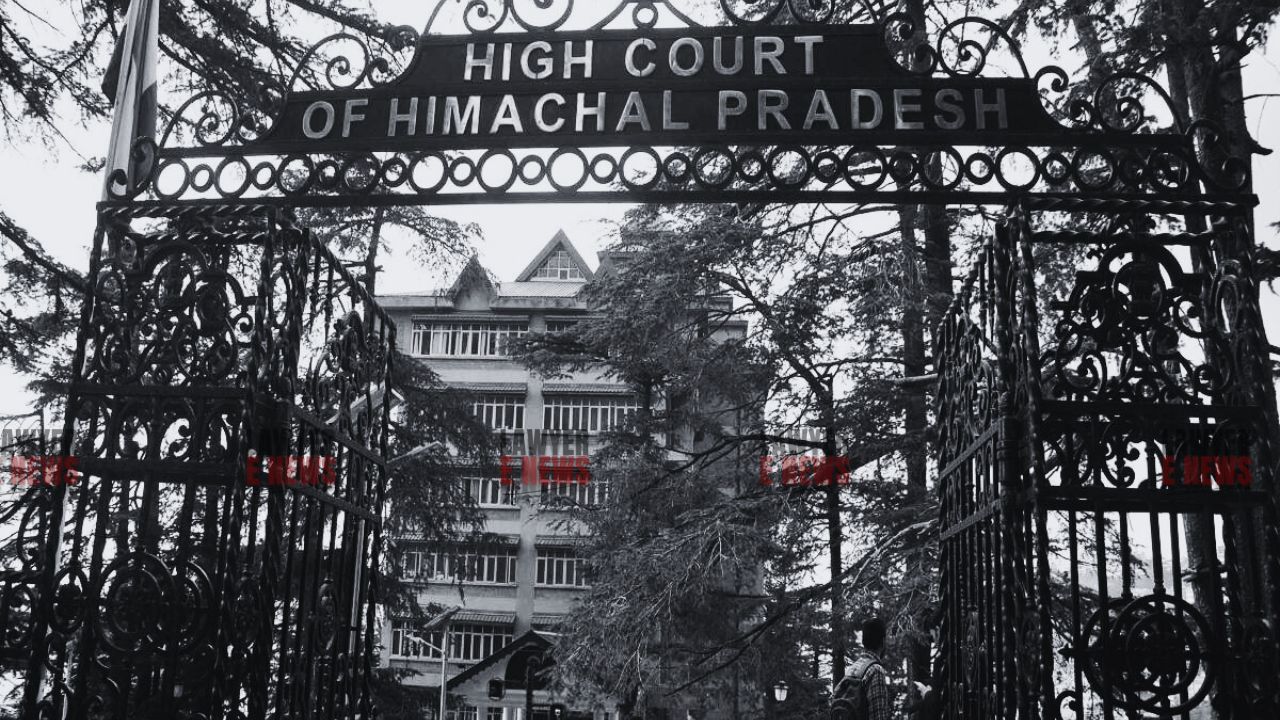
"The State Being a Welfare State Governed by Rule of Law Cannot Arrogate to Itself a Status Beyond What Is Provided by the Constitution", Himachal Pradesh High Court has dismissed a second appeal preferred by the State of Himachal Pradesh, upholding concurrent findings of two courts below that directed the State to formally acquire a portion of a citizen's land — used for the construction of National Highway-88 without following due process of law — and to pay due compensation within two years.
Justice Romesh Verma firmly rejected the State's twin defences of oral consent and delay and laches, holding that neither can shield a government that has dispossessed a citizen of his property without legal sanction.
The court examined whether the State's plea of oral consent by the plaintiff was legally sustainable; whether delay and laches could defeat a continuing cause of action for forcible dispossession; and whether the concurrent findings of the two courts below revealed any substantial question of law warranting interference under Section 100 of the Code of Civil Procedure.
No Document, No Consent — Oral Consent Plea Unsustainable
The State's primary defence before all three forums was that the plaintiff had orally consented to construction of the road through his land. The High Court dismissed this contention summarily, noting that the defendants produced no document whatsoever to substantiate any form of consent. "Admittedly, the defendants were not in possession of any document to show and to substantiate that there was any kind of consent for construction of the road through their land. Nothing has been placed on record to prove the case of consent by the State."
The court placed this finding within the larger constitutional framework laid down by the Supreme Court in Vidya Devi v. State of Himachal Pradesh, (2020) 2 SCC 569, which had categorically rejected an identical "oral consent" plea advanced by the State. As the Supreme Court had held in that case: "The contention of the State that the Appellant or her predecessors had 'orally' consented to the acquisition is completely baseless. We find complete lack of authority and legal sanction in compulsorily divesting the Appellant of her property by the State."
Article 300-A Is Not a Mere Formality — State Must Follow Due Process
The court rested the core of its reasoning on the constitutional right to property under Article 300-A of the Constitution, reinforcing the settled position that no person can be dispossessed of property without legal sanction, without following due process, and without payment of just and fair compensation.
Relying on Sukh Dutt Ratra v. State of H.P., (2022) 7 SCC 508, the court emphasised that the State, far from enjoying wider latitude than private parties, bears a higher responsibility to demonstrate it has acted within the confines of legality. As the Supreme Court observed in that judgment: "It is the cardinal principle of the rule of law, that nobody can be deprived of liberty or property without due process, or authorization of law."
The H.P. High Court also drew on its own Division Bench ruling in Sakuntla Devi v. State of H.P., CWP No. 491 of 2022, decided on October 20, 2023, which had directly held that the plea that landowners had made their land available with consent "is of no consequence" and that utilising land for construction of a road without compensation "certainly amounts to forcible dispossession... which is violative of Article 300-A of the Constitution of India."
"There Cannot Be a Limitation to Doing Justice" — Delay and Laches Rejected
The State contended that the plaintiff's claim was stale and highly belated, arguing that the road had been in existence for decades. The court rejected this with equal firmness. Being the owner of the suit property, the plaintiff retained the right to file a suit at any point unless and until the State defeated his title by perfection through adverse possession — a route the Supreme Court had already condemned as impermissible for the State itself.
The court quoted the powerful dictum from Sukh Dutt Ratra: "The State cannot shield itself behind the ground of delay and laches in such a situation; there cannot be a 'limitation' to doing justice."
The court further held that delay and laches cannot be raised where the cause of action is a continuing one — and forcible dispossession without compensation, persisting day after day, is precisely a continuing cause of action. Acquiescence, it added, requires proof of conduct amounting to encouragement or active assent; mere delay and silence cannot constitute acquiescence.
Second Appeal — No Substantial Question of Law Arises
On the scope of interference under Section 100 CPC, the court applied the settled principle reaffirmed by the Supreme Court in Hero Vinoth v. Seshammal, (2006) 5 SCC 545, and the recent decision in Annamalai v. Vasanthi, 2025 INSC 1267, that the first appellate court is the final court of fact, and the High Court in second appeal may interfere only where the finding is based on inadmissible evidence, ignores relevant evidence, misreads evidence, or is perverse. None of these conditions were found to be present. "Both the Courts below have rightly appreciated the point in controversy after considering the oral as well as documentary evidence placed on record. No question of law, much less a substantial question of law, arises in the present case."
The Himachal Pradesh High Court dismissed the State's Regular Second Appeal as devoid of merit and confirmed the direction to acquire the suit land and pay due compensation in accordance with law.
Date of Decision: March 13, 2026





