-
by sayum
27 July 2026 3:39 PM







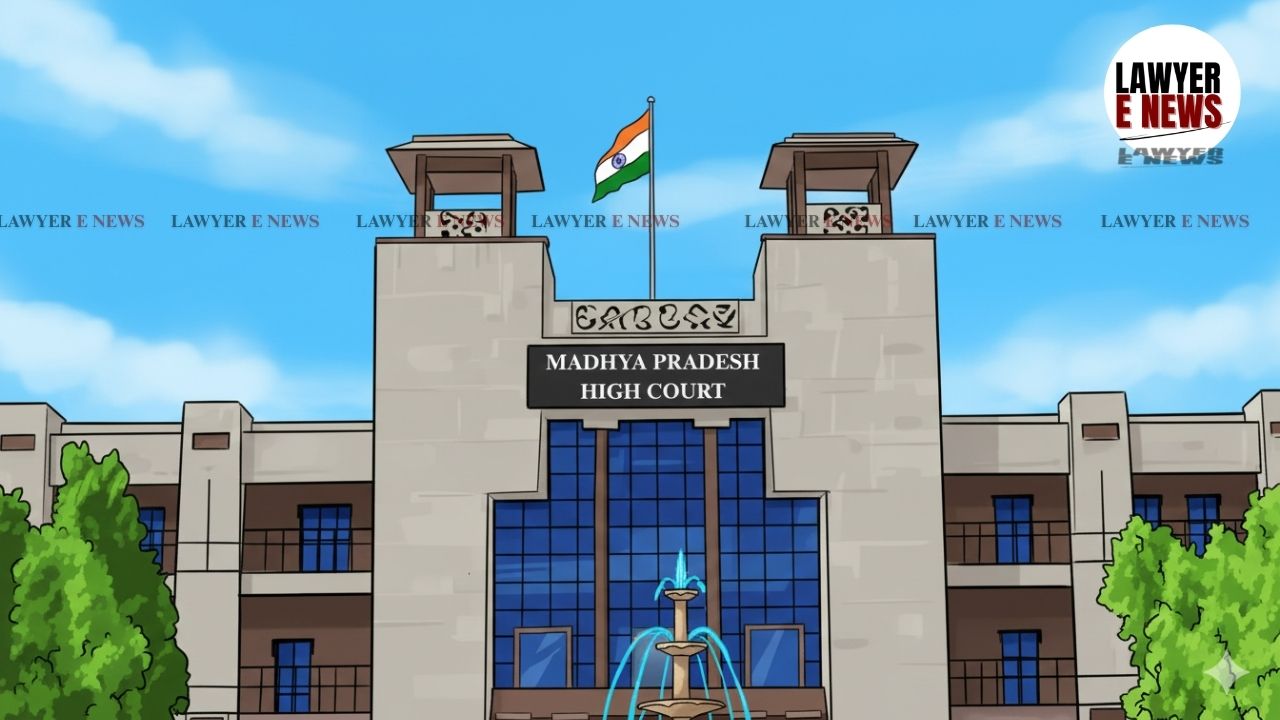
"State cannot be permitted to approbate the bravery for a cash reward and reprobate the same bravery to deny an out-of-turn promotion. For this reason, also, the findings arrived at by the committee are perverse" Madhya Pradesh High Court, in a significant ruling, held that the State cannot classify a high-risk rescue operation as "routine duty" to deny promotion while simultaneously awarding a cash prize for the same act.
A bench of Justice Vivek Kumar Singh observed that such contradictory stances by the Screening Committee reflect manifest arbitrariness and a failure to apply the correct legal parameters under the M.P. Police Regulations. The Court noted that dismissing an act involving extreme danger as just "part of the job" overlooks the reality that professional responders had refused to intervene.
The petitioner, Indramani Patel, a Sub-Inspector, sought out-of-turn promotion under Regulation 70-A for rescuing two individuals from a truck dangling over a 200-foot gorge in 2004. Despite recommendations from senior officers and a prior court remand, the Screening Committee rejected his claim in 2012, characterizing his actions as routine duty and offering a nominal cash reward instead. The petitioner challenged this rejection, arguing that his actions far exceeded standard expectations of police duty.
The primary questions before the court were whether the Screening Committee's decision to classify an extraordinary act of bravery as routine duty was arbitrary and whether the findings were legally sustainable. The court was also called upon to determine if it could directly mandate the grant of promotion given the prolonged history of litigation.
Court Analyzes Scope Of Regulation 70-A
The Court began by examining the statutory framework of Regulation 70-A of the M.P. Police Regulations, which serves as a special exception to general promotion rules. It noted that the provision is intended to recognize and reward acts of extraordinary valour and professional excellence. The bench emphasized that the regulation demands an objective assessment from the screening committee to distinguish between standard obligations and exceptional conduct.
"The Core intent and objective of this Regulation is to recognize, reward and permanently give incentive to such acts which are of extraordinary valour, extreme presence of mind and professional excellence."
Rescue Operation Exceeded Routine Police Obligations
Addressing the facts of the rescue, the Court observed that a routine officer's response would have been limited to securing the perimeter and calling for specialized teams. However, the petitioner descended a 200-foot gorge on a rope in darkness after professional crane operators refused to do so. The bench found that this life-threatening decision to secure an overloaded truck and save lives flawlessly satisfied the threshold of conspicuous gallantry.
"The very fact that professional crane operators refused to descend into the gorge highlights the extreme danger involved. The petitioner went beyond the call of duty and took a life-threatening decision."
State Cannot Adopt Contradictory Positions On Bravery
A central pillar of the judgment was the principle that the State cannot "approbate and reprobate." The Court found it deeply irrational that the administration could find an act brave enough for a cash reward of Rs. 5,000/- while simultaneously terming it "routine" to deny a statutory promotion. This inconsistency, the Court held, exposed the arbitrary standards applied by the committee and vitiated the entire decision-making process.
"On the same set of facts, the respondent State found the petitioner’s act brave enough to warrant a specific cash reward yet it concluded that it was merely a routine duty to deny him his statutory right of consideration for promotion."
Distinguishing Precedents On Parity And Judicial Review
The State had relied on the Supreme Court judgment in State of Madhya Pradesh v. Sanjay Shukla, arguing that out-of-turn promotion is not a matter of right. However, the High Court clarified that while judicial review is limited, it is warranted when a decision is "palpably arbitrary or perverse." Unlike the Sanjay Shukla case, where the committee provided cogent reasons, the committee here ignored ground-level assessments from senior officers who witnessed the topography and risks involved.
"In contrast, the committee in the present case failed entirely to measure the act against the statutory parameters of conspicuous gallantry... rewarding the act with cash for bravery while simultaneously dismissing it as routine is legally perverse."
Court Rejects Further Remand To Prevent Travesty Of Justice
Citing the fact that the petitioner had been litigating since 2005 and that a previous remand had already failed to produce an objective evaluation, the Court decided to put a "quietus" to the matter. Relying on coordinate bench precedents, the Court held that when a claim is denied arbitrarily over two decades, the Court can directly mandate the grant of promotion with retrospective effect rather than subjecting the petitioner to another round of administrative futility.
"As the petitioner is agitating his claim since 2005, this Court is of the view that in place of mechanically remanding the matter back to the authorities after a long period of 20 years... it would be a travesty of justice and an exercise in futility to remand the matter."
The Court quashed the impugned order dated December 28, 2012, and directed the respondents to grant the petitioner a notional out-of-turn promotion to the post of Inspector. This promotion is to be effective retrospectively from February 10, 2005, the date of the original recommendation. While the petitioner is not entitled to back-wages for the period he did not officiate, the Court ordered the fixation of his seniority and notional salary for the purpose of future increments.
Date of Decision: 15 June 2026