
-
by sayum
26 August 2026 1:49 PM







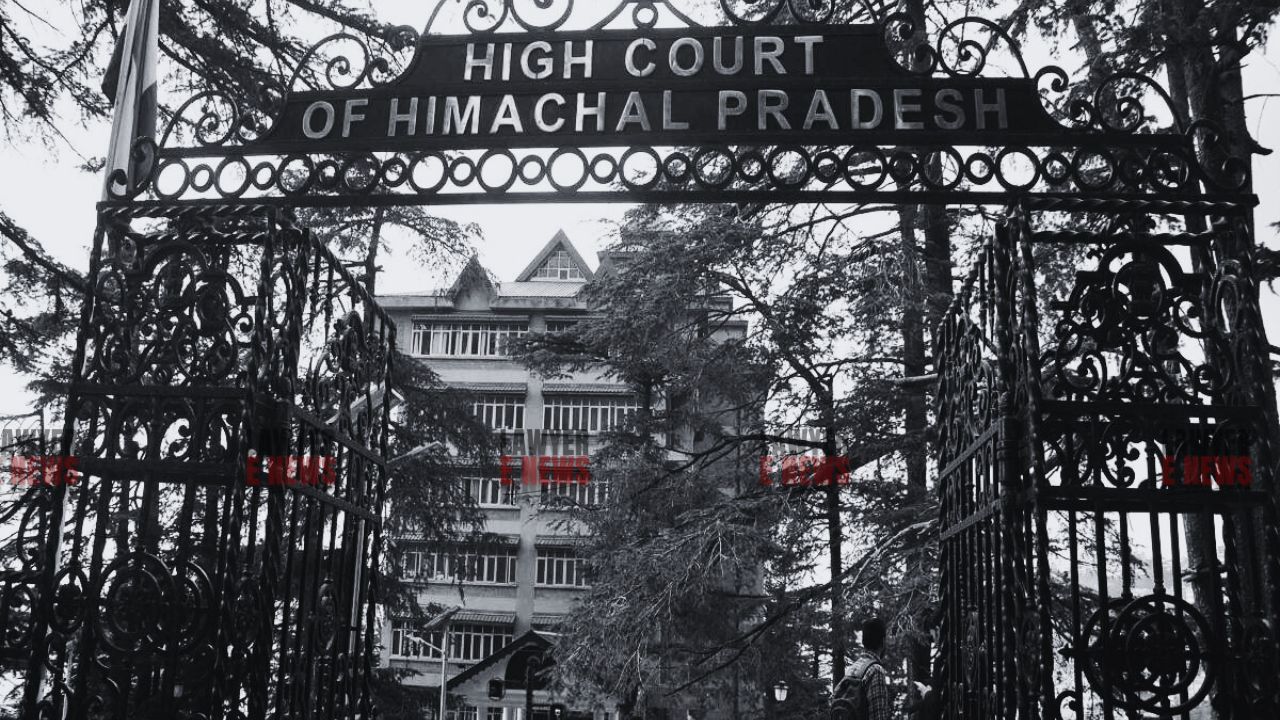
“When Trial Is Unlikely To Conclude Within Reasonable Time, Rigours Of Section 45 PMLA Must ‘Melt Down’ To Protect Article 21”, High Court of Himachal Pradesh at Shimla dealing with the scope of bail under the Prevention of Money Laundering Act, 2002 (PMLA) where the trial is likely to be prolonged.
Justice Virender Singh held that although Section 45 PMLA imposes stringent twin conditions for bail, constitutional courts cannot permit the provision to become a mechanism for indefinite incarceration. The Court emphasized that prolonged pre-trial detention combined with a remote possibility of trial completion violates the fundamental right to personal liberty and speedy trial guaranteed under Article 21 of the Constitution.
Granting bail to the applicant, the Court observed that the prosecution case involved more than 100 witnesses and over 63,000 pages of documentary evidence, making early completion of trial highly improbable.
Background of the Case
The case arose from allegations of large-scale embezzlement of post-matric scholarship funds meant for SC/ST/OBC students in Himachal Pradesh. The investigation began with FIR No. 133 of 2018 registered at Police Station Shimla East after complaints were received that students had not received scholarship amounts credited in their names.
An inquiry conducted by the Education Department revealed serious irregularities in the e-Pass portal used for disbursement of scholarships. The investigation was later transferred to the Central Bureau of Investigation, which registered RC No. 0962019S0002 in May 2019 under provisions of the IPC and the Prevention of Corruption Act.
During searches conducted at 22 private educational institutions, including the Himalayan Group of Professional Institutions (HGPI) and Apex Group of Professional Institutions (AGPI), records were seized indicating fraudulent scholarship claims.
The applicant Vikas Bansal, who served as Vice Chairman of both institutions, was also a trustee of Maa Saraswati Educational Trust and People Welfare Educational Trust. Based on the predicate offences investigated by the CBI, the Enforcement Directorate registered ECIR/SHSZO/04/2019 under Sections 3 and 4 of the PMLA.
Prolonged Detention and Article 21
The High Court held that the sheer volume of evidence and the large number of witnesses indicated that the trial was unlikely to conclude in the near future.
The Court observed: “Considering the total number of witnesses to be examined and the voluminous record relied upon, the chances of conclusion of the trial against the applicant in the near future are not so bright.”
Referring to Supreme Court decisions including Mahesh Joshi v. ED, V. Senthil Balaji v. ED, and Manish Sisodia v. ED, the Court reiterated that constitutional courts must intervene when statutory bail restrictions result in violation of Article 21.
Quoting the Supreme Court, the Court observed: “Section 45(1)(ii) does not confer power on the State to detain an accused for an unreasonably long time when there is no possibility of the trial concluding within a reasonable time.”
Court on Dependency of PMLA Proceedings on Predicate Offence
A significant legal observation of the Court concerned the relationship between the offence of money laundering and the predicate offence.
The Court noted:
“The existence of proceeds of crime at the time of trial under Section 3 PMLA can be proved only if the scheduled offence is established in the prosecution of the scheduled offence.”
Since the trial in the predicate CBI case had not commenced, the Court held that the PMLA trial itself could not reach final adjudication in the near future.
“Bail Is Not To Be Withheld As Punishment”
The Court reiterated the settled principle of criminal jurisprudence that pre-trial detention cannot become a substitute for punishment.
Quoting the Supreme Court’s classic observation, the Court noted:
“Bail is not to be withheld as a punishment, but merely to secure the attendance of the accused at trial.”
The Court further observed that the prosecution case was largely based on documentary evidence already seized, which significantly reduced the possibility of tampering with evidence.
Court Rejects ED’s Argument on Parity
The Enforcement Directorate argued that the applicant could not claim parity with co-accused who had already been granted bail because the roles attributed to them were different.
Rejecting this argument, the Court held:
“A person cannot be compelled to seek parity only after undergoing a similar period of custody as his co-accused.”
The Court noted that several co-accused including Hitesh Gandhi, Arvind Rajta, Krishan Kumar and Rajdeep Singh had already been granted bail, which was a relevant factor in favour of the applicant.
Constitutional Courts Can Relax Section 45 PMLA
The High Court concluded that statutory restrictions under Section 45 PMLA cannot override constitutional guarantees.
Relying on Union of India v. K.A. Najeeb, the Court held:
“The presence of statutory restrictions does not oust the ability of constitutional courts to grant bail on grounds of violation of Part III of the Constitution.”
The Court ultimately held that due to prolonged custody, delay in trial, documentary nature of evidence and parity with co-accused, the twin conditions under Section 45 PMLA could be considered satisfied at this stage.
Allowing the bail application, the Himachal Pradesh High Court ordered the release of the applicant on furnishing a personal bond of ₹2,00,000 with two sureties of the like amount, subject to conditions including regular appearance before the trial court, non-interference with evidence, and restriction on leaving India without permission of the court.
The judgment reinforces a crucial constitutional principle that stringent bail provisions under special statutes like PMLA cannot justify indefinite pre-trial incarceration, particularly when the trial is unlikely to conclude within a reasonable period.
Date of Decision: 12 March 2026





