-
by sayum
28 August 2026 6:47 AM







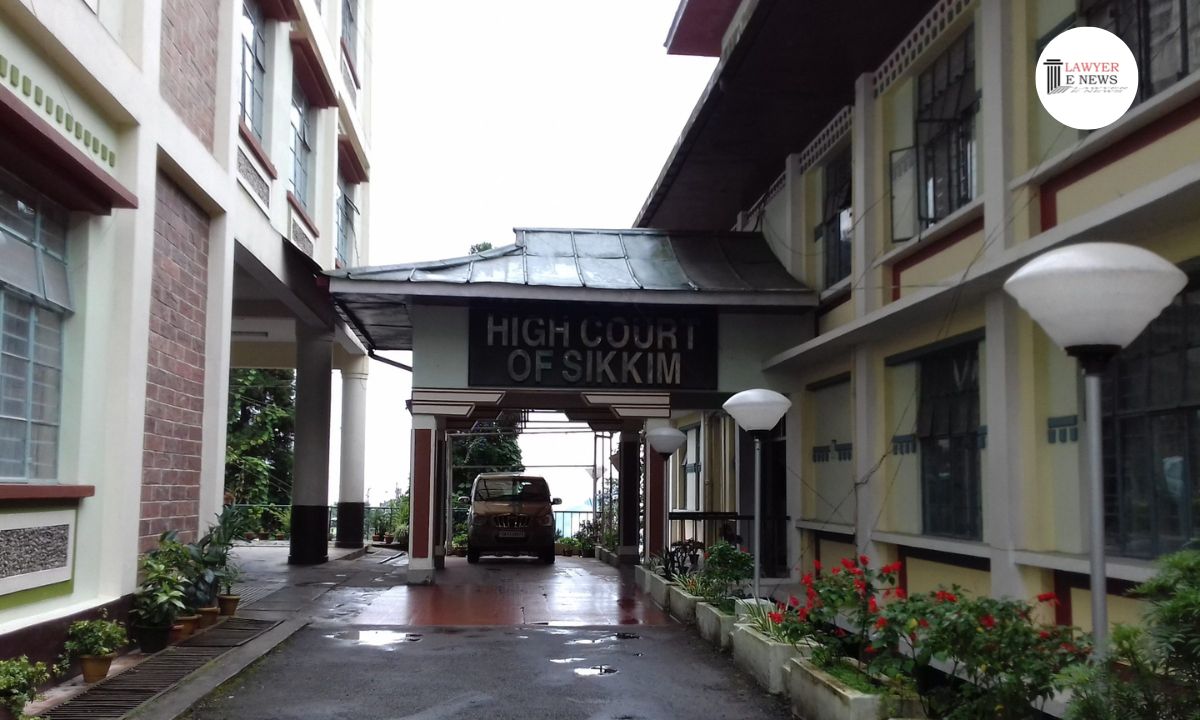
Prosecution Failed to Prove That the Accused Was a Government Servant — Custody Was Never Established - In a deeply scrutinized judgment High Court of Sikkim upheld the conviction of Ganesh Dhakal for the offences of abduction, wrongful confinement and rape of an 18-year-old woman but rejected the State’s attempt to enhance his sentence under Sections 376(2)(b) and 376(2)(c) of the IPC, citing a complete lack of evidence to prove he was a government servant or that the victim was ever in his custody within the meaning of the law.
In a joint verdict disposing of two appeals — Crl. A. No.14 of 2021 (by the convict) and Crl. A. No.27 of 2023 (by the State) — the Division Bench of Justice Meenakshi Madan Rai and Justice Bhaskar Raj Pradhan rejected the defence’s attempt to question the credibility of the victim, while also rebuking the State’s “piteous” failure to produce even basic proof of employment of the accused.
“The Evidence of the Prosecutrix Is Cogent, Consistent and Withstood Cross-Examination”
Ganesh Dhakal, a 30-year-old man, was convicted by the Fast Track Court, Gyalshing, for offences under Sections 342, 366, and 376(1) of the IPC. He was sentenced to 10 years' rigorous imprisonment for rape, along with imprisonment for abduction and wrongful confinement, and was ordered to pay fines totalling ₹1.5 lakh.
The victim (PW-1), then 18, deposed that on July 12, 2020, she was tricked and physically overpowered into a car, driven to a secluded house, and raped twice by the accused while her cousin (PW-2) and another male were present in the premises. The incident was reported three days later.
Rejecting the defence argument that the delay in FIR made the case unbelievable, the Court relied on settled principles from State of Punjab v. Gurmit Singh and State of Maharashtra v. Chandraprakash Kewalchand Jain, noting:
“The courts cannot overlook the fact that in sexual offences, delay in the lodging of the FIR can be due to a variety of reasons… no self-respecting woman would come forward in a Court just to make a humiliating statement against her honour.”
The Court found the victim’s statement credible, and her testimony reinforced by medical evidence, which confirmed vaginal tear, bruises, and bite marks. The examining doctor’s report stated that the injuries appeared consistent with a sexual assault and were about three days old, matching the date of the incident.
“You May Call Her Delayed, Not Contradictory”: Court Rejects Accused’s Attack on Victim’s Credibility
The accused had argued that the victim’s testimony had anomalies, and that she had not been confronted with contradictions under Section 145 of the Evidence Act. The Court struck this down firmly:
“All that the Learned Trial Court has recorded is ‘objected to as beyond her Section 161 Cr.P.C. statement’. In the absence of the witness being confronted with the concerned statements, such objections serve no purpose.”
It held that no substantial contradiction was proved, either with the victim’s police statement (Section 161) or her judicial statement (Section 164), because due procedure for contradiction was not followed.
The Court further reiterated: “The evidence of the prosecutrix is cogent and consistent… Her narrative withstands the test of cross-examination.”
“The State Did Not Even Produce an ID Card”: Court Rejects Enhancement under Section 376(2)(b) and (c)
In its appeal for sentence enhancement, the State of Sikkim argued that the accused was a government servant, posted as a security guard at the MLA’s residence, and thus liable for enhanced punishment under Section 376(2)(b) IPC (rape by a public servant on a woman in custody).
The Court observed with disappointment:
“All that the State-Appellant was able to indicate was the Arrest Memo which recorded his occupation as ‘Government servant’… No identification card was seized. No documentary proof was placed.”
Even more damning was the Court’s finding on the requirement of custody under Section 376(2)(b):
“By no stretch of the imagination can the victim be said to have been in the custody of the Respondent.”
The Court also rejected the applicability of Section 376(2)(c), holding that there was no evidence whatsoever to establish such conditions of dominance or misuse of official capacity.
“The State Didn’t Even Use Section 216 CrPC to Amend the Charges in Time — Need We Add More?”
The Court took note that the State failed to seek alteration of charges before judgment, under Section 216 CrPC, and added with biting precision:
“The piteous state of affairs of the Prosecution can be gauged from the admission… that the fact the Respondent was a Government employee came to the notice of the State-Appellant only during the course of hearing.”
Final Word: Conviction Upheld, Sentence Stands — But No Special Custody or Public Office Proven
Finding no infirmity in the Trial Court's conviction and sentence under Section 376(1), the Division Bench concluded:
“The Prosecution has established beyond reasonable doubt that the Appellant had perpetrated the offence of rape on PW-1 after abducting and unlawfully restraining her.”
Yet, it dismissed the State’s attempt to seek a higher sentence under aggravated clauses for want of foundational evidence.
Date of Decision: April 16, 2025