
-
by sayum
26 August 2026 1:49 PM







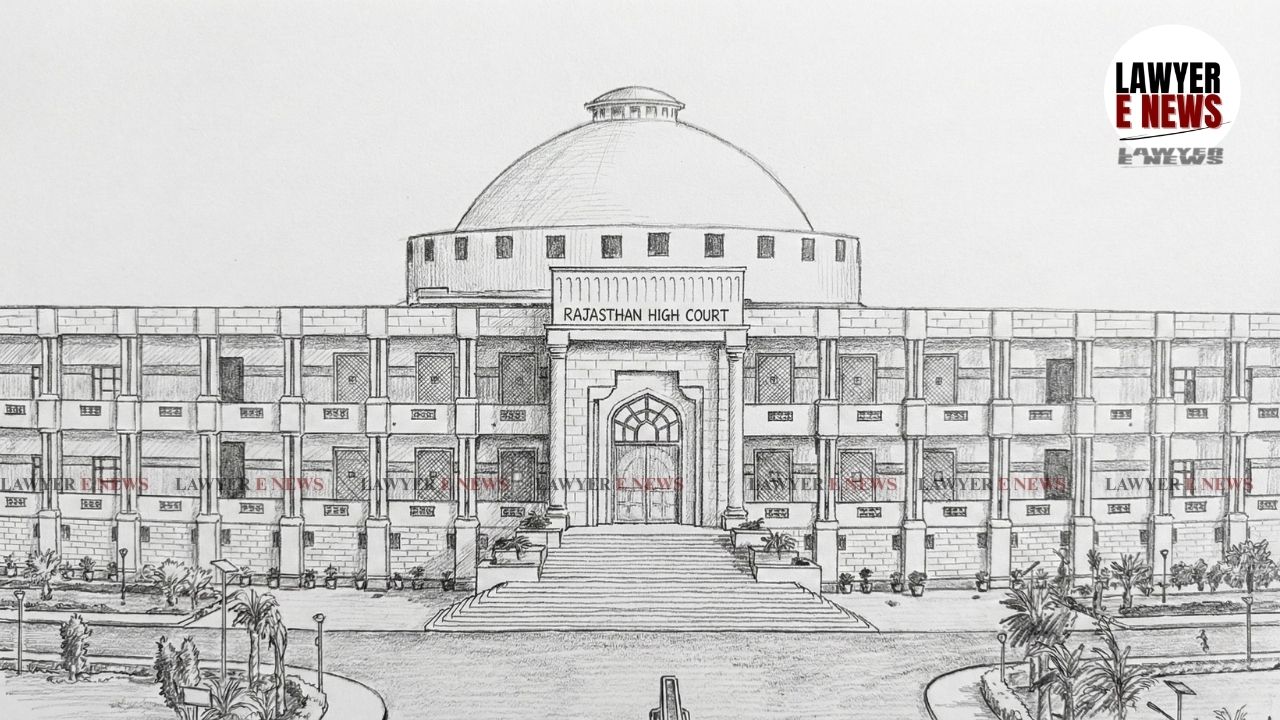
"The Public Prosecutor Is Not A Flunkey Of Political Power — The Decision To Withdraw Must Be His, Not An Order He Merely Obeyed", In a significant ruling on the independence of the Public Prosecutor and the limits of executive power over criminal prosecution, the High Court of Rajasthan at Jodhpur dismissed the State's revision petition challenging a trial court's refusal to permit withdrawal from prosecution in a case arising out of stone-pelting, obstruction of public ways, and damage to public property during the "Bharat Band" protests of April 2, 2018.
Justice Farjand Ali delivered a detailed and wide-ranging judgment affirming the order of the Additional Sessions Judge, Bhinmal, Jalore, which had declined the State's application under Section 321 of the Code of Criminal Procedure, and took the opportunity to comprehensively examine the role of the Public Prosecutor, the Court's supervisory function, and the unaddressed rights of victims in withdrawal proceedings.
The Court held that "the Public Prosecutor shall not act as a mere postman or a State Government employee following the orders as directed to him by his executive/appointing authority" and that the decision to withdraw from prosecution "must be his," arrived at through independent legal reasoning, free from executive compulsion.
On April 2, 2018, in the wake of a nationwide call for "Bharat Band" protesting a Supreme Court judgment concerning the SC/ST Act, approximately 500 persons assembled at Raniwada, District Jalore. The gathering turned violent — public ways were blocked, public property was damaged, and when the police resorted to tear gas to disperse the crowd, certain members of the assembly engaged in stone-pelting, injuring police personnel and government officials. FIR No. 53/2018 was registered at Police Station Raniwada under Sections 147, 148, 332, 333, 353, 336, 307, and 436 read with Section 149 IPC, along with Section 3 of the Prevention of Damage to Public Property Act. After investigation, a chargesheet was filed and the case was committed to the Sessions Court as Sessions Case No. 14/2020.
During the pendency of trial, the State moved an application under Section 321 CrPC for withdrawal from prosecution. The learned Additional Sessions Judge, Bhinmal, by order dated January 16, 2021, declined the prayer. The State challenged this in revision before the High Court. The accused had also filed a connected revision (S.B. CRLR No. 444/2024), which was dismissed as not pressed at the outset.
The central legal issue was whether the trial court's refusal to grant consent to withdrawal under Section 321 CrPC was perverse, illegal, or suffered from any jurisdictional infirmity warranting revisional interference. The State urged that the withdrawal was appropriate in the interest of public policy, while the respondents opposed any interference with the well-reasoned order of the trial court.
On the Structure of Section 321 CrPC — Three Parts
The Court began by dissecting Section 321 CrPC into three structural components: the prosecution part (who can apply — only the Public Prosecutor or Assistant Public Prosecutor), the judicial part (requirement of court's consent, which makes it a check on executive power), and the victim part (the unattended complainant or victim, whose interests are implicated but whose rights the section does not explicitly address). The Court noted that far too often, the second and third parts are given short shrift by both Prosecutors and trial courts.
On the Public Prosecutor's Independent Role
The Court's most emphatic observations were directed at the conduct of the Public Prosecutor. Relying on a string of Constitution Bench and larger Bench decisions of the Supreme Court, the Court underscored that "the Public Prosecutor is not the executive, nor a flunkey of political power." Quoting Justice Krishna Iyer in Subhash Chander v. State (Chandigarh Administration) (AIR 1980 SC 423) with evident approval, the Court reiterated: "The decision to withdraw must be of the Public Prosecutor, not of other authorities, even of those whose displeasure may affect his continuance in office."
The Court went on to hold that the Prosecutor has a dual character — he is the State's counsel but also an officer of the Court. As an officer of the Court, "Public Prosecutors are really Ministers of Justice whose job is none other than assisting the State in the administration of justice... they are not there to see the innocent sent to the gallows; they are also not there to see the culprits escape conviction." This formulation, borrowed from the Supreme Court in Centre for PIL v. Union of India (2012) 3 SCC 117, captures the Prosecutor's neutral but active role in the justice delivery system.
On the "Nail in the Coffin" — Wrong Section Cited in Application
The Court delivered perhaps its most pointed observation when it examined the actual withdrawal application filed by the concerned Public Prosecutor. The application, reproduced verbatim in the judgment, had been filed under Section 311 CrPC instead of Section 321 CrPC — an error that the Court characterised as conclusive proof of non-application of mind. The Court observed that the incorrect citation of the provision of law "is like a nail in the coffin which cements the view of this Court that the prosecutor has acted in a highly callous manner having no regard to the provisions of law." It further found that no reasons whatsoever had been recorded in the application — no assessment of evidence, no consideration of public interest, no evaluation of whether a prima facie case existed. The Prosecutor had simply relayed the State Government's resolution to withdraw, acting as what the Court called "a delivery agent of the state authority."
"Quoting a legal provision is not required while filing any application," the Court acknowledged, "but if it is mentioned, then in the least, that provision of law should be mentioned correctly, being the bare minimum that is expected from the officer of the Court."
On the Four Valid Grounds for Withdrawal
Drawing from the Supreme Court's landmark ruling in Sheonandan Paswan v. State of Bihar (1983) 1 SCC 438, the Court enumerated the four recognised grounds for seeking withdrawal from prosecution: (1) bleak possibility of successful prosecution bearing in mind the evidence; (2) incrimination of individuals born out of political or personal vendetta; (3) inexpediency of prosecution for reasons of State and public policy; and (4) unfavourable impact that continuance of prosecution would bring to public interest in light of the altered scenario. The Court found that none of the four grounds were present in the instant case. The evidence at this stage showed prospects of a successful prosecution, there were no signs of personal or political vendetta, no public policy impediment existed, and continued prosecution would not cause any pernicious impact on public interest. The withdrawal application thus lacked any legitimate justification.
On the Court's Role — Monitor, Not Servitor
Turning to the judicial part of Section 321, the Court affirmed that the trial court's function is supervisory rather than adjudicatory in character, but supervisory does not mean perfunctory. Before granting consent, the Court must satisfy itself on four counts: (a) that the application has been made in good faith, in the interest of public policy and justice, and not to thwart or stifle the process of law; (b) that the application does not suffer from improprieties causing manifest injustice; (c) that the grant of consent sub-serves the administration of justice; and (d) that the permission has not been sought with an ulterior purpose unconnected with the vindication of law. These principles, crystallised by the Supreme Court in State of Kerala v. K. Ajith (AIR 2021 SC 3954), leave no room for a Court to rubber-stamp the State's desire for withdrawal.
Condemning what had transpired in the Mubarak @ Salman case (whose extract the Court extensively reproduced), the judgment deprecated the conduct of the Additional Sessions Judge in that case who had allowed withdrawal merely because the State Government desired it, stating that the Court "was not aware of the fact that the Court has to consent to the application of withdrawal after its filing and not take the filing of the application as well as the resolution passed by the State as an order to terminate the prosecution." Such conduct, the Court warned, "deserves to be deprecated and is accordingly deprecated."
On Victims' Rights — A Radical but Necessary Suggestion
The Court's most forward-looking observations came in its treatment of the third structural component — the victim. The Court observed with concern that the current text of Section 321 CrPC is entirely silent on the victim's right to participate in, contest, or even be heard in withdrawal proceedings. Wrongful withdrawal, the Court catalogued, leads to denial of victims' rights, loss of public faith in the legal system, encouragement of impunity, weakening of deterrence, and the dangerous public perception that political power can stifle judicial proceedings mid-course.
The Court drew attention to England's Victim Right to Review (VRR) scheme developed in the wake of the Court of Appeal's ruling in R v. Christopher Killick [2011] EWCA Crim 1608, where it was held that a victim of crime has a right derived from ordinary principles of English law to seek review of the Crown Prosecution Service's decision not to prosecute. The Court suggested that such a mechanism could be adopted in India to fulfil the fundamental right of access to justice guaranteed under Articles 14 and 21 of the Constitution, as recognised by the Supreme Court in Anita Kushwaha v. Pushap Sudan (2016) 8 SCC 509. "Non-participation of the victim in such proceedings," the Court held, "would tantamount to deviation from the fundamental concept of 'Access to Justice'; non-adherence of the same would verily end up as sham justice."
Finding that the trial court had exercised judicial discretion with due circumspection, prudence, and in consonance with settled legal principles, and that the impugned order did not suffer from any perversity, illegality, or jurisdictional infirmity, the Court dismissed the State's revision petition as devoid of merit. The order dated January 16, 2021, passed by the Additional Sessions Judge, Bhinmal, Jalore, declining the withdrawal from prosecution in Sessions Case No. 14/2020 (FIR No. 53/2018) was affirmed in its entirety.
Date of Decision: February 17, 2026





