-
by sayum
27 July 2026 3:39 PM







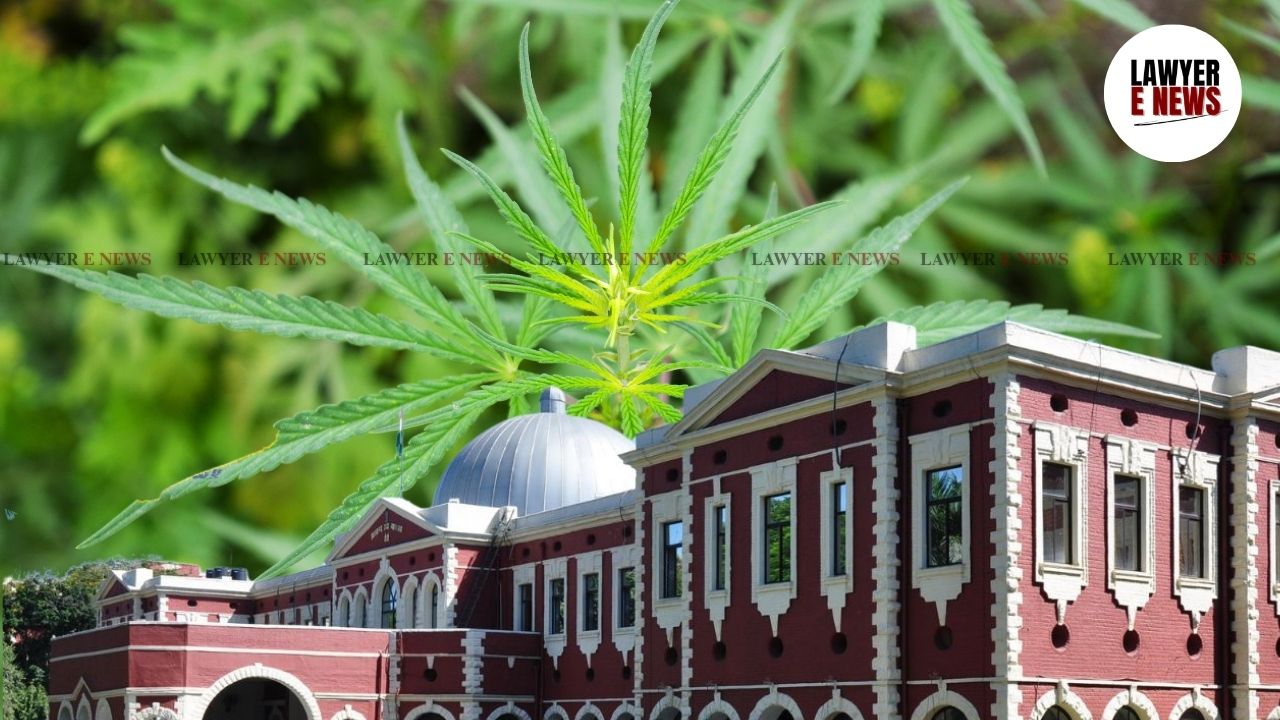
"Bhang does not fall within the definition of cannabis (hemp) as defined under Section 2(iii) of N.D.P.S. Act... possession of some substance like Ganja, which was ultimately found to be Bhang, is specifically excluded from the purview of the Act," High Court of Jharkhand, in a significant ruling dated June 30, 2026, held that the possession of 'Bhang' does not constitute a penal offence under the Narcotic Drugs and Psychotropic Substances Act, 1985.
A single-judge bench of Justice Pradeep Kumar Srivastava observed that Bhang is specifically excluded from the statutory definition of "cannabis" provided under Section 2(iii) of the Act.
Court Clarifies Legal Status Of Bhang Under NDPS Act
The court noted that while Ganja and Charas are prohibited, the leaves and seeds of the cannabis plant, when not accompanied by the flowering or fruiting tops, do not fall within the definition of Ganja. Consequently, since Bhang is typically prepared from the leaves of the cannabis plant, it remains outside the restrictive ambit of the NDPS Act.
The case originated in October 2000 when the appellant, Sunil Kumar Singh, was apprehended near the Chaibasa Bus Stand by a police patrolling party. Upon searching his briefcase, the police recovered 12 polythene packs containing approximately 11 kg of a substance they identified as Ganja.
The appellant was subsequently charged and convicted by a Special Judge in Jamshedpur in July 2009. He was sentenced to seven years of rigorous imprisonment and a fine of ₹50,000. The appellant challenged this conviction before the High Court, primarily arguing that the seized material was not a prohibited substance.
The primary question before the court was whether the substance seized from the appellant fell within the purview of the NDPS Act as a penal offence. The court was also called upon to determine whether the definition of "cannabis (hemp)" under Section 2(iii) of the Act includes 'Bhang'.
FSL Report Identified Substance As Bhang
During the trial, a Forensic Science Laboratory (FSL) report dated November 29, 2002, was submitted as evidence. The report specifically opined that the "broken leaves of vegetable flowery substances" found in the seized packs were "Bhang" and not "Ganja."
FSL Opinion On Seized Material The court took serious note of the FSL findings, observing that while the laboratory mentioned that both Ganja and Bhang are derived from cannabis, the statutory distinction is vital for criminal liability. The appellant's counsel argued that since Bhang is excluded from the Act, the conviction was fundamentally illegal.
Statutory Definition Of Cannabis (Hemp)
The court meticulously analyzed Section 2(iii) of the NDPS Act, which defines "cannabis (hemp)" as charas, ganja, or any mixture of the two. The bench highlighted that the definition of Ganja specifically excludes seeds and leaves when they are not accompanied by the flowering or fruiting tops of the plant.
Exclusion Of Leaves And Seeds From Definition Of Ganja
"On bare reading of the provision under Section 2(iii)(a) and (b) that charas and ganja... there is no scientific evidence before this Court to show that the Bhang is prepared out of either charas or ganja," the bench remarked. The court emphasized that the NDPS Act nowhere refers to Bhang as a prohibited drug or drink.
Reliance On Precedents From Other High Courts
The court placed heavy reliance on several judgments from different High Courts across India, including the Karnataka, Punjab & Haryana, Bombay, and Rajasthan High Courts. These courts have consistently held that Bhang does not fall within the definition of cannabis (hemp) under the NDPS Act.
Consistency In Judicial Interpretation Across High Courts Specifically, the bench cited Roshan Kumar Mishra Vs. The State of Karnataka (2022) and Arjun Singh Vs. State of Haryana (2004), noting that various jurisdictions have affirmed that the possession of Bhang does not constitute an offence. The court found that the State Government of Jharkhand had also not issued any specific notifications or rules to prohibit Bhang under the NDPS framework.
Invalidity Of The Conviction And Sentence
Concluding its analysis, the court held that the conviction and sentence passed by the trial court were not justified under the law. Since the substance was found to be Bhang, and no allegation of cultivation of the cannabis plant was made under Section 20(a), the penal provisions of the NDPS Act could not be invoked.
Court Sets Aside Trial Court Judgment
"The conviction and sentence of the appellant for the offence under Sections 22(B) and 20(B), 11 (B) of the N.D.P.S. Act is absolutely illegal and not justified under law," Justice Srivastava stated. The court found that the trial court erred in equating the seized Bhang with prohibited Ganja for the purposes of sentencing.
The High Court allowed the appeal and set aside the judgment of conviction dated July 20, 2009. The appellant, who was already on bail, was discharged from the liability of his bail bonds and sureties. The ruling reaffirms the strict interpretation of penal statutes and the necessity of aligning criminal convictions with precise statutory definitions.
Date of Decision: 30 June 2026