
-
by sayum
26 August 2026 1:49 PM







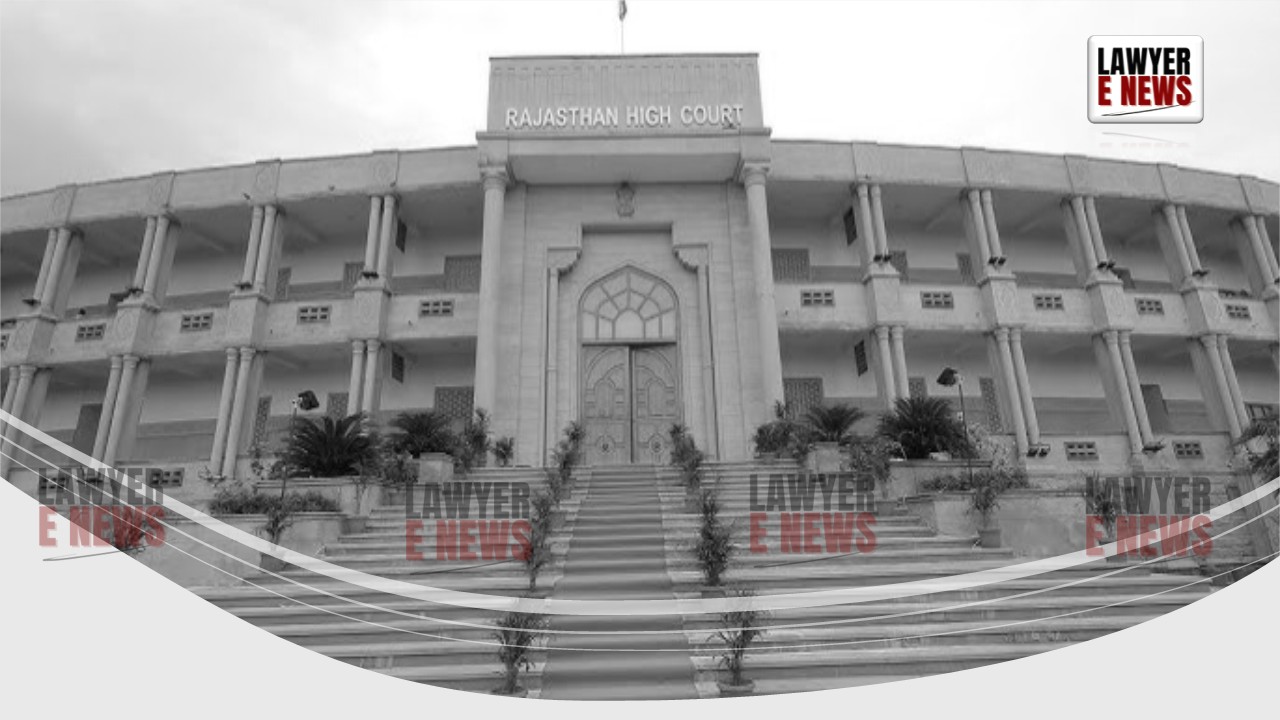
"A writ petitioner who comes to the court for relief in public interest must come not only with clean hands like any other writ petitioner but also with a clean heart, clean mind and clean objective", In a stern warning against the misuse of Public Interest Litigation jurisdiction, the Rajasthan High Court transposed the petitioner in a PIL concerning illegal weighbridges on National Highways as Respondent No. 17 in the very proceedings he had instituted, after finding that he had concealed his family's direct involvement in mining and weighbridge operations — the very subject matter of the petition.
A Division Bench of Justice Sunil Beniwal and Justice Arun Monga converted the proceedings into suo motu cognizance, appointed an amicus curiae, and issued notice to the petitioner to show cause why exemplary costs of Rs. 25 lakhs should not be imposed on him. The Court further directed that the petitioner shall not be entitled to institute any Public Interest Litigation in future.
Background of the Case
The petitioner had filed a PIL before the Rajasthan High Court, Jodhpur Bench, raising what appeared to be a serious road safety concern — the allegedly illegal installation and operation of weighbridges (Dharamkantas) and royalty check posts (nakas) on National Highways, ring roads, service roads and access roads across the State of Rajasthan. The petition sought removal and regulation of such installations, a State-wide audit of illegally operated royalty nakas and weighbridges, fixation of accountability of erring officials, and the framing of uniform safety-oriented guidelines to prevent accidents on highways. On earlier dates of hearing, the Court had already issued directions to Respondent No. 12 — M/s Riddhi Siddhi Housing Private Limited, a State concessionaire engaged in royalty collection — to relocate its weighbridge to beyond 75 metres from the National Highway on or before March 6, 2026, failing which authorities were directed to ensure its removal.
When the matter came up for resumed hearing on March 13, 2026, Respondent No. 12 stated on oath that the relocation had been duly carried out. However, the hearing took a dramatic turn when the bona fides of the petitioner himself came under the Court's scrutiny.
Legal Issues Before the Court
Two distinct questions crystallised before the Bench at the outset of the hearing. First, whether the petitioner suffered from a conflict of interest that disentitled him from prosecuting the PIL. Second, whether Respondent No. 12, having relocated its weighbridge, could be permitted to resume business operations.
Court's Observations and Judgment
On the Petitioner's Concealed Personal Interest
Dr. Sachin Acharya, Senior Advocate for Respondents No. 12 to 16, placed before the Court a serious set of allegations: that the petition was a motivated exercise to settle personal and commercial scores, that the petitioner's family was actively engaged in mining and weighbridge operations, that the petitioner's father held a quarry licence for sandstone, and that his brother operated two weighbridges — one of which had previously been operated by Respondent No. 12 under a royalty collection contract. When that contract ended and Respondent No. 12 declined to continue operating the weighbridge on grounds of non-compliance with prescribed norms, the private respondents alleged that the present petition was instituted as a retaliatory measure. It was further alleged that the petitioner had as many as three FIRs registered against him — facts concealed in the petition.
The Court put a direct query to the petitioner's senior counsel, Mr. Rajesh Joshi, as to whether any member of the petitioner's family was engaged in mining or weighbridge operations. The response was telling: counsel fairly admitted, upon instructions, that the petitioner's father was indeed engaged in the mining business. On the further allegation regarding the brother's weighbridge operations and criminal antecedents, the response was evasive — the submission being merely that these facts had no bearing on the present proceedings.
The Court found this candid admission deeply revealing when set against the unequivocal declaration made by the petitioner in his own petition: "the present writ petition is being filed by way of Public Interest Litigation and the present petitioner does not have any personal interest in the matter." The contrast between the declaration in the petition and the admission before the Court, the Bench held, made the concealment writ large.
On Rule 385-F: Mandatory Disclosure as the Gatekeeper of PIL Jurisdiction
The Court examined Rule 385-F of the Rules of the High Court of Rajasthan, 1952 — a provision that functions as the threshold gatekeeper of PIL jurisdiction. The Rule mandates that a petitioner filing a PIL must disclose, among other things, his social standing and public-spirited antecedents, the nature and extent of any personal interest in the cause, and the complete history of any past or pending civil, revenue or criminal litigation. The Court explained the rationale behind each requirement with precision.
Sub-Rule (1), the Bench observed, enables the Court to assess at the very threshold whether the litigation is genuinely motivated by public interest or by private or collateral objectives. Sub-Rule (6) — requiring disclosure of personal interest — is designed to ensure that any direct commercial, financial or competitive interest is placed before the Court, failing which the petition is liable to be treated as private interest litigation and dismissed. Sub-Rule (7) — requiring disclosure of litigation history — enables the Court to examine the petitioner's credibility and ensure the PIL is not being weaponised as a collateral tool in existing disputes.
"Collectively," the Court held, "the Rule mandates full disclosure and transparency as essential prerequisites for invoking the Court's PIL jurisdiction." The petitioner had violated each of these requirements. His family's engagement in mining, the brother's weighbridge operations, the criminal antecedents — none of these found mention in the petition. The Court held that the petitioner had prima facie not approached the Court with clean hands, a clean heart or clean objectives.
On the Misuse of PIL Jurisdiction
The Court invoked the Supreme Court's authoritative exposition in Ashok Kumar Pandey v. State of W.B., which drew a sharp line between genuine public interest litigation and its perversions. Quoting at length from that judgment, the Court endorsed the Supreme Court's caution that PIL "should not be 'publicity interest litigation' or 'private interest litigation' or 'politics interest litigation' or the latest trend 'paise income litigation'." The Supreme Court had warned that PIL, if not properly regulated, "becomes a tool in unscrupulous hands to release vendetta and wreak vengeance."
The Rajasthan High Court found that the facts of the present case fell squarely within this category. The petitioner appeared to have a clear conflict of personal interest vis-à-vis the public cause he purported to espouse. The material on record prima facie suggested that the proceedings were not entirely divorced from private or collateral considerations, and that "the cause of public interest has been invoked as a facade to pursue a matter in which the petitioner has a discernible personal stake."
On the Significance of Disclosure Even When Private Interest Overlaps Public Interest
In a nuanced observation that carries significant guidance for future PIL petitioners, the Court noted that private interest and public interest can sometimes legitimately overlap. The crucial distinction, however, lies in disclosure. "Had the petitioner, at the outset, candidly disclosed that his father is engaged in the mining business and, despite such personal interest, sought the leave of the Court to maintain the present proceedings as a Public Interest Litigation, the matter might have stood on a different footing." It was the concealment — not the existence of personal interest per se — that proved fatal to the petitioner's locus as a public interest litigant. This observation lays down an important principle: full and upfront disclosure may, in an appropriate case, permit a petitioner with some personal stake to maintain a PIL, provided the Court is satisfied of genuine public interest. Concealment, however, forecloses that possibility entirely.
On Consequences: Transposition, Future Bar, and Exemplary Costs
The Court drew the sharpest possible consequences from its findings. The petitioner was directed to be transposed as Respondent No. 17 in the very proceedings he had filed, with the cause title amended to read: "In the matter of Safety on the Highways versus State of Rajasthan and Others." The Registry was directed to carry out the corrections forthwith. The Court further directed that the petitioner shall not be entitled to institute any Public Interest Litigation in future — a permanent bar on his PIL locus. Notice was issued calling upon the petitioner to show cause why exemplary costs of Rs. 25 lakhs, to be deposited with the Legal Aid Cell of the Court, should not be imposed upon him.
On the Larger Public Interest: Conversion to Suo Motu Proceedings
Notwithstanding the petitioner's disentitlement, the Court took care to ensure that the underlying public concerns were not sacrificed at the altar of the petitioner's misconduct. The issues of road safety, hazardous installations on highways and the regulation of royalty nakas were found to be of significant public importance. The earlier directions issued by the Court were already in the process of implementation. The Bench accordingly converted the proceedings into suo motu cognizance and appointed Mr. Sharad Kothari as amicus curiae, assisted by Mr. Pranjul Mehta and Mr. Divik Mathur. Two intervenors who had filed applications for impleadment — and who were themselves found to have certain personal interest — were not impleaded as parties but were permitted to participate as interveners or whistle-blowers by sharing relevant information with the amicus curiae.
On Respondent No. 12's Weighbridge: Permitted to Operate Subject to Verification
On the second issue, the Court noted that Respondent No. 12 had stated on oath that its Dharamkanta had been relocated beyond 75 metres from the National Highway in compliance with the Court's earlier directions. This position was not disputed by NHAI or the State authorities at the hearing. The Court accordingly permitted Respondent No. 12 to resume business operations under the sanction order dated April 7, 2025 issued by the Mining Department — subject to physical and spot verification of the relocation by officials of both the Mining Department and NHAI. It was made clear that if the verification revealed non-compliance with the stated distance, the authorities would be at liberty to take appropriate steps including seeking modification of the order. The Court also took note of the regulatory framework — that the Mining Department is empowered to regulate check posts and mineral transportation while the Legal Metrology Department governs weighbridge operations — and held that these functions are intrinsically interconnected, since royalty collection based on the weight of minerals necessarily requires weighbridges. Denying weighbridge operations, the Court observed, would result not only in surreptitious and illegal mining but also in loss to the State exchequer through pilferage in royalty payments.
Conclusion
The Rajasthan High Court's order is a robust affirmation of the courts' power — and duty — to police the gateway of PIL jurisdiction. It crystallises the principle that Rule 385-F's disclosure requirements are not procedural formalities but substantive safeguards against the weaponisation of PIL. A petitioner who invokes the extraordinary jurisdiction of the High Court in the name of the public, while concealing a direct family interest in the very subject matter of the petition, cannot claim the moral authority of a public interest litigant. The judgment equally establishes that the courts will not allow genuine public concerns to be held hostage to a tainted petition — and will, where necessary, shed the petitioner entirely and take up the cause on its own motion. The matter has been adjourned to April 6, 2026 for further proceedings.
Date of Decision: March 13, 2026





