-
by kapil
21 November 2026 3:55 PM







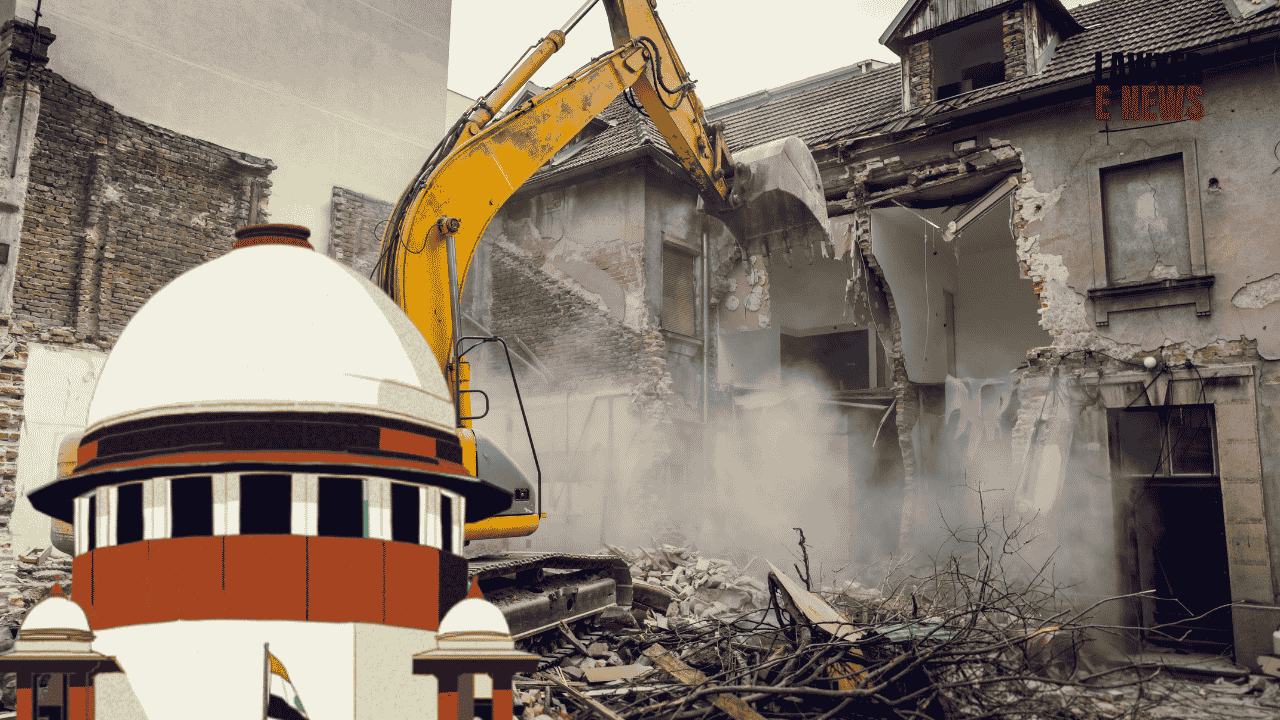
NEW DELHI — General judicial directions issued in public interest litigation aimed at securing highway safety and removing encroachments cannot be used by authorities as an independent justification to dispense with the mandatory statutory procedure under Section 26 of the Control of National Highways (Land and Traffic) Act, 2002, the Supreme Court observed on Wednesday, November 18, 2026. A Bench comprising Justice Vikram Nath and Justice Aparesh Kumar Singh held that an overarching obligation to clear encroachments does not amount to a conclusive adjudication of individual property rights or dispense with the statutory requirement of notice and hearing.
The proceedings emanate from suo motu writ proceedings initiated by the Supreme Court over highway safety concerns following fatal road accidents in Phalodi, Rajasthan. On April 13, 2026, the Court issued comprehensive interim directions instructing the National Highways Authority of India and District Magistrates to remove unauthorised structures within the Right of Way across the country. Following this order, several landowners and commercial occupants faced demolition notices and coercive removal actions without individual boundary adjudications, prompting them to move interlocutory applications before the apex court seeking clarification and interim protection.
Whether general judicial directions to clear highway encroachments empower authorities to bypass the statutory procedure of notice, hearing, and inquiry under Section 26 of the Control of National Highways (Land and Traffic) Act, 2002?
Whether the Supreme Court, while exercising suo motu public interest jurisdiction over road safety, can conclusively adjudicate individual disputed questions of title, demarcation, and lawful possession of land adjoining National Highways?
The Court clarified that the general directions issued on April 13, 2026, addressed systemic highway safety issues and did not determine whether individual properties constituted illegal encroachments. The Bench held that the existence of a broad judicial directive cannot be equated with a factual finding of illegality against specific structures.
General directions to clear encroachments do not determine individual property rights
Emphasising the distinction between a mandate to remove unauthorized occupations and the determination of encroachment, the Bench held that the former cannot serve as a conclusive finding on the latter.
"The directions dated 13.04.2026 undoubtedly cast an obligation upon the concerned authorities to identify and remove unauthorised encroachments. However, such an obligation cannot be understood as dispensing with the requirement of determining whether the structure sought to be removed is, in fact, an unauthorised encroachment upon highway land."
The Court noted that Direction 4(c) of its earlier order expressly instructed that removals must conform to the statutory procedure under the 2002 Act and the Standard Operating Procedure dated August 7, 2025.
Authorities cannot invoke Supreme Court orders to bypass Section 26 CNH Act
Examining the statutory scheme, the Bench observed that Section 26(2) to Section 26(6) of the 2002 Act provide a mandatory framework requiring issuance of notice, an opportunity to show cause, and objective consideration of representations before proceeding with demolition.
"The importance of adherence to this procedure has also been recognised by this Court in Gyan Prakash v. Union of India and Others... wherein it was emphasised that the procedure prescribed under Section 26 is essential for compliance with the principles of natural justice... The directions issued by this Court cannot be invoked as an independent justification for dispensing with the requirements of the statute."
While acknowledging that Section 26(7) and Section 26(8) permit summary removal without prior notice in specific emergency scenarios, the Bench underscored that the exercise of such powers must strictly satisfy statutory conditions and cannot be grounded merely on the Court’s interim orders.
Mere departmental assertion cannot substitute statutory inquiry where title is disputed
Addressing the factual disputes raised by the applicants, including registered title deeds, demarcation challenges, and lack of land acquisition compensation, the Court held that summary administrative action is impermissible when the foundational facts are contested.
"We are conscious that a mere assertion of ownership or lawful occupation cannot, by itself, prevent the authorities from exercising their statutory powers to remove unauthorised encroachments. Equally, the mere assertion by the authorities that a particular structure falls within the Right of Way cannot be treated as a substitute for the determination required under law, where the very basis of such assertion is disputed."
The Bench reiterated that such competing claims must be resolved within the statutory framework, giving affected occupants a meaningful opportunity to defend their rights.
Jurisdictional High Courts best suited to adjudicate complex factual disputes
Refusing to transform the suo motu highway safety matter into a title forum, the Supreme Court held that it was neither appropriate nor practicable to investigate individual boundaries, revenue entries, and survey reports in original writ proceedings.
"The present suo motu proceedings are concerned with the larger and systemic issues relating to highway safety, and it would neither be appropriate nor practicable for this Court to undertake a factual examination of the ownership, boundaries and legal status of each disputed property. The jurisdictional High Courts would be better placed to consider the relevant records, examine the legality of the action initiated by the authorities and determine whether the procedure prescribed by law has been duly followed."
The Bench ruled that relegating the parties to their respective High Courts preserves both the integrity of the highway safety campaign and the constitutional right to procedural fairness.
The Supreme Court disposed of the interlocutory applications by relegating the aggrieved applicants to their respective jurisdictional High Courts to adjudicate their claims regarding ownership, Right of Way demarcation, and compliance with statutory procedures. The Bench directed that the interim protection against demolition and coercive action shall continue until the final disposal of the proceedings before the High Courts, while clarifying that such protection will not authorize any fresh construction or encroachments.
Date of Decision: November 18, 2026