
-
by sayum
26 August 2026 1:49 PM







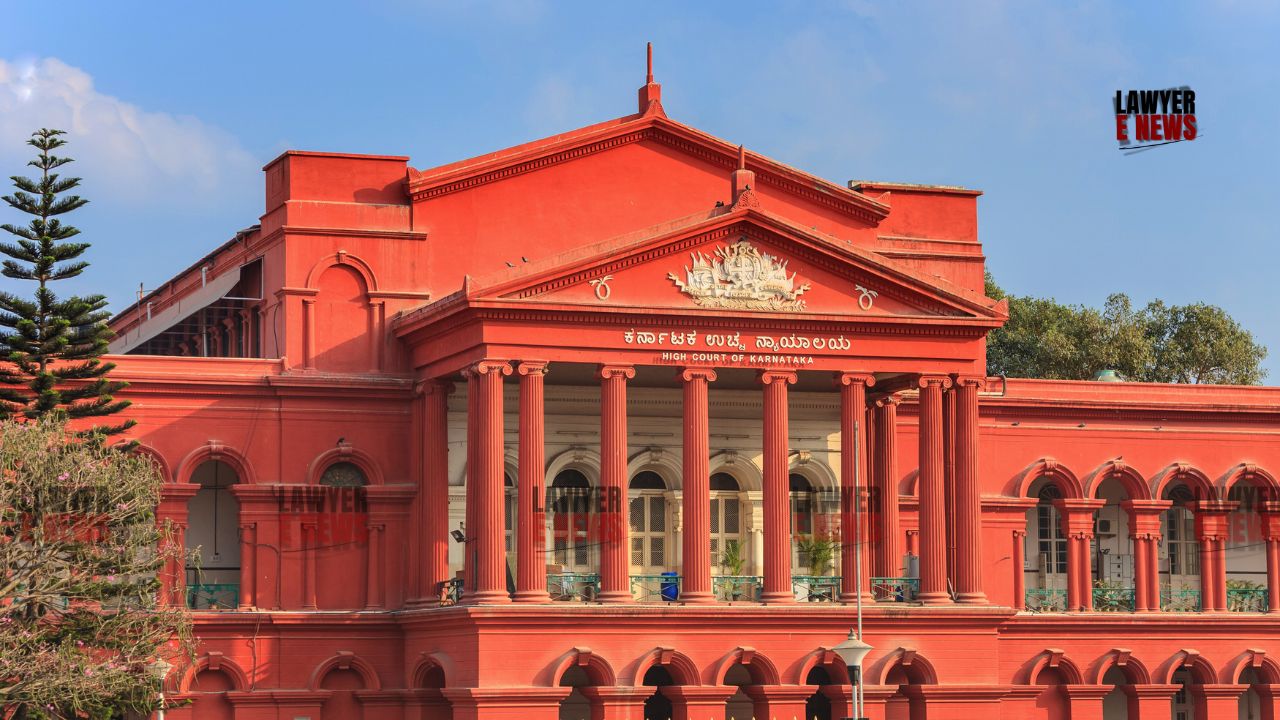
“Petitioner Suppressed Receipt of ₹51.36 Lakhs Compensation—Writ Petition Liable to Be Dismissed on This Ground Alone”, Karnataka High Court (Bench of Justice D.K. Singh and Justice Venkatesh Naik T) delivered a reportable judgment in W.P. No. 17839/2010, emphatically rejecting a land acquisition compensation claim filed by a landowner under the Bangalore-Mysore Infrastructure Corridor Project (BMICP).
The petitioner, Smt. Chandrika, sought additional compensation and residential site allotments despite having already accepted a negotiated compensation of over ₹51 lakh under Section 29(2) of the Karnataka Industrial Areas Development Act, 1966 (KIAD Act). The Court held her estopped from raising any further claim and described her conduct as a suppression of material facts, thereby disentitling her from any equitable relief under Articles 226 and 227 of the Constitution.
“There Can Be No Deviation From the Framework Agreement Without State Approval”: Supreme Court Ruling in NICE Case Reaffirmed
The High Court extensively relied on the binding precedent laid down by the Supreme Court in (2021) 18 SCC 401 (BMICAPA v. NICE), which unequivocally declared that the development of sites and layouts outside the five demarcated townships mentioned in the Framework Agreement (FWA) and Project Technical Report (PTR) was impermissible. The Court cited:
“The project proponents could not have directly approached the planning authority for approval of modified proposal, which was replete with deviations from the stipulations and specifications in the FWA read with the PTR… Any deviation must receive prior approval from the State” (Para 90, BMICAPA v. NICE).
The Case: Claim for Sites Despite Executing Full and Final Settlement Agreement
The case arose from acquisition proceedings initiated for the BMIC Project. The petitioner, claiming under a Will executed by her mother Late Smt. Sarojamma, alleged that she was entitled to receive seven 40x60 and one 30x40 residential sites and interest on compensation, purportedly promised as part of a compensation package.
However, it emerged that she had already received ₹51,36,250/- by way of negotiated compensation under Section 29(2) KIAD Act in 2007, and had executed an agreement and indemnity bond indicating it was in full and final settlement of her claim. Critically, she failed to disclose this payment in her writ petition filed in 2010, a fact which the Court held to be fatal to her claim.
“Petitioner received negotiated compensation and executed indemnity bond. She is now estopped from seeking further compensation or alternative relief such as allotment of sites” (Para 47).
The Court reiterated that once the compensation has been received voluntarily under a negotiated settlement, the party cannot later challenge or seek enhancements under the garb of a constitutional remedy:
“The petitioner cannot now wriggle out of the contract and claim allotment of land on the basis of some promise, consent, etc.” (Para 67).
BMIC Project Remains a “Vision on Paper”: Court Laments 25 Years of Delay and Litigation
The judgment also included a scathing critique of the BMIC Project's execution. Despite the project being conceptualized in 1995 through a Framework Agreement signed in 1997, the expressway component remains largely unconstructed. The Court noted that only one kilometre of the 110 km expressway had been built, with the project proponents (NICE/NECE) collecting tolls on peripheral roads while failing to develop the five approved self-sustaining townships.
“The beautiful and futuristic concept of decongesting the city… has been killed by the project opponents and the authorities at the cost of the citizens and the environment” (Para 77).
The Bench further stated:
“This project, instead of de-clogging and decongesting the city… has clogged and congested the High Court and other Courts with more than 2,000 cases filed in respect of this corridor” (Para 54).
Claim for Allotment of Sites Rejected as Contrary to the FWA and Supreme Court Ruling
The Court refused to entertain the claim for residential sites on two primary grounds:
No such allotment was ever promised or contractually agreed upon under the FWA or any other legal instrument binding on the respondents.
Allotment outside the five demarcated townships would amount to a deviation from the PTR and FWA, which is impermissible without prior approval from the State Government, as held by the Supreme Court.
“There is no option available to the petitioner or the project proponent to form a layout and allot the land to the petitioner. There is no deviation possible in the FWA without prior approval of the State” (Para 74).
Suppression of Material Facts: Petition Dismissed With Strong Adverse Remarks
The Court took serious exception to the petitioner’s suppression of having received substantial compensation in 2007:
“The petitioner failed to disclose receipt of ₹51,36,250/- towards compensation – suppression of material facts disentitles petitioner from discretionary relief under Articles 226 and 227” (Para 45).
This, coupled with the delay of nearly a decade in approaching the Court after receiving compensation, led the Bench to rule that the writ petition deserved to be dismissed on this ground alone.
“Such suppression and delay disentitles the petitioner from invoking the extraordinary jurisdiction of this Court” (Para 47).
Court Urges Government to Re-Examine Viability of BMIC Project
In its closing observations, the Court urged the State Government to re-evaluate the viability of continuing with the BMIC Project in its current form, noting that despite sitting on a massive land bank, the project proponents had failed to construct any of the five townships or the main expressway.
“The project proponents are collecting huge tolls by constructing peripheral roads and toll plazas… but the Bangalore-Mysore Infrastructure Corridor has remained only on the papers” (Para 78).
The Court directed the State to relook the project and consider whether the existing FWA and its terms had become obsolete or unworkable, hinting at the potential for fresh urban planning initiatives to better serve the public interest.
Petition Dismissed with No Relief
The writ petition was dismissed, and all pending interlocutory applications were disposed of. The Court left no room for ambiguity: any future claims or development outside the terms of the FWA must first secure the State’s prior approval, and cannot be claimed as a matter of right under writ jurisdiction.
Date of Decision: 09 January 2026





