-
by sayum
21 August 2026 7:31 AM







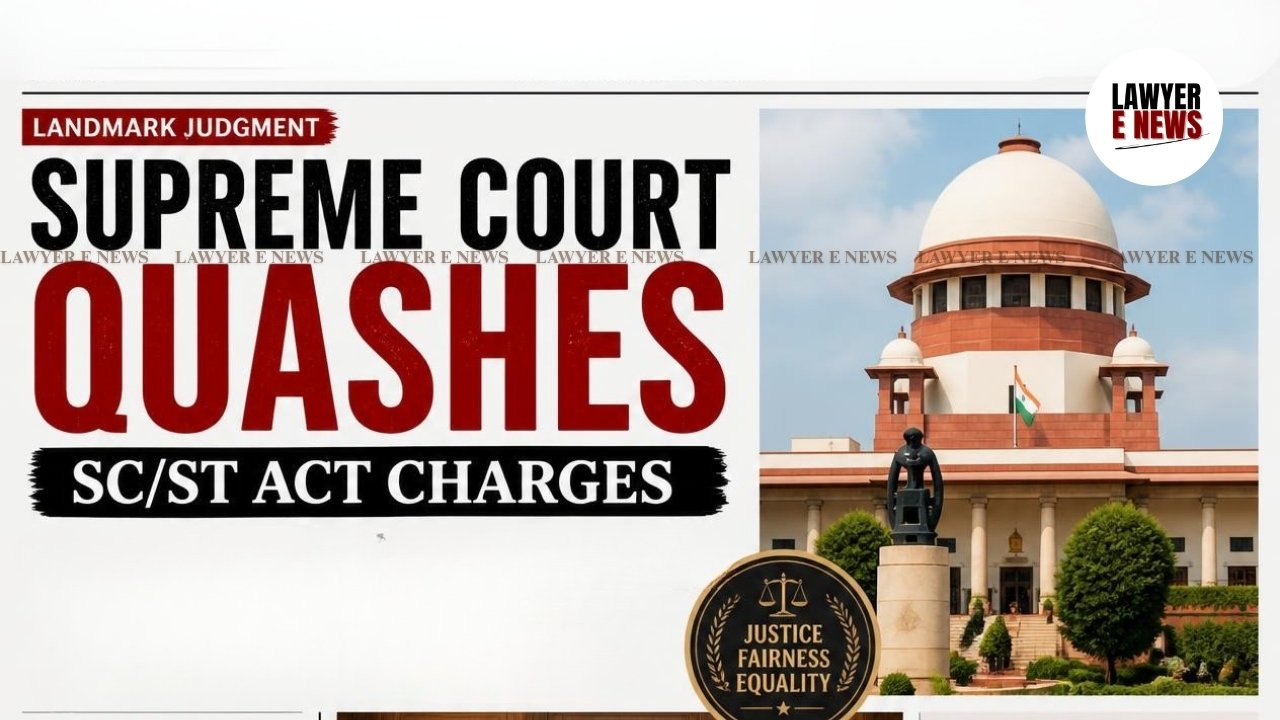
"If the alleged offence takes place within the four corners of the wall where members of the public are not present, then it cannot be said that it has taken place at a place within public view." Supreme Court has held that an alleged caste-based abuse occurring inside an enclosed room without the presence or hearing of members of the public does not satisfy the mandatory statutory requirement of taking place "within public view" under the Scheduled Castes and the Scheduled Tribes (Prevention of Atrocities) Act, 1989.
A bench comprising Justice Vikram Nath and Justice Sandeep Mehta quashed the summoning order and criminal proceedings under Sections 3(1)(r) and 3(1)(s) of the SC/ST Act initiated against a school manager, reiterating that general allegations of abuse without specific caste-based slurs cannot sustain prosecution.
The dispute arose after the complainant lodged FIR No. 37 of 2020 alleging that when he approached the appellant school manager following a quarrel involving his son, the appellant and school staff assaulted him and hurled caste-based abuses. The Special Judge took cognizance of the offences under Sections 147, 323, 342, and 504 of the IPC along with Sections 3(1)(r) and 3(1)(s) of the SC/ST Act and issued summons. The Allahabad High Court subsequently dismissed the appellant’s appeal under Section 14A(1) of the SC/ST Act, prompting the appellant to approach the Supreme Court.
The primary question before the court was whether the material on record disclosed the essential ingredients of Sections 3(1)(r) and 3(1)(s) of the SC/ST Act, particularly whether the alleged caste-based utterances took place at a place "within public view". The court was also called upon to determine whether general allegations lacking specific caste-based slurs could prima facie sustain summoning under the Act.
Statutory Mandate Of 'Within Public View'
The Court underscored that for an offence to be attracted under Section 3(1)(r) and Section 3(1)(s) of the SC/ST Act, the alleged intimidation, insult, or caste-name abuse must necessarily take place "in any place within public view". The bench noted that this requirement is a core statutory ingredient that goes to the root of the penal provision.
Enclosed Four Walls Do Not Amount To Public View
Reiterating settled law, the bench relied on its prior ruling in Karuppudayar v. State (2025 INSC 132) and the landmark decision in Hitesh Verma v. State of Uttarakhand (2020) 10 SCC 710 to explain the legal threshold of the phrase "within public view". The bench reiterated that to satisfy this test, the place must be open where members of the public can actively witness or hear the utterance.
Incident Inside Enclosed Room With No Public Access
Examining the record, the Court noted that the site plan prepared by the Investigating Officer explicitly identified the place of occurrence as an enclosed room inside the school premises. The Court recorded that the room had no window or public access, and the FIR failed to assert that any member of the public was present to witness or hear the utterance.
Mere Presence In School Premises Insufficient
The bench carefully evaluated the statements of four school teachers recorded under Section 161 of the CrPC. The Court highlighted that while the teachers mentioned a scuffle in the school office, none of them stated that they were inside the room when the alleged caste abuses were hurled, nor did they hear any caste-based words.
"Their mere presence in the school premises, therefore, does not establish that the alleged utterance was made within public view."
Vague And General Allegations Fail SC/ST Act Threshold
The Supreme Court further observed that the prosecution case suffered from a total absence of specific caste-based allegations against the appellant. Neither the FIR nor the informant's statement attributed any specific caste-based words or slurs to the appellant, leaving the allegation entirely general in nature and establishing only a scuffle.
Basic Ingredients Must Emerge At Cognizance Stage
Addressing the scope of inquiry at the stage of taking cognizance, the Court clarified that while a meticulous appreciation of evidence is not warranted, the fundamental ingredients of the alleged offences must clearly emerge from the record. Where the essential condition of "public view" is missing, the summoning order cannot be sustained.
The Supreme Court allowed the appeal and set aside the judgment of the Allahabad High Court, quashing the summoning order and proceedings under Sections 3(1)(r) and 3(1)(s) of the SC/ST Act against the appellant. The Court clarified that criminal proceedings shall, however, continue against the appellant insofar as they relate to the remaining offences under the IPC.
Date of Decision: August 20, 2026