-
by sayum
21 August 2026 8:01 AM







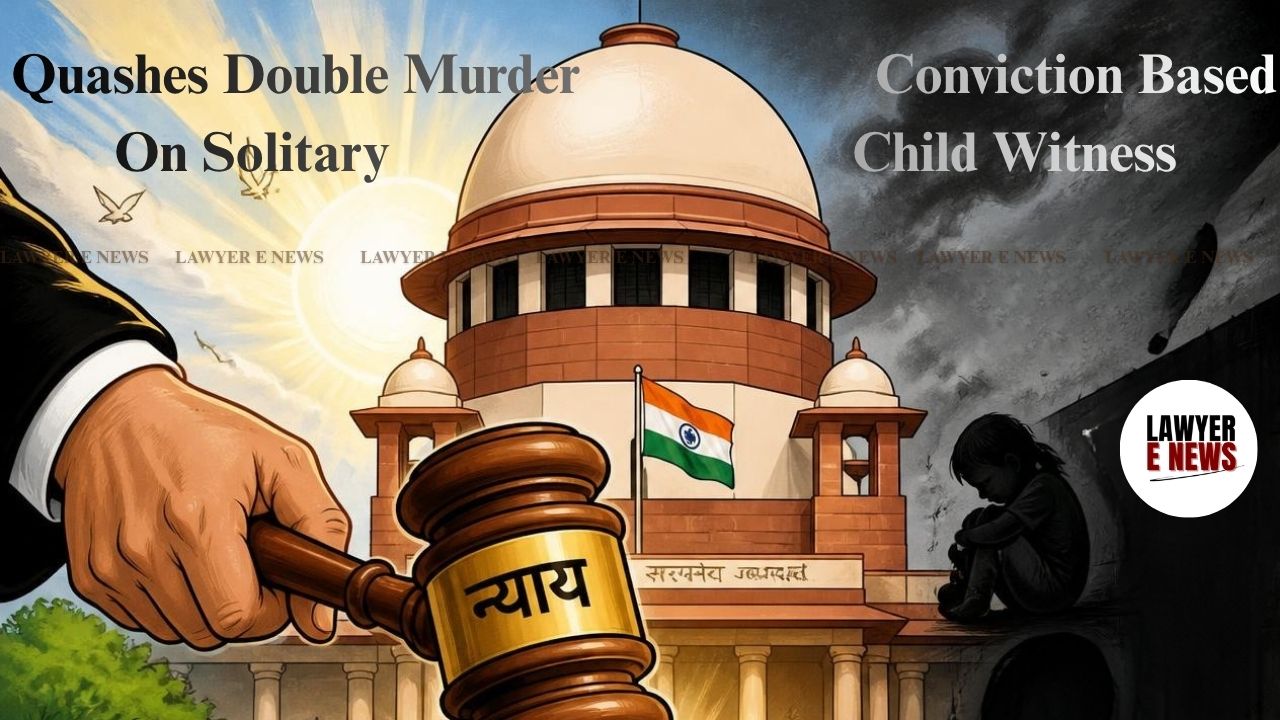
"The evidence of a child is required to be evaluated carefully because he is an easy prey to tutoring. Therefore, always the court looks for adequate corroboration from other evidence to his testimony." The Supreme Court, in a significant ruling delivered on August 20, 2026, held that while a child is a competent witness under the law, their testimony cannot form the sole basis of a conviction without independent corroboration since a child of tender age is "an easy prey to tutoring."
A bench comprising Justice Sanjay Karol and Justice Augustine George Masih set aside a High Court verdict that had overturned the acquittal of a man accused of murdering his wife and minor child.
The bench stressed that corroboration of a child witness's deposition is an established "rule of prudence" that courts must ordinarily follow to prevent grave miscarriages of justice.
The prosecution alleged that on September 20, 1989, the appellant took his estranged wife and two young sons on a trip from Kanpur to Khajuraho, during which he allegedly strangulated his wife and one son, while his four-and-a-half-year-old child (PW-28) escaped. The Additional Sessions Judge, Panna acquitted the appellant on December 14, 1993, finding the child’s deposition unnatural, inconsistent, and tutored. However, the High Court of Madhya Pradesh at Jabalpur reversed the acquittal on October 9, 2012, convicting the appellant under Sections 302 and 201 of the Indian Penal Code and sentencing him to life imprisonment.
The primary question before the Supreme Court was whether the High Court was justified in reversing an order of acquittal solely relying upon the uncorroborated testimony of a child witness who admitted to being tutored. The bench was also called upon to determine whether the circumstantial evidence on record established an unbroken chain unerringly pointing to the guilt of the accused.
High Court Ignored Double Presumption Of Innocence In Acquittal Appeals
The Supreme Court commenced its analysis by observing that an appellate court exercising jurisdiction against an acquittal is bound to bear in mind the double presumption of innocence operating in favour of the accused. Referring to the authoritative ruling in Chandrappa v. State of Karnataka (2007), the bench underscored that if two reasonable conclusions are possible on the evidence, the appellate court should not disturb the findings of the trial court.
The bench observed that the trial court's view declining to place undue weight on the child's testimony was plausible and well-supported by the evidence on record, meaning the threshold required to overturn an acquittal was completely unmet.
Rule Of Prudence Mandates Corroboration Of Child Testimony
Addressing the evidentiary weight of child witnesses, the bench cited Bhagwan Singh v. State of M.P. (2003) and Panchhi v. State of U.P. (1998) to emphasize that while there is no inflexible rule mandating corroboration, evaluating a child’s account with utmost caution is indispensable.
"The law recognises the child as a competent witness but a child particularly at such a tender age of six years, who is unable to form a proper opinion about the nature of the incident because of immaturity of understanding, is not considered by the court to be a witness whose sole testimony can be relied upon without other corroborative evidence."
The bench noted that the child was barely four and a half years old at the time of the incident, and his testimony was recorded four years later. During this entire period, the child was residing with a police constable, creating severe doubts regarding undue influence and coaching.
Child Admitted To Being Tutored By Police Before Giving Deposition
The Court pointed out that the child witness himself candidly admitted in cross-examination that he had been tutored by the police. The child deposed that the Station House Officer made him read out a statement prior to entering the court and specifically instructed him to repeat the same narrative before the Magistrate.
Furthermore, the bench observed that the child's assertion that the appellant had attempted to strangulate him with a rope and poured acid on him stood completely falsified by the medical evidence, which showed zero external neck injuries and no chemical burns.
The bench also highlighted the unnatural narrative given by the child, noting that his claim of waking up, seeing his mother killed and thrown into the jungle, then going back to sleep, and waking up again to witness his brother being murdered was entirely contrary to normal human conduct.
Chain Of Circumstances Broken; Suspicion Cannot Replace Proof
Reiterating the five golden principles ("Panchsheel") governing circumstantial evidence summarized in Karakkattu Muhammed Basheer v. State of Kerala (2024) and Ramreddy Rajesh Khanna Reddy v. State of A.P. (2006), the bench reiterated that every link in the chain of circumstances must be proved beyond reasonable doubt.
The Court held that the prosecution failed to establish the 'last seen' theory, as neighboring witnesses categorically testified that the appellant had not visited the deceased for months, and an independent witness confirmed that the person seen leaving with the deceased was not the appellant.
"Mere suspicion alone, irrespective of the fact that it is very strong, cannot be a substitute for a proof. The chain of circumstances must be so complete that they lead to only one conclusion, that is, the guilt of the accused."
Planted Recoveries And Unexplained Delay In Lodging FIR Fatal To Prosecution
The apex court found the alleged recoveries of clothes and an acid bottle from under a six-foot rock six months after the crime highly suspect, especially when the independent panch witnesses turned hostile and the investigating officer admitted the recovered clothes had no soil, mud, or water stains.
Lastly, the Court noted that though the child was handed to police on September 26, 1989, and purportedly named the appellant on September 29, the FIR was inexplicably registered only on October 1, 1989, casting serious doubt on the genesis of the prosecution case.
Holding that the prosecution failed to establish guilt beyond reasonable doubt and that the High Court erred in overturning a well-reasoned acquittal, the Supreme Court allowed the appeal and set aside the conviction under Sections 302 and 201 IPC. The appellant was acquitted of all charges and his bail bonds were ordered to be discharged.
Date of Decision: August 20, 2026