
-
by sayum
26 August 2026 1:49 PM







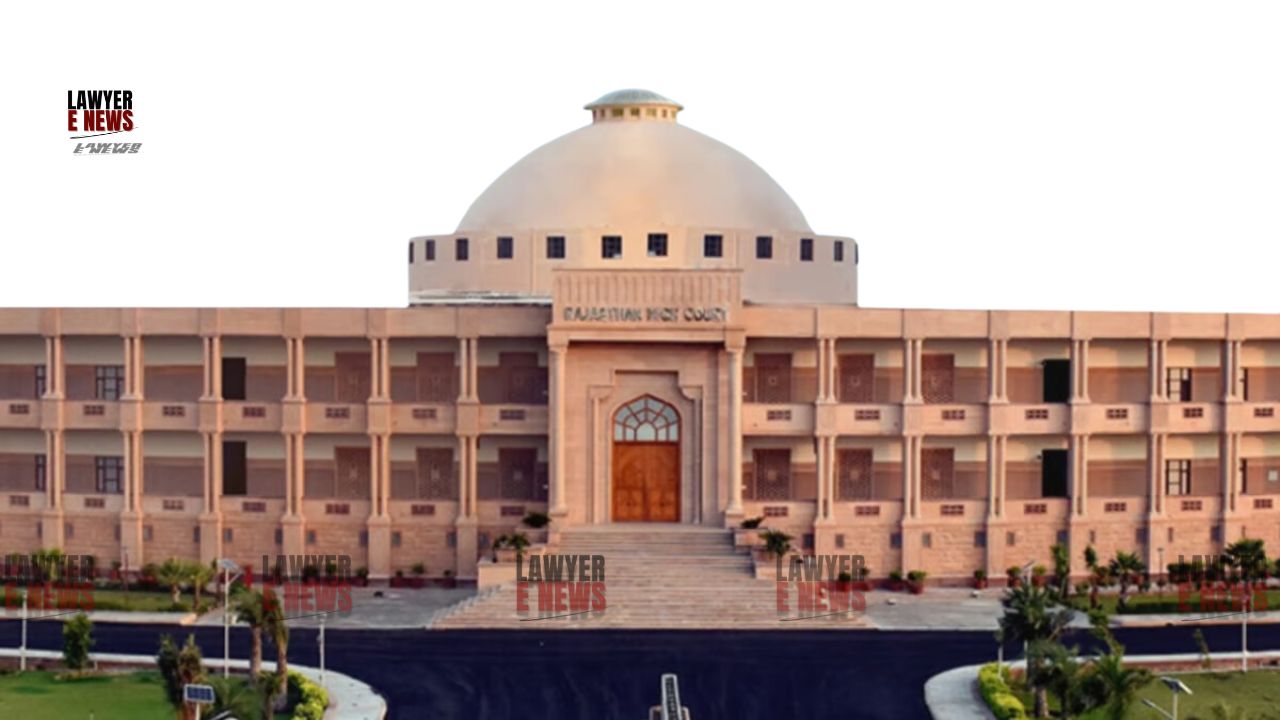
“The substratum of the prosecution case rests on fragile evidentiary footing — mere presence, without overt act or shared object, cannot attract constructive liability under Section 149 IPC.” - In a significant ruling on the contours of vicarious liability under Section 149 IPC, the Rajasthan High Court set aside the conviction of three accused persons — Ram Swaroop, Dalip Singh, and Tara Chand — in a 1992 murder case. The Court held that there was no credible proof of a shared common object, no deadly weapons in possession, and no overt act or participation in the fatal assault, which was carried out solely by two now-deceased co-accused.
Allowing the appeal filed under Section 374(2) CrPC, Justice Farjand Ali quashed the conviction under Sections 148, 304 Part I read with 149, and 323/149 IPC, observing that “the trial court extended constructive liability mechanically, without satisfying the essential prerequisites under Section 149.”
“Constructive Liability Under Section 149 IPC Cannot Be Stretched to Convict Passive Bystanders”
The Court clarified that liability under Section 149 IPC requires proof of an unlawful assembly, a shared common object, and knowledge that the offence committed was a probable outcome of that object. In the absence of such proof, courts must guard against convicting mere onlookers, especially in cases involving large number of accused persons.
Appellants had been convicted in 1993 by the Additional Sessions Judge, Nohar, for their alleged role in the death of one Kashiram. The incident arose out of a longstanding enmity and was triggered by a confrontation on 12 September 1992. During the altercation, fatal lathi blows were inflicted solely by Fularam and Ram Chandra, both of whom have since died, causing the appeal to abate against them.
“Vicarious Liability Under Section 149 Must Be Founded on Cogent Proof of Shared Object — Not on General Allegations or Presence Alone”
The prosecution alleged that six accused persons formed an unlawful assembly and attacked Kashiram and his relatives. The FIR alleged that the group shouted a common slogan to “eliminate” Kashiram and that he was struck with lathis by Fularam and Ram Chandra, which led to his death. The remaining accused, including the three appellants, were alleged to have been present, but no specific role or overt act was attributed to them.
The trial court convicted all six accused under Sections 148, 304 Part I/149, and 323/149 IPC, invoking the principle of constructive liability. However, the High Court, after careful scrutiny of evidence, concluded that the appellants were not armed with deadly weapons, were not assigned any role in the fatal injuries, and there was no proof that they shared the intention or knowledge that the killing would occur.
“Assembly Was Not Formed With the Common Object to Kill — No Premeditation, No Coordination, No Consensus”
Legal Analysis and Judicial Reasoning
Justice Farjand Ali devoted a detailed section of the judgment to the doctrinal foundations of Section 149 IPC, reaffirming that:
“Not every assembly becomes unlawful. The law requires the presence of a common object — a concerted consensus among its members to carry out the object by criminal force or violence.”
The Court observed: “The prosecution failed to establish that Ram Swaroop, Dalip Singh, and Tara Chand were members of an unlawful assembly formed with the intent to kill. The evidence does not disclose they exhorted, encouraged, or participated in the fatal assault.”
On applying the law to facts, the Court found:
Post-mortem showed only two fatal injuries, both inflicted by co-accused who are now deceased.
No weapons were recovered from the appellants.
No injuries were attributed to them in the medical or ocular evidence.
No evidence of prior planning, shared motive, or post-offence conduct suggesting their complicity.
“Doctrine of Caution Must Guide Courts in Large Group Assaults – Innocent Bystanders Cannot Be Sacrificed at the Altar of Vicarious Liability”
The High Court relied on recent Supreme Court precedents including:
Zainul v. State of Bihar, Criminal Appeal Nos. 1187–1188 of 2014 (decided 07.10.2025)
Subal Ghorai v. State of West Bengal, (2021) 4 SCC 602
Charan Singh v. State of U.P., (2004) 4 SCC 205
Mizaji v. State of U.P., 1958 SCC OnLine SC 95
Mohan Singh v. State of Punjab, AIR 1963 SC 174
Quoting Zainul, the Court emphasized:
“The nucleus of Section 149 is common object. Mere presence at the scene does not ipso facto render a person liable unless it is proved that such an accused also shared that object. Courts must exercise a rule of prudence to safeguard innocent spectators.”
The Court held that in the present case:
“There is a conspicuous absence of any material to show that the appellants shared the common object or acted in prosecution thereof. Their conviction solely on the basis of presence and general allegations was unwarranted.”
No Shared Object, No Liability – Conviction Set Aside, Accused Acquitted After 33 Years
Allowing the appeal, the Rajasthan High Court quashed the conviction and sentence imposed on the three surviving appellants and directed their acquittal on all counts.
Justice Farjand Ali concluded: “The trial court fell into manifest error by mechanically extending Section 149 to all accused without examining whether the appellants shared any unlawful object. In the absence of conclusive proof, the appellants are entitled to the benefit of doubt.”
The bail bonds were cancelled and sureties discharged, but the appellants were directed to execute fresh bonds under Section 437-A CrPC, to ensure their presence in case of an appeal before the Supreme Court.
Date of Decision: 15 October 2025





