-
by sayum
24 August 2026 3:22 PM







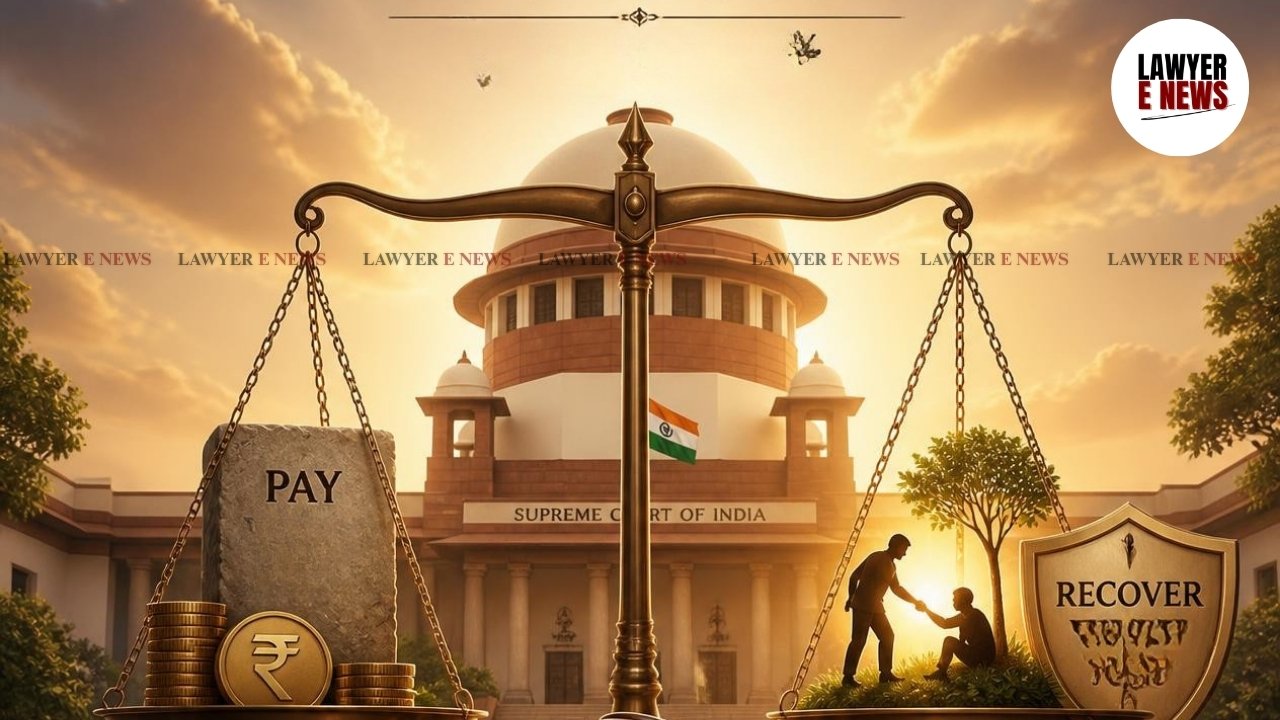
"once the basic care of verifying the driving licence has to be taken by the employer... it cannot be said that thereafter he can wash his hands off the responsibility of not checking up whether the driver has renewed the licence." Supreme Court of India, in a significant ruling dated July 30, 2026, unequivocally held that unsubstantiated claims of "data loss" or mere oral assertions by motor licensing authorities are insufficient to prove the validity of a driving license during an accident, thereby overturning a High Court judgment that had fastened liability on the insurer.
A bench of Justices Sanjay Karol and Nongmeikapam Kotiswar Singh emphasized the owner's strict duty to ensure the driver possesses a valid and renewed license, ultimately applying the 'pay and recover' principle against the owner and driver.
The case originated from an accident on October 14, 2009, involving the respondent Om Prakash (driver) and Rajinder Singh (owner). The Motor Accidents Claim Tribunal (MACT), Panipat, found that the driver did not possess a valid license at the time of the accident and thus held the driver and owner liable, absolving Reliance General Insurance Company Ltd. (the appellant-insurer). However, the High Court of Punjab and Haryana reversed this finding, determining that the driver indeed had a valid license based on the testimony of a Motor Licensing Officer (RW3) and a communication citing "technical error" leading to data loss, consequently making the insurer liable.
The primary question before the court was whether Om Prakash, the driver of the offending vehicle, possessed a valid driving license on the date of the accident. The court was also called upon to determine if the 'data loss' explanation provided by the authorities and relied upon by the High Court was sufficient to prove the continuous validity of the license, and consequently, if the appellant-insurer could be held liable.
High Court Erred in Accepting Uncorroborated 'Data Loss' Claim
The Supreme Court expressed its difficulty in accepting the High Court's reliance on the statement of RW3, Shailendra Pal Singh, the Motor Licensing Officer, and a communication (Ex.RW3/B) from his office. It observed that RW3's oral testimony about the license's validity was directly contradicted by the official extract of record (Ex.RW3/A) he himself produced before the Tribunal. The High Court failed to adequately consider this glaring contradiction.
"We find it difficult to accept the version of the High Court which places reliance on a document (RW3/B), which Om Prakash had produced, allegedly sent by the Wazirpur Authority informing him of the gap in the data."
Strict Proof Required for Official Documents
The Court reiterated the fundamental principles of evidence under the Indian Evidence Act, 1872 (IEA). Citing Neeraj Dutta v. State (NCT of Delhi), the bench stressed that primary evidence is the best evidence, offering the greatest certainty. Secondary evidence is admissible only when the absence of primary evidence is satisfactorily explained.
Foundational Requirements for Secondary Evidence
Referring to Tharammel Peethambaran v. T. Ushakrishnan, the Court underscored that secondary evidence is an exception and requires a proper factual foundation. This includes proving the original document existed and providing valid reasons why it cannot be furnished. The Authority, in this case, failed to produce any document officially recording the alleged data loss or the steps taken to recover it.
"Unless circumstances as enumerated in Section 65 of the IEA are pleaded, present and proved, an original document must be proved by primary evidence."
Payment of Penalty Implies License Lapse
The Supreme Court pointed out that both the Tribunal and the High Court acknowledged the payment of a penalty for the renewal of Om Prakash's license, covering the period relevant to the accident. The Court observed that this payment of a penalty "is a gap that is unaddressed" by the High Court. Such a penalty inherently suggests a break in the continuous validity of the license, a crucial aspect overlooked by the High Court in its reasoning.
Owner's Strict Duty to Verify License Validity
Referring to Sections 3 and 5 of the Motor Vehicles Act, the Court highlighted the owner's responsibility to ensure that the driver possesses a valid and effective driving license. The bench cited Telangana State Level Police Recruitment Board v. Penjarla Vijay Kumar, which observed that driving is not merely a paper qualification and renewal after a gap does not backdate validity.
Precedents Affirm Owner's Responsibility
The Court extensively relied on Beli Ram v. Rajinder Kumar and National Insurance Co. Ltd. v. Hem Raj, which established that an owner has a continuous duty to verify the driver's license validity and ensure its timely renewal. The absence of the owner in the witness box to clarify steps taken for renewal further weakened their case.
"When an employer employs a driver, it is his duty to check that the driver is duly licensed to drive the vehicle... The owner must show that he has verified the license. He must also take reasonable care to see that his employee gets his license renewed within time."
Insurer Not Liable; 'Pay & Recover' Principle Applied
Given the lack of conclusive proof of a valid driving license at the time of the accident, the Supreme Court concluded that the appellant-insurer could not be held liable to make good the award. The appeals were accordingly allowed, and the Court applied the principle of 'pay and recover', directing that the amount already released to the claimants (as per the earlier interim order) should be recovered by the insurer from the owner and driver.
Recommendations for Road Safety and Licensing Process
Acknowledging the significant financial burden on the driver and owner, the Court underscored the critical importance of driving licenses. It suggested that the Ministry of Road, Transport and Highways and state counterparts undertake awareness campaigns, streamline license issuance and renewal processes, and address issues like affordability of driving schools and accessibility of information in regional languages.
The Supreme Court allowed the appeals, setting aside the High Court's judgment and reinstating the Motor Accidents Claim Tribunal's finding that the insurer was not liable. The ruling firmly establishes that vague explanations like "data loss" are insufficient to prove the validity of a driving license when challenged, and places a stringent duty on vehicle owners to ensure their drivers possess continuously valid licenses. The 'pay and recover' principle ensures that claimants receive compensation while the ultimate liability rests with the negligent owner and driver.
Date of Decision: July 30, 2026