-
by sayum
04 August 2026 1:39 PM







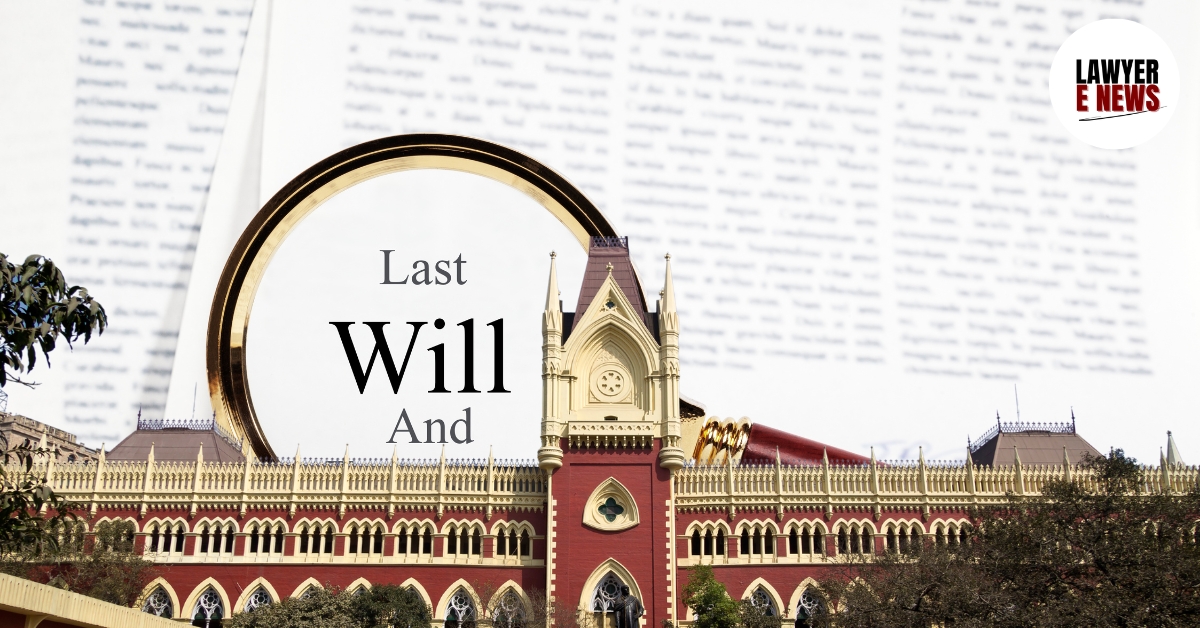
Calcutta High Court affirmed a City Civil Court decision granting probate of the Will. The Court dismissed the appeal brought by Tapasee Choudhury, who contested the genuineness of the Will alleging suspicious circumstances, and upheld that “no real, germane or valid suspicious features have been substantiated.”
“Suspicious circumstances cannot be invented merely because the Will deviates from the natural line of succession,” the Court said, emphasizing the significance of testamentary freedom under Section 63 of the Indian Succession Act, 1925 and evidentiary compliance under Section 68 of the Indian Evidence Act, 1872.
“Mindsets cannot be typecast; every Hindu widow doesn’t conform to a presumption”
The case arose after the death of Anima Sen, who had executed her Will on 15th May 1994, bequeathing her Kolkata property equally to her daughters Saswati and Bhaswati, and gifting the Kalna property to her niece, Tapasee, the appellant. Upon the testatrix’s death in 2003, Bhaswati filed for probate. Tapasee challenged the Will, asserting it was forged, executed under suspicious circumstances, and not properly proved.
The trial court granted probate, and Tapasee appealed, alleging delay in production of the Will, inconsistent ink and overwriting, suppression of a codicil, inequality in bequests, and denial of opportunity to cross-examine witnesses.
“Dual inks or overwrite are not inherently suspicious unless accompanied by mala fide”
Court’s Observations: Rejecting Tapasee's arguments, the Court clarified that suspicion must be “real and germane” and not speculative. It addressed the core legal objections as follows:
On the use of different inks and overwriting, the Court held that “such variation does not ipso facto constitute a suspicious circumstance, especially when the signatures are not challenged and no handwriting expert was sought.”
On the alleged inequality in bequests, it stated, “Even a complete deprivation might not vitiate a Will; here, the appellant was bequeathed the Kalna property, so the challenge on that ground lacks bona fides.”
On the timing of execution, it said, “the mental make-up of a Hindu widow cannot be cast in any straightjacket formula… she may have had her own reasons, possibly linked to the upcoming marriage in the family, to make a Will at that point.”
“Sole attesting witness was examined and his testimony stands unrebutted”
Evidence and Procedural Findings: P.W.2, the only surviving attesting witness, was examined under Section 68 of the Indian Evidence Act and confirmed all statutory requirements under Section 63 of the Succession Act. The Court noted that “his cross-examination did not shake the veracity of the Will’s execution.”
His evidence, though earlier expunged due to procedural confusion, was later reinstated by the High Court itself. The trial court then validly relied on it, and the appellant neither challenged that reinstatement nor adduced further rebuttal evidence. “The appellant cannot now claim prejudice,” said the Court.
“A document not complying with testamentary formalities cannot be called a codicil”
On the issue of an alleged codicil (Exhibit-3), the Court clarified that the letter dated 13.11.1999 by the testatrix was not executed with legal formalities akin to a Will and did not modify or revoke the earlier Will. “It was, at best, a letter and not a testamentary document.”
“No contradiction in propounder’s version; production delay was explained”
The appellant argued that there was contradiction in the propounder’s statement about when she obtained the Will. The Court dismissed this argument stating, “There is no such contradiction in the pleadings or evidence. The Will was always with the testatrix, and the carbon copy was handed over posthumously to the propounder, which is entirely believable.”
The Division Bench held that the Will had been validly executed, free from suspicious circumstances, and duly proved as per law. It noted that Tapasee was not disinherited and had failed to discharge her burden of rebutting the Will’s authenticity.
The appeal was dismissed, and the probate confirmed, with the Court reinforcing that “mere doubts or strained constructions do not substitute for hard proof when attacking a Will.”
Date of Decision: 13th May 2025