Auction Purchaser Has No Vested Right Without Sale Confirmation: Calcutta HC Upholds Borrower’s Redemption Right Under Pre-Amendment SARFAESI Law Mere Breach of Promise to Marry Doesn’t Amount to Rape: Delhi High Court Acquits Man in False Rape Case Father Is the Natural Guardian After Mother’s Death, Mere Technicalities Cannot Override Welfare of Child: Orissa High Court Restores Custody to Biological Father Assets of Wife and Father-in-Law Can Be Considered in Disproportionate Assets Case Against Public Servant: Kerala High Court Refuses Discharge Identification Without TIP, Electronic Records Without 65B Certificate – Conviction Set Aside: Patna High Court Nothing Inflicts A Deeper Wound On Our Constitutional Culture Than A State Official Running Berserk Regardless Of Human Rights: Jharkhand High Court Orders ₹1.5 Lakh Interim Compensation Dishonour Due to ‘Account Blocked’ Not Attributable to Drawer—No Offence Under Section 138 NI Act: Delhi High Court Quashes Criminal Proceedings Presumption Under Section 139 NI Act Cannot Be Rebutted By Mere Assertions: Delhi High Court Affirms Conviction In 32-Year-Old Cheque Bounce Case Signature Alone Doesn’t Prove Debt: Kerala High Court Upholds Acquittal in Cheque Bounce Case, Rejects Blanket Presumption Under Section 139 NI Act Justice Cannot Be Left to Guesswork: Supreme Court Mandates Structured Judgments in Criminal Trials Across India Truth Must Be Proven Beyond Doubt—Not Built On Flawed FIRs, Tainted Witnesses And Investigative Gaps: Supreme Court Acquits Man in POCSO Rape-Murder Case Once parties agree and reconciliation is impossible, a fault-based decree is unnecessary: Supreme Court Sets Aside Divorce on Desertion No Escape from Statutory Ceiling: Exclusive Expenditure by Foreign Head Offices Also Attracts Section 44C Income Tax: Supreme Court Loss Of A Child Cannot Be Calculated In Rupees, But Law Must At Least Offer Dignity In Compensation: Supreme Court Enhances Compensation Sessions Court Cannot Direct Life Imprisonment Till Natural Life Without Remission: Supreme Court Reasserts Limits on Sentencing Powers of Subordinate Courts ‘Continuously Means Without a Single Break’: Supreme Court Bars Expired-and-Renewed Licences From Police Driver Recruitment Chief Justice’s Power Under Section 51(3) Is Independent and Continuing: Supreme Court Upholds Kolhapur Bench Notification Last Seen Evidence Alone Cannot Sustain Conviction: Supreme Court Acquits Accused in Murder Case No Cultivation on Forest Land Without Central Clearance: Supreme Court Cancels Lease Over 134 Acres, Orders Reforestation Appointment from Rank List Must Respect Communal Rotation: SC Declines Claim of SC Waitlisted Candidate After Resignation of Appointee Supreme Court Dissolves 20-Year Estranged Marriage Under Article 142 Despite Wife’s Objection Murder Inside Temple Cannot Be Treated Lightly: Supreme Court Cancels Bail of Father-Son Convicts in Group Killing Case

Mere Assertion Without Title Cannot Sustain Ownership Claim: Punjab & Haryana High Court

02 March 2025 9:47 PM

By: Deepak Kumar


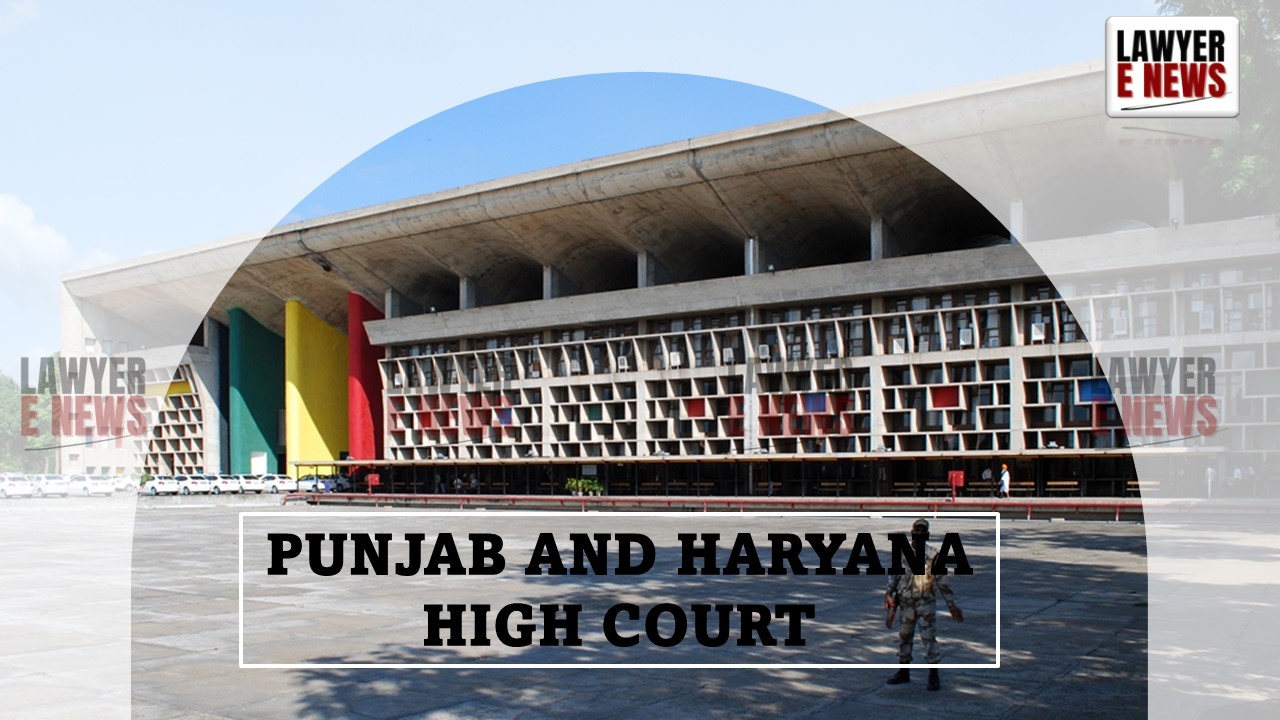
Encroachment Claim Fails Without Legal Ownership and Timely Action - Punjab & Haryana High Court, in a judgment delivered on 13th February 2025, dismissed a second appeal filed by Khubi Ram challenging concurrent findings of fact in a property dispute, ruling that a mere assertion of ownership without documentary proof cannot sustain a claim for possession, especially when the claim is time-barred.
Justice Nidhi Gupta, rejecting Regular Second Appeal No. 910 of 2022 (O&M), ruled that "a plaintiff must establish a legal title over the disputed property to seek possession. Mere allegations of encroachment, unsupported by documentary evidence, do not create a legal right. Additionally, a claim made decades after the alleged encroachment is barred by limitation."
The case involved a dispute over a passage in a residential area in Village Bhakli, Tehsil Kosli, District Rewari. The appellant, Khubi Ram, claimed that the defendant had illegally encroached upon a passage adjacent to his property, which was allegedly left as a common access route when the land was partitioned in 1979. The defendant, however, established that his house had been constructed on the disputed land as early as 1984, and the revenue records showed it as "Gair Mumkin Makan."
The trial court dismissed the suit on 6th April 2017, holding that:The appellant had no legal title over the disputed passage.
•    The claim was time-barred, as the defendant’s construction had existed since 1984, while the suit was filed only in 2013.
•    The local commission’s report and cross-examination contradicted the appellant’s claims.
The first appellate court upheld this decision on 13th February 2020, emphasizing that the appellant’s failure to object to the defendant’s construction for decades weakened his case.
The High Court found no reason to interfere, ruling that "a plaintiff who does not hold title to a property has no cause of action to claim possession or challenge a mutation." The court noted that the appellant himself admitted in cross-examination that he had no ownership over the disputed passage.
The judgment further stressed that "limitation laws exist to prevent stale claims from being reopened. When a construction has existed for nearly 30 years without objection, the courts cannot entertain belated claims under Article 65 of the Limitation Act, 1963."
Reaffirming that a second appeal under Section 100 CPC can only be entertained if a substantial question of law arises, the court ruled that "mere dissatisfaction with concurrent factual findings is not a valid ground for appeal. When both lower courts have applied settled legal principles correctly, a second appeal cannot be entertained."
Dismissing the appeal, the court concluded that "the appellant’s claim was neither supported by legal ownership nor filed within the limitation period. No substantial question of law arises, and the appeal stands dismissed."


Date of Decision: 13 February 2025

 

Latest Legal News