
-
by sayum
26 August 2026 1:49 PM







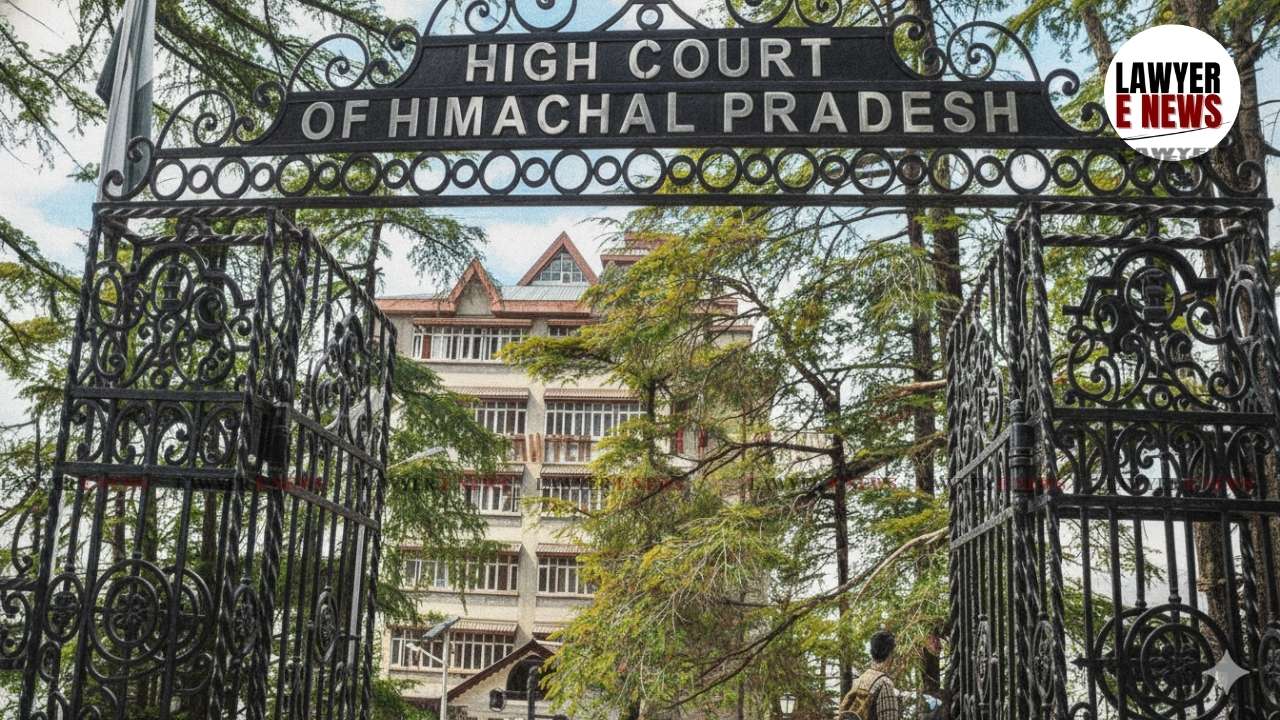
On March 16, 2026, the Himachal Pradesh High Court refusing regular bail to an accused booked under Sections 8, 20, 25 and 29 of the Narcotic Drugs and Psychotropic Substances Act, 1985. The case arose out of the recovery of 1.950 kilograms of charas from a vehicle allegedly occupied by the petitioner along with two co-accused.
The Court held that since the recovery involved a commercial quantity, the stringent bar contained in Section 37 of the NDPS Act was fully attracted. It found that the petitioner failed to satisfy the twin mandatory conditions for bail, namely, that there were reasonable grounds to believe he was not guilty and that he was not likely to commit any offence while on bail. The Court also rejected the petitioner’s pleas based on alleged lack of conscious possession, 80% paraplegia, and delay in trial, though it reserved liberty to seek interim bail before the Trial Court in the event of a medical emergency.
“Negation of Bail Is the Rule, and Its Grant an Exception” in Commercial Quantity NDPS Matters
The petition was filed in Crime No. 52 of 2022 dated July 21, 2022, registered by the Narcotics Control Bureau, Sub Zone, Mandi, Himachal Pradesh. According to the prosecution case recorded in the order, the NCB received secret information that Vivek Sharma was travelling from Tissa with Rakesh Kumar and a woman in vehicle No. PB-07Y-2385 and that a huge quantity of charas had been concealed in the vehicle. Acting on the information, an NCB team associated local police officials, intercepted the vehicle, and identified the occupants as Rakesh Kumar, Vivek Sharma, and Praveen Kumari. After completing the requisite formalities, the vehicle was searched and 1.950 kilograms of charas was allegedly recovered.
The petitioner’s case before the High Court was that he was innocent, had been falsely implicated, and no recovery was effected from his conscious possession. He also relied heavily on his medical condition, asserting that he had suffered paraplegia, was 80% disabled, and his entire body was not functioning properly. It was further argued that investigation stood completed, the challan had already been filed, and therefore no useful purpose would be served by continued incarceration.
The NCB opposed the plea by pointing out that the quantity recovered was commercial, that the petitioner was an occupant of the vehicle from which the contraband was recovered, and that his statement under Section 67 allegedly disclosed that he had purchased 2 kilograms of charas from one Taj Mohammad. The agency also informed the Court that 11 witnesses had been cited and two had already been examined.
Justice Rakesh Kainthla began by recalling the general principles governing bail, referring to the Supreme Court’s decisions in Pinki v. State of U.P., Gudikanti Narasimhulu, Prahlad Singh Bhati, Ram Govind Upadhyay, Kalyan Chandra Sarkar, Prasanta Kumar Sarkar and Brijmani Devi. The Court acknowledged the ordinary criminal law principle that “bail is the rule and jail is the exception,” as stated in State of Rajasthan v. Balchand. Yet, the High Court made it clear that this ordinary rule cannot be mechanically applied in NDPS cases involving commercial quantity because Parliament has imposed an additional and overriding restriction through Section 37.
On the issue of possession, the Court placed reliance on Madan Lal v. State of H.P. to hold that where contraband is recovered from a vehicle occupied by accused persons travelling together, conscious possession may prima facie be inferred unless rebutted. The Court noted that the status report specifically stated that the petitioner was occupying the vehicle from which 1.950 kilograms of charas was recovered. The order also records that the petition itself mentioned that the petitioner was driving the vehicle and had taken out a white-blue packet from the luggage kept in the back of the car, which was found to contain charas. In that background, the Court held that the material on record prima facie connected the petitioner with the commission of the offence.
The High Court then turned to the decisive statutory barrier: Section 37 of the NDPS Act. Since the Central Government has notified 1 kilogram of charas as commercial quantity, the recovery of 1.950 kilograms clearly attracted the rigours of Section 37. Reproducing the statutory text, the Court emphasized that for offences involving commercial quantity, bail cannot be granted unless the Court is satisfied that there are “reasonable grounds for believing” that the accused is not guilty and that he is not likely to commit any offence while on bail.
The order carefully traces the Supreme Court line of precedent on the mandatory nature of this requirement, citing Union of India v. Niyazuddin, State of Kerala v. Rajesh, Union of India v. Mohd. Nawaz Khan, Union of India v. Ajay Kumar Singh, State of Meghalaya v. Lalrintluanga Sailo, Narcotics Control Bureau v. Kashif, Union of India v. Vijin K. Varghese and Union of India v. Namdeo Ashruba Nakade. The High Court reiterated that these twin conditions are cumulative, not alternative, and that “reasonable grounds” means something more than a mere prima facie view. It requires substantial probable cause to believe that the accused is not guilty. Unless both requirements are met, the embargo on bail continues to operate.
Applying that test, the Court found that the prosecution had collected sufficient material to prima facie connect the petitioner with the crime and that there was nothing on record to show that he would not indulge in an offence if released on bail. On that reasoning, the petitioner failed to cross the statutory threshold under Section 37.
The petitioner’s argument that “bail is the rule” was specifically rejected in the NDPS context. Referring to NCB v. Kashif, the Court underscored that in commercial quantity cases under the NDPS Act, “negation of bail is the rule and its grant an exception.” This observation is significant because it reinforces the increasingly strict judicial approach in narcotics cases where the quantity recovered crosses the commercial threshold. From an advocacy perspective, the order reaffirms that ordinary liberty-based bail submissions, unless tied to the statutory satisfaction required by Section 37, are unlikely to succeed.
The plea of delay in trial was also considered and rejected. The petitioner had relied on prolonged proceedings and the right to speedy trial. However, the High Court found that the record did not support any such exceptional delay. The chargesheet had been filed on October 27, 2025, and the matter was fixed for evidence on March 3, 2026. Two witnesses had already been examined, and further evidence dates were fixed for January 13, 14 and 15, 2026. In these circumstances, the Court held that no serious delay had been established.
The High Court distinguished the Supreme Court ruling in Mohd. Muslim alias Hussain v. State (NCT of Delhi) on the ground that bail there had been granted because of a genuine speedy trial violation. In the present case, the Court held, “there is no delay in the progress of the trial.” Likewise, Lakhwinder Singh was found distinguishable because that case concerned a convict who had remained in jail for four-and-a-half years, whereas the present petitioner had earlier been released on interim bail for treatment and that interim protection was later cancelled. The Court also observed that the Jammu & Kashmir decision in Parvaiz Ahmad Hanga could not override binding Supreme Court precedent, particularly Lalrintluanga Sailo.
The medical ground urged by the petitioner received separate treatment. The Court did not dispute that the petitioner claimed 80% paraplegia, but held that medical condition by itself cannot justify regular bail in a commercial quantity NDPS matter unless Section 37 is satisfied. Relying on State of Meghalaya v. Lalrintluanga Sailo, where even HIV status was held insufficient to bypass the statutory rigour, the High Court concluded that disability or illness cannot be used to dilute the legislative embargo. At the same time, the Court tempered the rejection by expressly granting liberty to the petitioner to move the Trial Court for interim bail in case of a medical emergency.
That balance is one of the more important legal takeaways from the order. The High Court did not shut the door entirely on medical relief; rather, it drew a clear distinction between regular bail and interim bail on emergency medical grounds. For practitioners, this signals that in stringent NDPS cases, medical circumstances may still be relevant, but more appropriately in the framework of temporary or interim relief rather than regular bail that would run into Section 37.
Ultimately, the High Court dismissed the petition, holding that the petitioner was “not entitled to bail.” It also clarified that the observations in the order would remain confined to disposal of the bail petition and would not affect the merits of the trial.
The ruling is a firm reiteration of the proposition that once commercial quantity is involved, the bail inquiry changes fundamentally. The Court’s reasoning makes it clear that allegations regarding lack of recovery from the person of the accused, physical disability, or generalized claims of delay will not, by themselves, overcome the mandatory statutory bar. The order strengthens the prosecutorial position in vehicle-recovery NDPS cases by relying on the doctrine of prima facie conscious possession of occupants travelling together and by reaffirming the presumptive structure flowing from Sections 35 and 54 of the Act.
In effect, the Himachal Pradesh High Court has sent out a clear message: in commercial quantity NDPS prosecutions, liberty arguments must first pass through the narrow gate of Section 37. Unless the Court can positively record that there are reasonable grounds to believe the accused is not guilty and not likely to reoffend, regular bail remains out of reach.
Date of Decision: 16/03/2026





