
-
by sayum
26 August 2026 1:49 PM







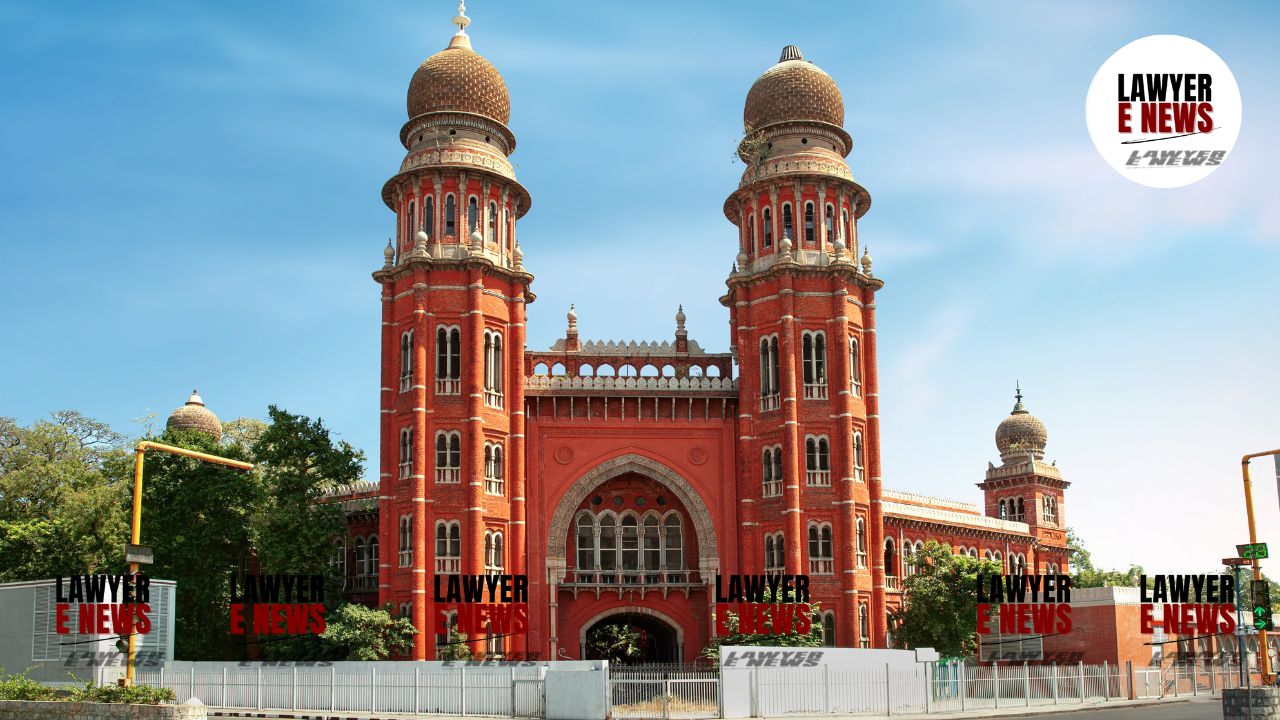
" Law Should Lean In Favour Of Correcting The Other Procedures Towards Truth", In a judgment that cuts to the heart of India's examination-driven education culture, the Madras High Court on February 25, 2026 delivered a significant ruling in B. Shajimon v. Union of India & Ors., permitting a Class XII student, S. Aswatha, to appear in the CBSE Board's supplementary Mathematics examination after her parents had switched her subject from Mathematics to Physical Education under pressure to crack the NEET examination. Justice D. Bharatha Chakravarthy, while allowing the writ petition filed under Article 226 of the Constitution, directed CBSE to permit the student to write the additional Mathematics paper — provided she produces proof of having studied the subject — and issued sharp observations on the "terrible rat race" that parents force their children to run in the pursuit of professional college admissions.
Background of the Case
The petitioner, B. Shajimon, approached the Madras High Court after CBSE's Regional Director, Chennai, rejected his application by order dated January 8, 2026, refusing to allow his daughter S. Aswatha to appear in Mathematics as an additional subject under CBSE Bye-law 43 in the Senior School Certificate Examination 2025-2026 as a private candidate. The student had originally been admitted to Class XI at Sri Chaitanya Techno School with Mathematics as one of her five subjects, studied it throughout XI standard and into XII standard, but had her subject changed to Physical Education at the last minute when the family decided she would pursue medicine and appear in NEET. Having failed NEET, she now required Mathematics to seek admission in engineering colleges.
Legal Issues
The central legal question before the Court was whether CBSE Bye-law 43, which permits a passed candidate to appear in an additional subject as a private candidate, could be invoked by a student who had not formally studied Mathematics as a registered subject in XI standard as per CBSE records, but had in fact studied the subject throughout XI standard in school. The secondary question was whether incorrect information fed to CBSE at the time of subject registration could disentitle a student from seeking the benefit of the additional subject scheme.
Court's Observations and Judgment
Justice Chakravarthy opened his analysis with a penetrating observation on the systemic reality of Indian education, making clear that the Court was not blind to the societal pressures at play. "Education = Learning throughout the world. But, in this part of the world, education = admission to medical seat or engineering seat," the Court observed, adding that "Parents make the children to run the terrible rat race. In the madness, all kinds of subject change, as the one done here by choosing subjects which they think lighter all happen. In high school, even mother tongue is sacrificed to take other easier subjects."
"The Child Finds Itself At The Crossroads"
The Court acknowledged the precarious position the student found herself in — through no fault of her own — as a direct consequence of decisions made by adults around her. The student had studied Mathematics with subject code 041 throughout Class XI and into Class XII, as evidenced by the school mark sheet for Academic Year 2023-2024, which the petitioner produced before the Court. The Court noted that it was under external pressure that the subject was changed at the last minute, and incorrect information was consequently fed to CBSE. Recognising this, the Court observed that merely because incorrect data was submitted to the Board, the student's actual learning history could not be erased.
CBSE contested the petition on the ground that Bye-law 43 requires the additional subject to have been formally studied for two years — covering both Class XI and Class XII — and that since the student was registered for Physical Education and not Mathematics in her CBSE records, she did not satisfy the eligibility conditions. The Board also sought to distinguish the Delhi High Court's ruling in Prabhroop Kaur Kapoor and Ors. v. Union of India (W.P.(C) No.15086 of 2025), which had held that legitimate expectations could not be overridden by mere policy change, arguing that the Delhi case dealt with gap year students and was in any event under appeal before a Division Bench.
The Court, while acknowledging the force of CBSE's objection, held that it could not ignore the factual reality that the student had genuinely studied Mathematics throughout Class XI. "The fact remains that the child studied Mathematics throughout the XI standard and upto some time, in the XII standard. Therefore, ultimately, the law should lean in favour of correcting the other procedures towards truth," the Court held, directing relief on the basis of the extraordinary circumstances of the case.
The Court accordingly directed the petitioner and the student to appear before CBSE's Regional Director on or before March 3, 2026 with the webcopy of the order, along with proof of studying Mathematics in XI standard, including the school mark sheet, notebooks, homework, and other evaluations. If the Regional Director was satisfied that the student had genuinely studied Mathematics for the requisite period, CBSE was directed to permit her to appear in the supplementary Mathematics examination scheduled for March 9, 2026, declare her result, and issue the mark sheet. The Court expressly noted: "The above directions are issued in the peculiar facts of the instant case."
The Madras High Court allowed the writ petition, quashing the CBSE Regional Director's rejection order dated January 8, 2026 and directing CBSE to consider the student's proof of having studied Mathematics and, upon satisfaction, permit her to appear in the supplementary Board examination. The judgment is a notable exercise of the High Court's extraordinary writ jurisdiction to remedy a situation where procedural technicality had been weaponised against a student who was the victim of misguided parental decisions rather than her own academic default. The Court made no order as to costs.
Date of Decision: 25.02.2026





