-
by sayum
17 August 2026 10:05 AM







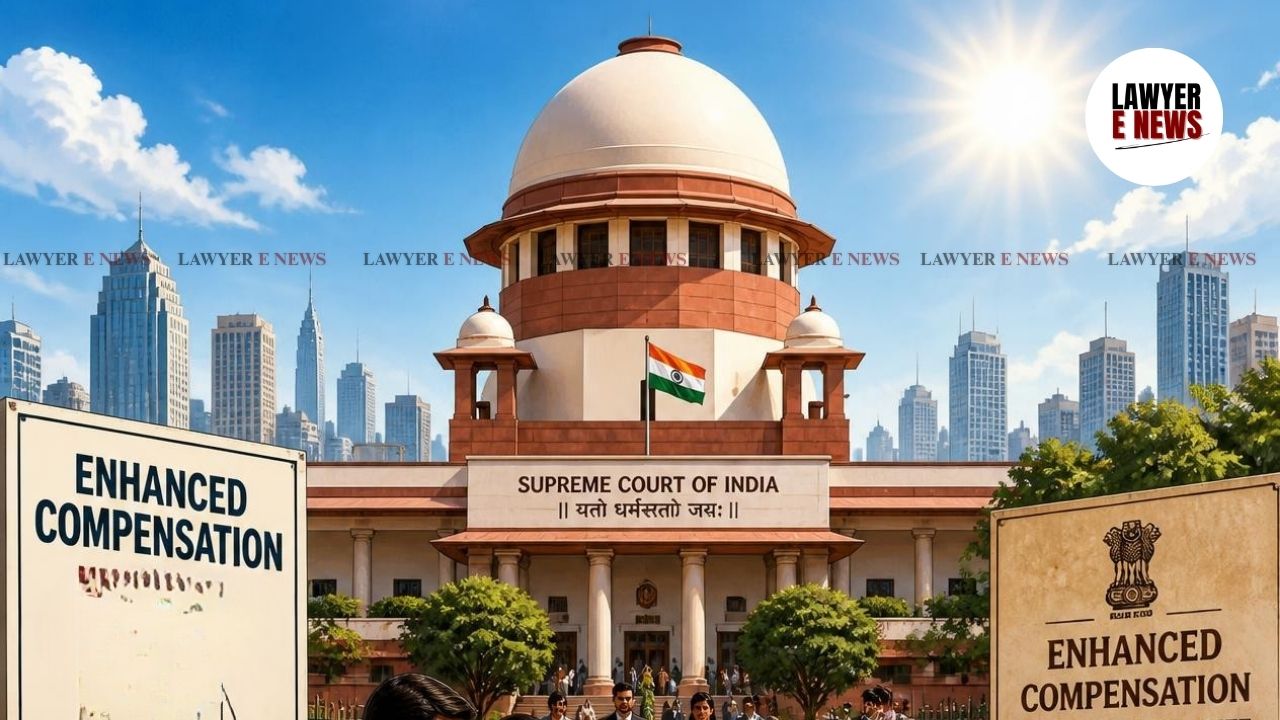
"By loss of consortium, the courts have made an attempt to compensate the loss of spouse's affection, comfort, solace, companionship, society, assistance, protection, care and sexual relations during the future years." Supreme Court, in a significant ruling dated August 14, 2026, held that adult children of a deceased motor accident victim are legally entitled to compensation under the head of parental consortium, irrespective of their major status or earning capacity.
A bench comprising Justice Nongmeikapam Kotiswar Singh and Justice N.V. Anjaria observed that all legal representatives of a deceased victim are entitled to claim compensation under the Motor Vehicles Act, 1988, emphasizing that the absence of complete dependency does not extinguish the statutory right to seek solace and care compensation.
The dispute arose from a tragic motor vehicular accident on June 23, 2012, where the deceased pedestrian Shaik Janimiya was struck by a speeding car at Malkajgiri, resulting in fatal injuries. The widow and three children of the deceased filed a claim petition seeking compensation before the Motor Accidents Claims Tribunal, which initially awarded Rs. 8,44,000. Upon appeal, the High Court for the State of Telangana enhanced the compensation to Rs. 11,00,672, which still left the conventional heads undervalued and failed to grant independent parental consortium to the adult children.
The primary question before the court was whether major children who are aged between 18 and 21 years and gainfully occupied can claim compensation under the head of parental consortium. The court was also called upon to determine the correct application of statutory conventional heads and mandatory periodic enhancements as mandated by constitutional bench precedents.
Court Reaffirms Scope Of Legal Representatives Under Motor Vehicles Act
The bench examined the statutory framework under Sections 140 and 166 of the Motor Vehicles Act, 1988, and reiterated that the expression "legal representative" is wide enough to encompass all persons who in law represent the estate of a deceased person. Referring to landmark precedents including Manjuri Bera v. Oriental Insurance Company Limited and National Insurance Company Limited v. Birender, the court noted that the liability to pay compensation does not cease merely because a legal representative is a major son or daughter earning an independent livelihood.
"Devolution Of Estate Governs Entitlement"
The court underscored that the devolution of the estate of the deceased is the governing principle under clause (c) of Section 166(1) of the Act rather than strict financial dependency. Every legal representative who suffers emotional and familial deprivation on account of a fatal vehicular accident has a statutory remedy for realization of compensation under different heads.
Consortium Encompasses Spousal, Parental, And Filial Categories
Explaining the evolution of non-pecuniary damages, the court cited Magma General Insurance Company Limited v. Nanu Ram to reiterate that consortium is a compendious term encompassing spousal, parental, and filial consortium. The bench observed that parental consortium is in the nature of compensation for parental aid, protection, affection, society, discipline, guidance, and training which would have been available to the child had the parent survived.
"Parental Consortium Essential For Just Compensation"
The bench heavily criticized both the tribunal and the high court for awarding a meager and collective sum under conventional heads, completely omitting independent parental consortium for the children. The court ruled that each claimant—comprising the wife and the three children—is entitled to a fixed baseline amount of Rs. 40,000 each under the head of consortium, classified respectively as spousal and parental consortium.
Mandatory Ten Percent Triennial Enhancement Applied
Applying the foundational doctrine laid down in National Insurance Company Limited v. Pranay Sethi, the court incorporated the mandatory 10 percent enhancement at the interval of every three years to counter inflation and changing economic realities. Consequently, the consortium figure for each of the four appellants was escalated to Rs. 48,400 each, resulting in a total consortium payout of Rs. 1,93,600.
Court Recalculates Total Compensation Package
Maintaining the loss of dependency quantified by the high court at Rs. 10,23,672, the bench rectified the conventional heads of funeral expenses and loss of estate by enhancing them from Rs. 10,000 each to the standard benchmark of Rs. 15,000 each. The aggregate compensation was thus recalculated to stand at Rs. 12,47,272.
Directions For Immediate Deposit And Disbursement
The Supreme Court directed the respondent insurance company to deposit the additional differential compensation of Rs. 1,46,600 before the concerned tribunal within six weeks, carrying an interest rate of 7.5 percent per annum from the date of filing the original claim petition. The tribunal was further instructed to disburse the amounts directly into the respective bank accounts of the appellants in equal proportions after due verification.
In conclusion, the appeal filed by the legal representatives was allowed by modifying the high court judgment, reinforcing the legal certainty that non-pecuniary compensation for loss of parental guidance must be meticulously honored by all judicial fora. The ruling solidifies the doctrinal protection afforded to surviving family members under Indian tort and motor accident jurisprudence.
Date of Decision: 14 August 2026