-
by sayum
04 August 2026 1:39 PM







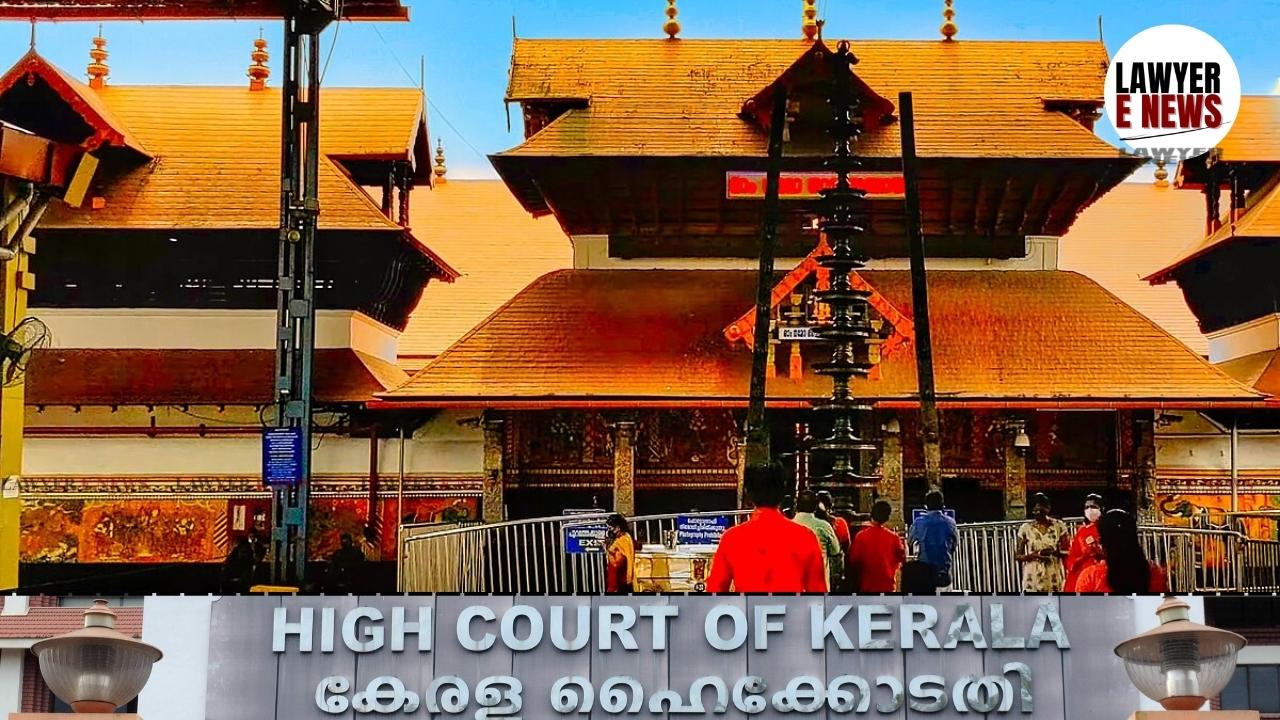
"Technology Can Complement Tradition, Not Compromise It…..No devotee should leave the temple with a sense of grievance or dissatisfaction… The rights and dignity of pilgrims are paramount”, In a significant judgment aimed at reimagining temple administration in the context of modern pilgrim needs, the Kerala High Court directed the Guruvayoor Devaswom Managing Committee to reintroduce online darshan facilities at least two days a week and to implement a scientifically designed queue system for the Sree Krishna Temple, Guruvayoor. The division bench of Justice Raja Vijayaraghavan V and Justice K.V. Jayakumar, delivering the judgment in P.N. Radhakrishnan v. State of Kerala (WP(C) No. 41543 of 2024 with connected matters), invoked both statutory duties under the Guruvayoor Devaswom Act, 1978 and the spiritual ethos of the Bhagavad Gita and Srimad Bhagavatam to hold that the constitutional and religious rights of worshippers must be protected with dignity and modern administrative efficiency.
The petitions were filed by devotees, including Advocate Lekha Suresh (party-in-person), seeking judicial intervention to restore the online booking system for darshan and to improve infrastructure and crowd control mechanisms, especially citing severe hardships faced by senior citizens, differently-abled persons, and women during peak seasons like Ekadashi and Ashtami Rohini.
“How to avoid the queue—not just how to manage it—must be the guiding principle in temple administration”
At the heart of the Court's ruling was a deeply empathetic observation: “A devotee visiting a temple expects a peaceful and hassle-free darshan. The purpose of such a visit is not merely to see the deity but to attain inner peace, solace, and spiritual elevation.” The Court found that the traditional long-standing physical queue system had become untenable in light of the exponential rise in pilgrim footfall and called for a complete reengineering of the darshan experience through hybrid technological integration.
While the Devaswom Committee had discontinued online bookings after facing practical challenges—including ritual unpredictability and conflicts between online and offline pilgrims—the Court rejected the outright elimination of digital access, holding that “technology can be adapted to complement, not compromise, traditional tantric practices.” The Court further noted: “Given the hardships faced by devotees, it is high time that a new, modern, scientifically-designed system is introduced to ease their difficulties and ensure a dignified and spiritually fulfilling experience.”
“It is the bounden duty of the Managing Committee to ensure a hassle-free darshan to the devotees”
The Court relied heavily on Section 10 of the Guruvayoor Devaswom Act, 1978, which mandates the Devaswom Committee to “provide facilities for the proper performance of worship by the worshippers” and “ensure maintenance of order and discipline and proper hygienic conditions in the Temple.” The bench interpreted this as imposing a statutory and fiduciary duty on the Committee to ensure orderly, safe, and accessible darshan for all.
On the issue of past refusal by the Committee to restore online darshan (challenged in the writs), the Court found that such rejection was not in consonance with the earlier directions issued in the suo motu order in DBP No. 94/2023. The bench further directed the Committee to comply with its obligations in a proactive and systematic manner, issuing 12-point binding guidelines for implementation.
“If anyone creates obstacles for those who worship Me with exclusive devotion, I cannot tolerate it”—Srimad Bhagavatam, cited in judgment
In a rare and spiritually resonant move, the Court grounded its reasoning in scriptural morality, quoting Bhagavad Gita 9.29 and Srimad Bhagavatam 9.4.65 to underline the sacred responsibility of temple administration in protecting the dignity of devotees:
“Those who, with exclusive devotion, worship Me—giving up all worldly duties and relationships for My sake—if anyone creates obstacles for them, I cannot tolerate it. I immediately act to remove their distress.”
Describing the Guruvayoor Temple as Bhooloka Vaikuntam, the bench opined that the hardships faced by devotees in standing for hours—often 8 to 12 hours during festival seasons—without adequate facilities like shade, water, or seating, was “neither acceptable in a constitutional framework nor in the religious consciousness of Hindu Dharma.”
Hybrid System, Scientific Queueing, Real-Time Monitoring, and Dignified Amenities
The Court’s directives were comprehensive, ranging from reintroduction of exclusive online darshan for at least two days a week to the creation of a mobile application with real-time queue progress updates. It also ordered a scientific study to determine the temple’s carrying capacity, grouping of devotees with assigned time slots, construction of air-cooled waiting halls, priority darshan for vulnerable groups, and the formation of a multi-departmental coordination committee with representatives from the police, municipality, health department, and Suchitwa Mission.
“A mobile application needs to be developed and digital display systems providing real-time updates,” the Court mandated, while also warning against arbitrary crowding: “If the permissible daily limit is 7,000, then physical bookings should not exceed that number.”
On the issue of staff behaviour and volunteer support, the Court stressed that the Committee must “ensure a dignified darshan experience and prevent misconduct by staff,” and directed regular training to improve “efficiency, discipline, and courteous behaviour.”
A Paradigm Shift in Temple Governance
This judgment marks a critical shift in the judicial approach towards temple management. Rather than treating temples as isolated religious institutions governed solely by tradition, the Court integrated constitutional values of dignity, welfare, and accessibility with spiritual devotion, carving out a new administrative standard rooted in both faith and functionality.
Drawing from Nar Hari Sastri v. Shri Badarinath Temple Committee, the Court reiterated that while the Thantri's spiritual authority under Section 35 of the Act remains sacrosanct, it does not extend to administrative indifference. “It is always competent to the temple authorities to make and enforce rules to ensure good order and decency of worship and prevent overcrowding in a temple,” the bench quoted from the Supreme Court ruling.
Legal Duty Meets Spiritual Trust
The Kerala High Court’s decision establishes a legal and moral framework for the administration of temples that prioritises devotee welfare without undermining religious sanctity. It provides a blueprint not only for Guruvayoor, but for temples across India grappling with rising pilgrim numbers in an age where devotion must meet digital innovation.
The Devaswom Committee has been directed to submit a comprehensive action plan within two months from the date of receipt of the judgment.
Date of Decision: 21 November 2025