-
by sayum
27 July 2026 3:39 PM







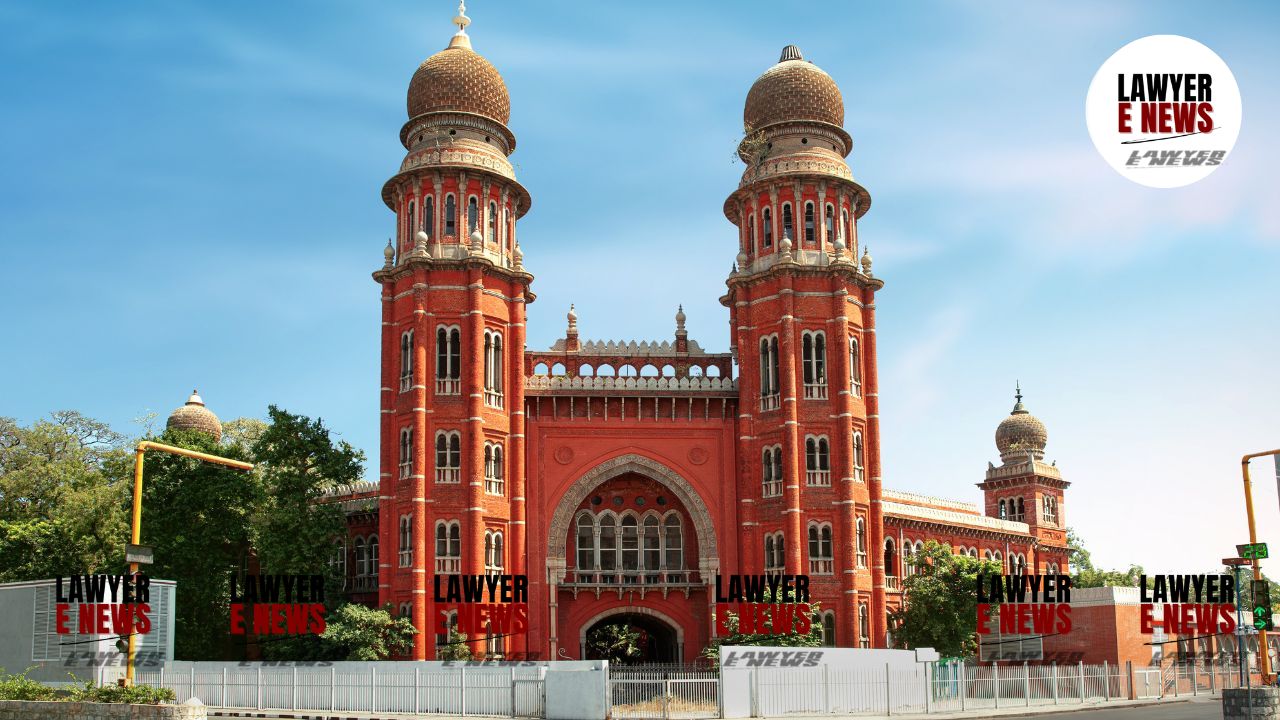
Madras High Court, in a significant ruling, held that Motor Accident Claims Tribunals should allow applications by insurance companies to subpoena Investigating Officers when the insured and the driver are untraceable.
A single bench of Justice Abdul Quddhose observed that if an insurance company is unable to obtain full vehicle particulars despite its best efforts, the interest of justice requires the court to facilitate the summoning of official records to ensure a fair trial.
The petitioner, Tata AIG General Insurance Co. Ltd, filed a Civil Revision Petition challenging an order of the Chief Judge, Small Causes Court, Chennai (Motor Accident Claims Tribunal). The Tribunal had dismissed the insurer's application to subpoena the Investigating Officer of the Bagalur Police Station to produce records of a lorry involved in a 2023 accident. The insurer contended that since the owner and driver of the offending vehicle were not traceable, they were unable to apply for certified copies of the necessary documents through standard channels.
The primary question before the court was whether the Tribunal was justified in rejecting an application for the issuance of a subpoena on the ground that the insurer should independently obtain certified copies. The court was also called upon to determine if the non-traceability of the insured constitutes a valid ground for the court to exercise its power to summon an Investigating Officer and official police records.
Tribunal's Refusal To Issue Subpoena Found Erroneous
The High Court scrutinized the reasoning of the Motor Accident Claims Tribunal, which had suggested that the insurance company could obtain vehicle particulars by applying for certified copies from the concerned authorities. The Tribunal had dismissed the insurer's plea for a subpoena on the assumption that official channels for certified copies remained accessible to the company regardless of the circumstances.
Insurer's Inability To Trace Insured Hindered Document Collection
The Court took note of the petitioner’s submission that despite their best efforts and the appointment of an investigating agency, the insured and the driver of the vehicle remained untraceable. The learned counsel for the petitioner argued that the lack of full particulars made it impossible to apply for certified copies from the authorities, necessitating the assistance of the Tribunal through a subpoena.
Court Finds No Prejudice To Parties In Allowing Subpoena
After considering the submissions, the bench observed that allowing the request for a subpoena would not cause any prejudice to the claimants or any other party involved in the litigation. The Court emphasized that the production of official vehicle records and the testimony of the Investigating Officer are crucial for the proper adjudication of the claim, especially when the vehicle's involvement is in question.
"According to the petitioner, the insured and the driver of the vehicle, who is alleged to have committed an accident, are not traceable. Therefore, this Court is of the considered view that the impugned order has to be set aside."
Direction To Expedite Proceedings In Motor Accident Claims
While allowing the revision petition, the Court also addressed the concerns of the claimants regarding the delay in the disposal of the main claim petition (MCOP). It was noted that the case had been pending since 2024 due to the interlocutory proceedings and the subsequent revision petition. Consequently, the Court found it necessary to balance the insurer's right to evidence with the claimants' right to a timely resolution.
Strict Timeframe Fixed For Disposal Of Claim Petition
The Court directed the Tribunal to issue the summons to the Investigating Officer of Bagalur Police Station to let in oral evidence and produce records pertaining to Crime No. 213 of 2023. To ensure that the proceedings are not further delayed, the High Court issued a mandatory direction for the disposal of the main claim petition within a specific window.
"The Tribunal is also directed to dispose of MCOP.No.3191 of 2024 within a period of six months from the date of receipt of a copy of this order."
The High Court concluded that the Tribunal's rigid stance on certified copies ignored the practical difficulties faced by insurers when dealing with untraceable owners. By setting aside the impugned order, the Court reaffirmed that the power to subpoena is a tool to ensure all relevant evidence is before the Tribunal. The Civil Revision Petition was allowed with a direction to the Registry of the Small Causes Court to list the matter for further directions regarding the subpoena on July 24, 2026.
Date of Decision: 22 June 2026