-
by sayum
23 August 2026 2:56 PM







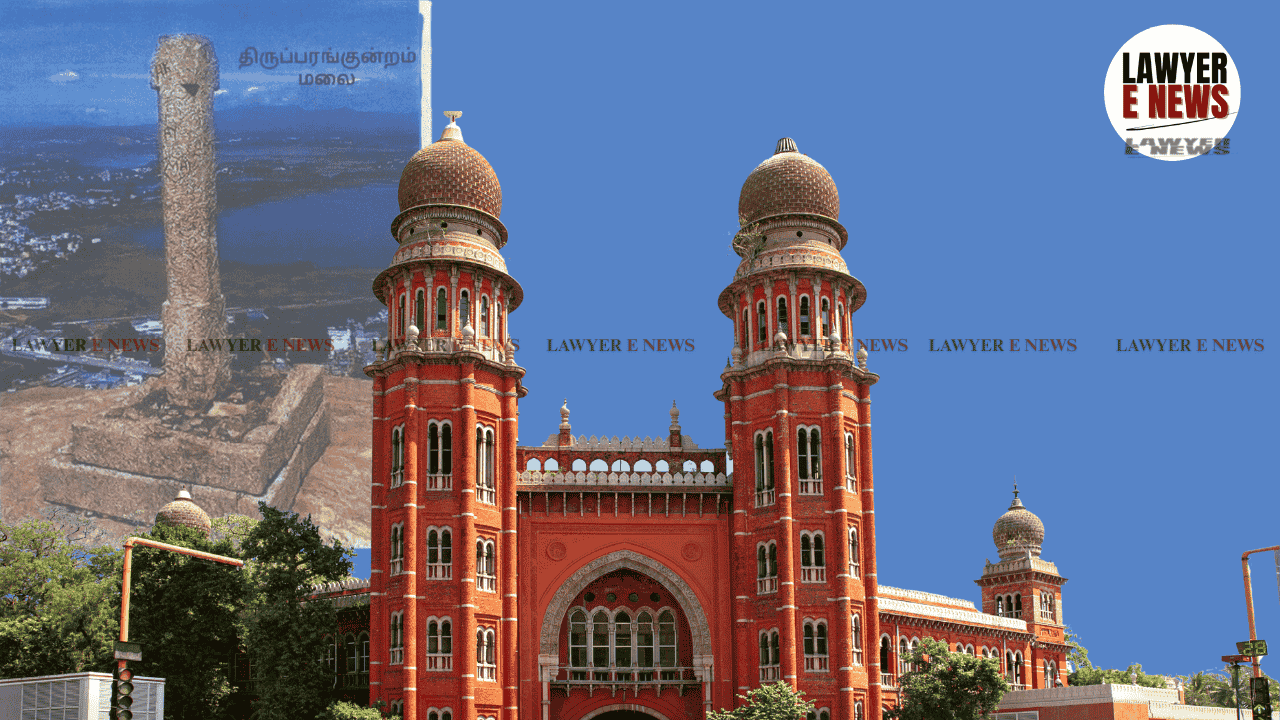
“It is ridiculous and hard to believe the fear of the mighty State that allowing representatives of the Devasthanam to light the lamp at the stone pillar... will cause disturbance to public peace. Of course, it may happen only if such disturbance is sponsored by the State itself.” — In a seminal ruling, the Madurai Bench of the Madras High Court, comprising Dr. Justice G. Jayachandran and Justice K.K. Ramakrishnan, has directed the Thiruparankundram Devasthanam to light the Karthigai Deepam at the ‘Deepathoon’ (Stone Lamp Pillar) situated on the hill, rejecting the State’s apprehension of communal tension with the adjacent Sikkandar Badhusha Dharga.
The Historic Conflict: Temple vs. Dharga
The judgment resolves a century-old dispute concerning the Thiruparankundram Hill, a site of immense religious significance housing the Arulmigu Subramaniyaswamy Temple at the foot and the Sikkandar Badhusha Dharga at the summit. The controversy centered on the location for lighting the ‘Maha Deepam’ during the Karthigai festival. While the State and Dharga representatives argued for the status quo (lighting the lamp at the Uchipillaiyar Temple), devotees sought to restore the tradition of lighting it at the ‘Deepathoon’—a stone pillar located near the Dharga.
The State argued that the pillar was merely a Great Trigonometrical Survey (GTS) stone and that altering the lighting spot would violate the 1920 Civil Court decree and incite communal violence.
“The dispute is not just an enforcement of custom; it is sufficiently demonstrated that it concerns the enforcement of fundamental right of worship and expression.”
Rejection of the ‘Survey Stone’ Theory
The Division Bench undertook a meticulous factual analysis regarding the nature of the stone pillar. While private appellants argued the structure was a British-era survey mark, the Court examined historical records from the Great Trigonometrical Survey of India (1879). The Bench observed that standard survey marks were mere dots surrounded by circles engraved on rock.
In contrast, the subject pillar possessed distinct features—carvings on either end and a bowl shape on top—indicating it was indeed a ‘Deepathoon’ meant for lighting lamps. The Court noted that the HR & CE Department itself did not subscribe to the "survey stone" theory, and the pillar was historically screened with cloth by Devasthanam authorities to prevent devotees from using it, proving it was under Temple control.
Agama Sastras and Customary Rights
The Court dismantled the argument that lighting the lamp at the Deepathoon violated Agama Sastras. The State contended that the lamp must be lit only at the Uchipillaiyar Temple as it aligns with the Sanctum Sanctorum.
Rejecting this, the Bench noted that in other major Shiva temples like Thiruvannamalai and Thiruchirapalli, the deepam is lit at a vantage point visible to the public, not necessarily directly above the deity. The Court held that the Appellants failed to produce "formidable evidence" that Saivite Agamas prohibit lighting a lamp at the Deepathoon.
“We pray no State should stoop to that level to achieve their political agenda.”
State’s ‘Law and Order’ Plea: A Ghost Created by Administration
In a stinging rebuke of the District Administration and Police, the Court termed the fear of communal disturbance as an “imaginary ghost” created for convenience. The Bench observed that the State, instead of bridging the gap between the two communities, had allowed peace meetings to pave the way for widening mistrust.
The Court held that the “peaceful co-existence” touted by the State cannot equate to a complete surrender of religious rights by the devotees. The Bench emphasized that the stone pillar is located on a different rock summit, lower than the Dharga, and within the property declared as Devasthanam land by the Privy Council in 1931.
Bypassing Alternate Remedy
The Court rejected the argument that the writ petitioners should have approached the Joint Commissioner under Section 63(e) of the HR&CE Act to establish custom. The Bench reasoned that since the HR&CE Department and the Government had already "taken a side" and pre-closed their minds against the devotees, relegating the parties to the statutory authority would be a futile exercise—likened to going “from Caesar to Caesar’s wife.”
“The alternate remedy of resorting to the provisions of Act is not efficacious.”
The Final Directions
Dismissing the Writ Appeals filed by the Executive Officer, the District Collector, and the Dharga, the Court issued the following mandatory directions:
1. Mandatory Lighting: The Devasthanam must light the lamp at the Deepathoon.
2. ASI Supervision: The Archaeological Survey of India (ASI) shall impose necessary conditions to preserve the monuments, as the hill is a protected site.
3. Execution: The Devasthanam team shall light the lamp during the Karthigai Deepam festival. No public shall accompany the team; only the team members decided in consultation with the Police and ASI shall be permitted.
4. State’s Duty: The District Collector is directed to coordinate and supervise the event, ensuring "only light and not any fight."
Date of Decision: 06.01.2026