-
by sayum
27 August 2026 3:32 PM







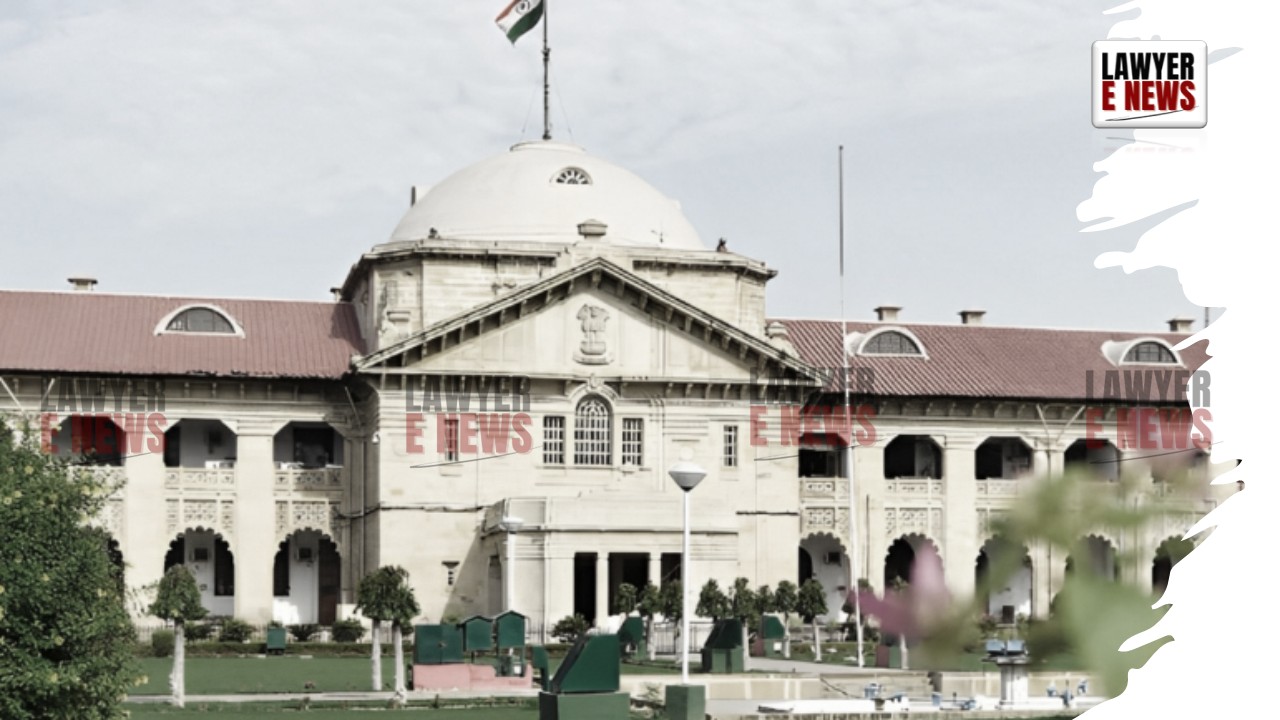
"High Court is not a window shopping forum, and the petitioner has approached this Court numerous times with incorrect and misleading facts and swearing false affidavits... the conduct of the petitioner in suppressing material facts and pursuing parallel remedies, while seeking equitable relief, disentitles him from any indulgence," Allahabad High Court, in a significant ruling, held that a husband is not entitled to claim maintenance from his wife under Section 144 of the Bharatiya Nagarik Suraksha Sanhita (BNSS), 2023.
A bench of Justice Vinod Diwakar observed that Section 144, which replaces Section 125 of the CrPC, primarily contemplates the grant of maintenance to wives, children, and parents, and does not clothe the husband with a reciprocal right to seek sustenance from his spouse. The Court dismissed the petition with an exemplary compensatory cost of ₹15 lakhs for "gross suppression of material facts" and "economic exploitation" of the wife.
The petitioner-husband, a practicing advocate and former construction contractor, approached the High Court seeking a direction to expedite maintenance proceedings he had initiated against his wife under Section 144 BNSS. The wife, serving as an Additional Private Secretary at the High Court, contended that the marriage had been a vehicle for financial exploitation. She alleged that the husband had fraudulently induced her to take personal loans exceeding ₹25 lakhs, which he subsequently transferred to his own accounts and exhausted on a "luxurious and debauched life" involving alcohol.
The primary question before the court was whether a husband is legally entitled to maintain an application for maintenance against his wife under the provisions of Section 144 of the BNSS, 2023. The court was also called upon to determine whether the petitioner’s deliberate concealment of a prior maintenance order under Section 24 of the Hindu Marriage Act (HMA) and his actual financial background warranted the dismissal of his petition with punitive costs.
Legislative Intent Behind Section 144 BNSS
The Court noted that the words of Section 144 BNSS are plain and the legislative intention is explicit. Justice Diwakar observed that the Parliament, in its wisdom, intentionally did not include the word "husband" or "spouse" in the clauses defining who may claim maintenance. The bench emphasized that while certain personal laws may allow a husband to claim maintenance under specific conditions, such a right is certainly not available under the summary and quasi-criminal nature of Section 144 BNSS or its predecessor, Section 125 CrPC.
Husband Cannot Claim Maintenance Under BNSS
The Court cited precedents from the Madras and Hyderabad High Courts to reinforce that Section 125 CrPC (now Section 144 BNSS) was designed as a measure of social justice to prevent vagrancy among vulnerable groups. It held that the legislature did not intend to empower an able-bodied husband to seek maintenance from his wife under this specific chapter. The Court remarked that the husband's attempt to use this provision was legally unsustainable and "frivolous."
"Marriage is not a license for exploitation, but a partnership grounded in equity, good faith, and mutual obligation."
Suppression of Material Facts and "Window Shopping"
The bench took a very serious view of the husband’s conduct in concealing that he was already receiving ₹5,000 per month as maintenance from the wife under Section 24 of the Hindu Marriage Act. The husband had also received ₹10,000 towards litigation expenses in the divorce proceedings. Despite this, he filed a fresh application under BNSS and a subsequent petition in the High Court, swearing false affidavits that no other maintenance case was pending. The Court termed this behavior as "window shopping" for favorable orders.
Economic Abuse and Unjust Enrichment
The Court delved deep into the "insidious" nature of economic abuse within the marriage. It was revealed that the wife was paying monthly EMIs of ₹26,020 for loans the husband had coerced her into taking. The bank statements showed that the husband had transferred almost the entire loan amount to his personal accounts via UPI. The Court observed that the husband, coming from a politically influential and well-off family, had systematically depleted the financial resources of a young professional woman who had secured a government job through hard work.
"Economic abuse within marriage operates in insidious ways through control over income, coercive appropriation of assets, and the gradual erosion of financial independence."
Constitutional Commitment to Dignity
Justice Diwakar noted that legal remedies must evolve to recognize that justice within marriage is materially enforceable. The Court applied the doctrine of "unjust enrichment," stating that no person should benefit at another’s expense without lawful justification. The bench observed that the law cannot remain indifferent when a marital relationship becomes a vehicle for sustained economic and emotional exploitation, especially when one spouse treats the other's income as a personal resource.
Imposition of Exemplary Compensatory Costs
The Court held that the petitioner’s conduct in pursuing parallel remedies and suppressing facts disentitled him from any indulgence. To curb such "vexatious and luxury litigation," the Court dismissed the petition with a compensatory cost of ₹15,00,000 (Fifteen Lakhs). This amount was intended to restore, as far as possible, the economic position of the aggrieved wife who had been burdened with the husband’s debts and unnecessary litigation.
"The compensatory cost may act as a deterrent to vexatious or luxury litigation born out of false pretenses, ego, greed, or resorted to as buying-time tactics."
Final Directions and Perjury Inquiry
The Court directed the Principal Judge, Family Court, Prayagraj, to expedite the divorce proceedings and conclude them within the timeframe specified in Section 21-B of the Hindu Marriage Act. Crucially, the High Court directed the Family Court to conduct an inquiry into the initiation of perjury proceedings against the husband for filing false affidavits. The District Magistrate, Etawah, was ordered to recover the ₹15 lakh cost as arrears of land revenue if the husband failed to deposit it within six weeks.
The Court concluded that the petition lacked bona fides and was a gross abuse of the process of law. It emphasized that marriage is a partnership of equals and the law will intervene to prevent one party from exploiting the other under the guise of marital duty. The ruling serves as a stern warning against the suppression of material facts in matrimonial litigation and clarifies that the summary maintenance provisions under the BNSS are not available to husbands.
Date of Decision: 23 April 2026