-
by sayum
04 August 2026 1:39 PM







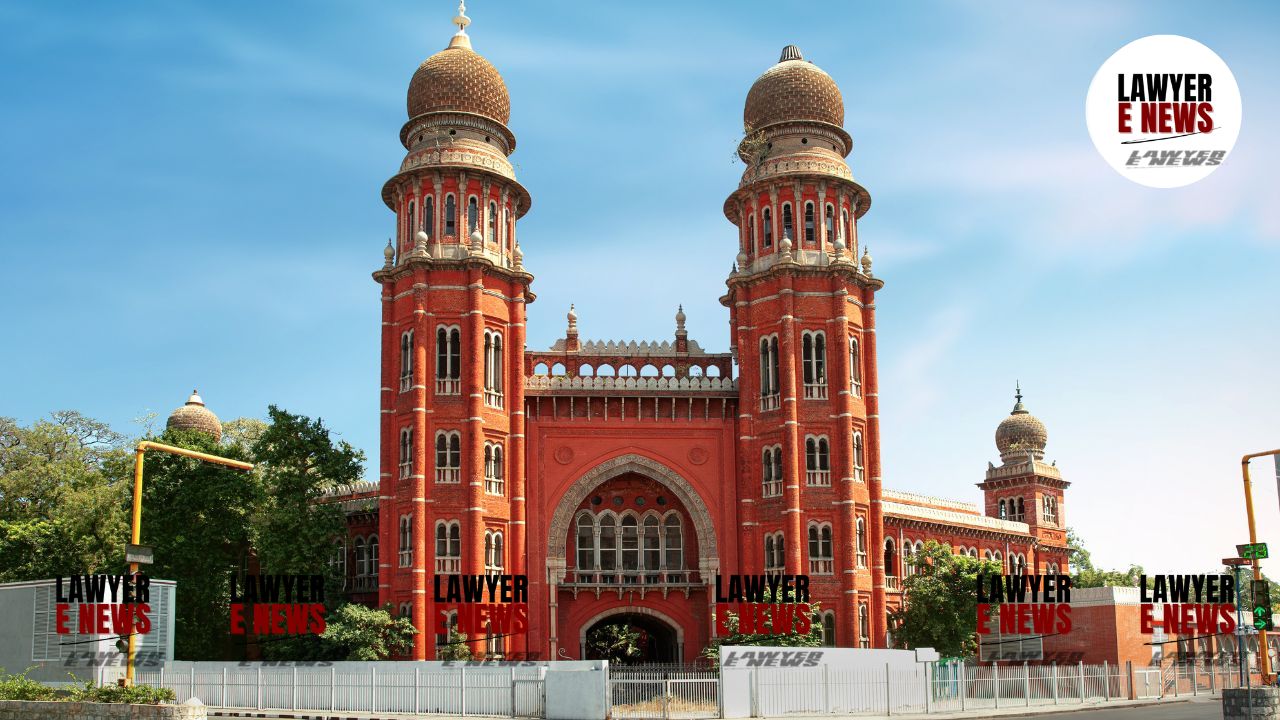
“Court Cannot Proceed Merely on Oral Claims—Tobacco or Nicotine Presence to be Verified by Competent Authorities”, Madras High Court directed the Food Safety and Standards Authority of India (FSSAI) to examine whether the hookah products offered at the petitioner’s restaurant contain tobacco or nicotine. While disposing of the plea, the Court restrained the police from interfering with the lawful functioning of the petitioner’s business unless any illegality is detected.
Justice A.D. Jagadish Chandira clarified that mere suspicion or oral allegations of tobacco usage cannot justify police interference in an ongoing restaurant business offering herbal hookah. The Court firmly stated:
“Whether the petitioner’s hookah contains tobacco or nicotine or not is an issue that has to be determined by the competent authority. This Court cannot proceed merely on the basis of oral submissions.”
Petitioner Claimed Use of Herbal Hookah Without Nicotine—Sought Protection from Police Interference
The petitioner, Rakesh Kumar, runs a restaurant named J.K. Food Company at Nungambakkam High Road, Chennai, and claimed to serve only herbal hookah without any tobacco or nicotine in a designated smoking area. He alleged continuous harassment and threats of closure by local police, who claimed he was selling tobacco products in violation of the Cigarettes and Other Tobacco Products Act, 2003 (COTPA).
His counsel relied on a 2014 Supreme Court order in SLP (C) No. 8143 of 2014, which held that herbal hookah is not banned under COTPA if it does not contain tobacco or nicotine. The petitioner also relied on prior Madras High Court decisions, including W.P. Crl. No. 560 of 2025 and Crl.O.P. No. 23188 of 2025, where courts directed business owners to submit their products for testing by FSSAI instead of facing police action without factual verification.
Police: Restaurant Located Near Educational Institutions—Inspections Based on Public Interest
Responding to the petition, the Government Advocate for the police clarified that no arbitrary interference was made in the petitioner’s business, but that regular inspections were carried out in public interest. The restaurant was situated near multiple educational institutions, and the police claimed concern that minors might be exposed to nicotine or tobacco via hookah products.
They argued that if the petitioner claims his products are free from restricted substances, it is for him to prove that before competent authorities like FSSAI—not the police or the Court.
“Hookah Products Without Nicotine Fall Under Food Safety Act, Not COTPA”: High Court Distinguishes Regulatory Jurisdiction
In a critical observation, the Court held that inhalable products offered through hookah, if free from tobacco and nicotine, fall within the ambit of the Food Safety and Standards Act, 2006 (FSSA), not COTPA.
“The inhalation of smoke derived from any product other than tobacco containing nicotine will also fall within the definition of ‘food’ under Section 2(za) of the Food Safety and Standards Act.”
Hence, if the petitioner’s products are indeed herbal and free of prohibited substances, the matter must be verified by FSSAI, not the police.
Section 4A of COTPA (as Amended by Tamil Nadu) Prohibits Hookah Bars—but Only if Tobacco/Nicotine Is Found
Referring to the Tamil Nadu amendment introducing Section 4A into COTPA via L.A. Bill No. 57 of 2022, the Court observed that hookah bars are banned only if the products involve tobacco or nicotine.
“The petitioner cannot use tobacco or any product containing nicotine in view of the prohibition under Section 4A of the COTPA Act. If he wants to use any product other than that containing nicotine and claims it to be herbal, the same must comply with the Food Safety and Standards Act.”
Direction to FSSAI: Test the Product Before Any Further Action
In line with previous rulings, the Court directed the petitioner to approach FSSAI authorities with all relevant details and ingredients of the hookah products used at his establishment. The Food Safety Officer was instructed to draw samples, test them in a certified laboratory, and determine the presence or absence of tobacco and nicotine.
“If the authorities are satisfied that the products used by the petitioner in their hookah do not contain any tobacco or nicotine, the petitioner is at liberty to continue his business.”
Police Cannot Interfere With Lawful Business—But May Act If Illegality Is Found
The Court issued a clear warning to the police not to interfere in the regular business of the restaurant in the absence of proven illegality. However, it balanced the direction by granting liberty to act if actual violations of the law are detected.
“The respondents shall not interfere with the petitioner’s business. However, it is made clear that the police are always at liberty to take action if any illegal activities are found to be carried on.”
Regulatory Scrutiny Must Be Evidence-Based—Police Cannot Assume Facts Without Testing
This judgment reaffirms the principle that enforcement actions, especially those interfering with business, must be rooted in verified factual findings and not assumptions. Until the FSSAI confirms the presence of prohibited substances, the restaurant cannot be treated as running afoul of COTPA.
The Court’s ruling strikes a balance between public interest and individual business rights, ensuring that statutory bodies like FSSAI play the role of scientific arbiters in such disputes, not the police or courts acting on conjecture.
Date of Decision: 14 November 2025