-
by sayum
04 August 2026 1:39 PM







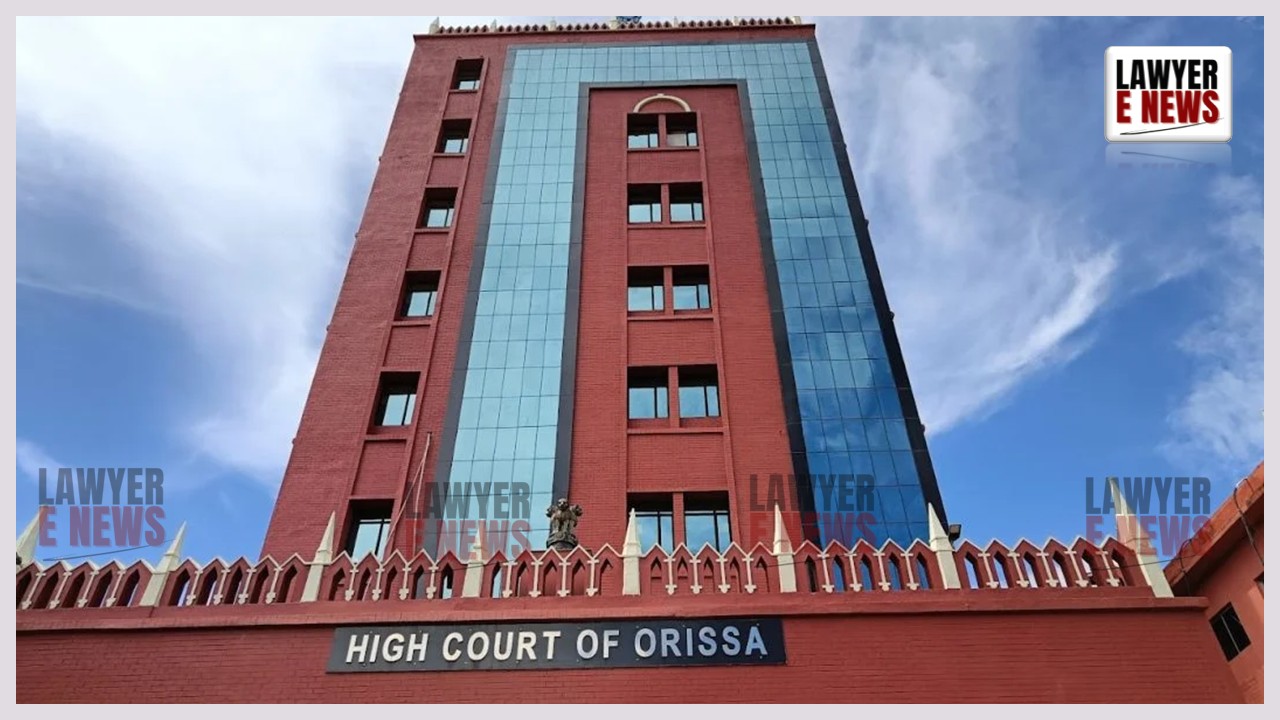
"When a tendering authority misconstrues the essential conditions of the NIT and declares an ineligible bidder as L1, the process is not only flawed—it is violative of Article 14", ruled the Orissa High Court, while allowing a writ petition challenging the award of a tender by National Aluminium Company Limited (NALCO).
In a significant judgment rendered in Vedika Resources v. National Aluminium Company Ltd. [W.P.(C) No. 9039 of 2024], a Division Bench comprising Chief Justice Harish Tandon and Justice Murahari Sri Raman set aside NALCO’s decision to declare Maa Mangala Construction (Opposite Party No. 2) as the L1 bidder in a tender process concerning mechanical cleaning of overhead and underground water tanks. The Court found that the successful bidder failed to meet the pre-qualification criteria, and its selection amounted to arbitrary and unequal treatment, offending constitutional mandates of fairness and transparency.
“Cleaning Sewage Sludge Is Not Similar to Cleaning Drinking Water Tanks”: Court Rejects NALCO’s Justification
The tender floated by NALCO explicitly defined "similar work" under its Pre-Qualification Criteria as “cleaning of overhead tanks/underground reservoirs by mechanical means”. However, the winning bidder, Maa Mangala Construction, had submitted credentials for work related to operation and maintenance of a sewage pump house and wastewater treatment plant, which the Court found did not satisfy the criteria in either nature or value.
As the Court observed: “On bare perusal of documents submitted by the opposite party No.2 ex facie leads to indicate that its work credential does not fall within the scope of definition of the term ‘similar work’.”
Rejecting the contention that cleaning a “zero discharge sump pit” or “sedimented sludge” could be equated with cleaning potable water tanks, the Court reasoned that both works are "distinct in process, purpose, and technical requirement.”
NALCO’s Bid Evaluation Was Arbitrary, Violated Article 14; Judicial Review Warranted
While reiterating the limited scope of judicial review in contractual matters, the Court nonetheless held that courts are duty-bound to interfere when the decision-making process is irrational, arbitrary, or unfair.
Citing Tata Cellular v. Union of India [(1994) 6 SCC 651] and Banshidhar Construction Pvt. Ltd. v. Bharat Coking Coal Ltd. [(2024) SCC OnLine SC 2700], the Bench stated:
“It is well-settled that while the Government enjoys the freedom of contract, that freedom must be exercised within the bounds of reasonableness and non-arbitrariness. The decision-making process is subject to judicial review if it fails the test of fairness and transparency.”
The Court found that NALCO’s Technical Evaluation Committee, while re-evaluating the credentials of Opposite Party No.2, had erroneously matched the sewage-related work with the tender’s scope, despite the value of submitted work being only ₹57,518, far below the minimum threshold of ₹17.36 lakhs stipulated in the NIT.
Further, the Committee’s acceptance of a non-conforming bid for one party, while not extending similar benefit to others, was found to be a "blatant deviation from equal treatment."
Terms of NIT Are Not Redundant or Optional — They Are the Backbone of Equal and Transparent Bidding
In its detailed reasoning, the Court emphasized that the essential conditions of a tender are not to be treated as procedural niceties. They are "mandatory requirements that uphold the integrity of public procurement.”
The judgment reiterates the principle laid down in Vidarbha Irrigation Development Corporation v. Anoj Kumar Agarwala [(2020) 17 SCC 577], where the Supreme Court observed:
“The requirements in a tender notice can be classified into two categories—those which are essential conditions of eligibility and the others which are ancillary. In the first case, the authority issuing the tender must enforce them rigidly.”
The Court thus concluded that NALCO's deviation from the defined tender terms, by accepting credentials that were neither technically nor financially compliant, rendered the process arbitrary and legally unsustainable.
“Acceptance of Ineligible Bidder Defeats Public Interest and the Purpose of the NIT”
Striking at the heart of public contracting, the Court highlighted the broader implications of administrative discretion exercised without accountability. It said:
“Allowing a bidder with non-conforming experience to qualify offends equality and fairness. Acceptance of such a bid defeats purpose of tender conditions and affects public interest.”
Citing Jagdish Mandal v. State of Orissa [(2007) 14 SCC 517], the Court held that judicial intervention is warranted where:
The decision-making process is arbitrary or intended to favour someone;
The process is so irrational that no reasonable authority would have arrived at such a conclusion; or
Public interest is adversely affected.
All three were found satisfied in the instant case.
Court Orders Re-evaluation of Bids, Sets Aside L1 Declaration
Accordingly, the Court allowed the writ petition and passed the following directions:
“The declaration of Opposite Party No.2 as L1 bidder is hereby quashed. NALCO is directed to re-evaluate the technical bids strictly in accordance with the Pre-Qualification Criteria laid down in the Notice Inviting Tender. No order as to costs.”
In its closing remarks, the Court warned against relaxed interpretation of essential conditions, observing that transparency and rule-based evaluation are the “bedrock of public procurement under a constitutional democracy.”
The Orissa High Court’s ruling in Vedika Resources v. NALCO sends a strong message that government contracts cannot be manipulated by vague interpretations of technical criteria. When tender terms explicitly define eligibility, subjective equivalence or internal adjustments—especially when used to favour a particular bidder—cannot withstand judicial scrutiny.
In a procurement ecosystem often plagued by procedural irregularities, this decision reaffirms that Article 14 does not stop at the door of administrative discretion, particularly when public money and public interest are at stake.
Date of Decision: 20 November 2025