
-
by sayum
26 August 2026 1:49 PM







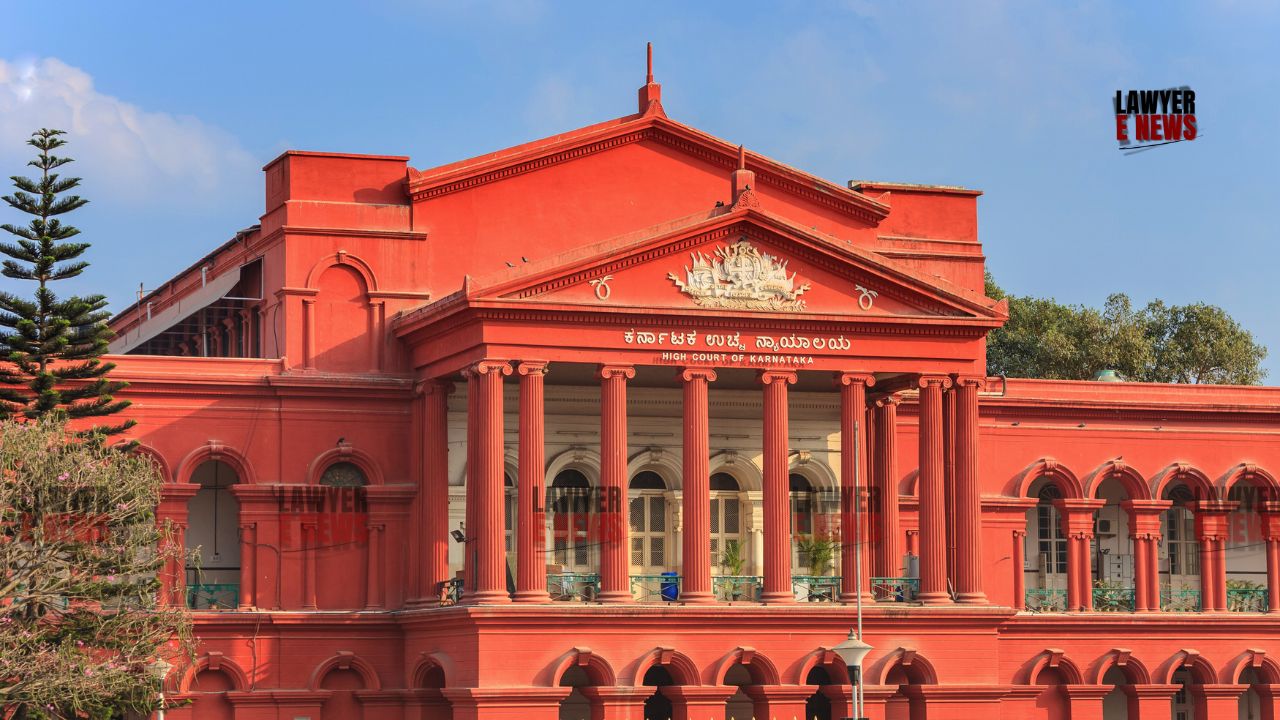
"Enforcement Directorate cannot resort to action against any person for money laundering on an assumption that the property recovered must be proceeds of crime", In a significant ruling that places firm constitutional guardrails on the sweeping freezing powers exercised by the Directorate of Enforcement under the Prevention of Money Laundering Act, 2002, the Karnataka High Court has upheld a Single Judge's direction permitting Zo Private Limited — a wholly owned subsidiary of Winzo Games Private Limited — to pay salaries to its 220 employees from frozen bank accounts, holding that the entire amount in the accounts of a company cannot be treated as "proceeds of crime" when the sole surviving predicate offence involves a mere Rs.42 Lakhs.
Division Bench of Hon'ble Mrs. Justice Anu Sivaraman and Hon'ble Mr. Justice Vijaykumar A. Patil dismissed the Enforcement Directorate's writ appeal on 9th March, 2026, with a further finding that clinched the case: the Adjudicating Authority under Section 8 of the PMLA has no power to order a partial defreeze for payment of salaries, making the exercise of the Single Judge's discretion under Article 226 not merely permissible but necessary.
The ruling invokes the Supreme Court's landmark constitutional bench judgment in Vijay Madanlal Choudhary v. Union of India (2023) to remind the Enforcement Directorate that the expression "proceeds of crime" is not a blank cheque — it is a tightly defined statutory concept that must be strictly and demonstrably linked to a registered predicate offence, and cannot be stretched on the assumption that future FIRs may emerge.
Background of the Case
Winzo Games Private Limited, a prominent real money gaming company, came under the scrutiny of the Enforcement Directorate in November 2025, when an Enforcement Case Information Report was registered against it on the basis of multiple FIRs filed in different States alleging cheating, forgery, conspiracy and fraud in connection with the company's real money gaming operations. The Directorate conducted searches under Section 17 of the PMLA between 18th November and 22nd November, 2025 and again on 30th December, 2025.
The investigation allegedly revealed that Winzo Games had generated total proceeds of crime amounting to Rs.3,522.05 Crores across financial years 2021-22 to 2025-26 — a figure that the respondent strenuously challenged and which a Sessions Court, even at the bail stage of Winzo's Director Paavan Nanda, noted was not supported by clear-cut material. A Prosecution Complaint was filed before the designated Special PMLA Court in Bengaluru on 23rd January, 2026.
Zo Private Limited, the respondent, is a wholly owned Indian subsidiary of Winzo Games and has no direct role in any of the predicate offences alleged. Winzo Games had advanced unsecured inter-corporate loans to Zo Private Limited through Board Resolutions dated 13th July, 2023, 7th August, 2025 and 24th November, 2025 — for legitimate business operations including meeting salary obligations. Of Rs.255 Crores advanced, Rs.231.20 Crores remained outstanding. The Directorate contended that these loans represented a diversion and dissipation of proceeds of crime from Winzo to its subsidiary, and on 30th December, 2025, froze Zo Private Limited's bank accounts under Section 17(1A) of the PMLA in respect of assets of approximately Rs.690 Crores.
Zo Private Limited challenged the freezing order before the Single Judge under Article 226. The Single Judge declined to interfere with the freezing order itself but directed the Directorate to verify a list of employees and communicate to the bank to permit salary payment for January 2026. The Directorate appealed only that limited direction before the Division Bench.
By the time the matter came up before the Division Bench, the position had become even starker for the Directorate. Three of the four original FIRs relied upon had ended in either quashing or acceptance of closure reports. The sole surviving FIR — registered by the Cyber Crime Police Station, Gurugram, against Winzo for alleged algorithmic manipulation and digital deception in real money games — involved a complainant who had suffered a loss of approximately Rs.42 Lakhs.
Legal Issues and Court's Observations
'Proceeds of Crime' Cannot Be Presumed — Strict Statutory Linkage Required
The central legal question was whether the Directorate could maintain that the entire amount in the accounts of Zo Private Limited constituted "proceeds of crime" under Section 2(1)(u) of the PMLA, when the only live predicate offence involved a cheating allegation of Rs.42 Lakhs and carried no allegation whatsoever against Zo Private Limited itself.
The Court reproduced and applied the Supreme Court's definitive exposition in Vijay Madanlal Choudhary v. Union of India (2023), where the constitutional bench had held that "proceeds of crime" must be strictly construed — only property derived or obtained, directly or indirectly, as a result of criminal activity relating to a scheduled offence can qualify. Critically, the Supreme Court had held: "The authorities under the 2002 Act cannot resort to action against any person for money laundering on an assumption that the property recovered by them must be proceeds of crime and that a scheduled offence has been committed, unless the same is registered with the jurisdictional police or pending enquiry by way of complaint before the competent forum."
The Supreme Court in Vijay Madanlal Choudhary had further held that if a person is finally discharged or acquitted of the scheduled offence, or the criminal case against him is quashed, there can be no action for money laundering in relation to the property linked to that offence — reinforcing the strict dependency of money laundering proceedings upon a living, surviving predicate offence.
The Division Bench applied these principles with precision. There is no allegation of any kind against Zo Private Limited in any of the FIRs. The sole surviving FIR against the parent entity Winzo involves a cheating amount of approximately Rs.42 Lakhs. It is not the Directorate's own case that Rs.42 Lakhs was utilised by Winzo or Zo to generate the hundreds of crores now frozen. The Directorate's candid position — that the entire amount must be held frozen in anticipation of future FIRs that may be filed — received short shrift from the Court.
"The contention of the appellant is clearly that there may be other amounts which would answer the definition of 'proceeds of crime', if more FIRs are registered and that therefore, the entire amount in account of the respondent is to be held hostage for further FIRs that are likely to be filed," the Court observed pointedly, making clear that this argument was wholly inconsistent with the statutory scheme and the Supreme Court's binding pronouncements.
The Adjudicating Authority's Crucial Limitation — No Power for Partial Defreeze
A critical finding that determined the outcome of the appeal was the admitted position before the Court: the Adjudicating Authority constituted under Section 8 of the PMLA has no power to issue interim directions or to order payments from amounts frozen under Section 17(1A). This admission by the Directorate itself proved fatal to its appeal.
The Directorate's primary argument was that the Single Judge ought not to have granted any interim relief when the respondent had been relegated to the statutory remedy before the Adjudicating Authority — relying on the Supreme Court's recent ruling in Mangal Rajendra Kamthe v. Tahsildar, Purandhar (2026), which holds that a constitutional court cannot grant interim relief alone when it relegates parties to statutory remedies.
The Division Bench distinguished Mangal Rajendra Kamthe on a critical factual distinction: in that case, the statutory authority to which the party was relegated had the power to deal with the situation and grant the relief sought. In the present case, the Adjudicating Authority has no such power — it cannot order a partial defreeze to enable salary payments. The employees of Zo Private Limited had absolutely no alternative forum, no statutory mechanism, and no remedy other than the High Court's jurisdiction under Article 226 of the Constitution of India.
Referring to the Supreme Court's ruling in OPTO Circuit India Ltd. v. Axis Bank (2021), the Court noted that where freezing of accounts is in question under the PMLA, the statutory framework itself contemplates fairness of procedure and protection of the rights of persons proceeded against — and where the statutory authority is powerless to address an urgent human situation such as non-payment of salaries, the High Court's discretion under Article 226 is not merely available but warranted.
"Since the issue of payment of salaries from the frozen accounts could not have been considered by the Adjudicating Authority, we are of the opinion that the exercise of discretion by the learned Single Judge cannot be said to be incorrect," the Division Bench held.
The Human Cost: 220 Employees' Livelihoods at Stake
The Court also took note of a deeply practical dimension: Zo Private Limited's accounts were frozen on 30th December, 2025; the accounts of parent entity Winzo Games were attached on 21st November, 2025; and the accounts of Winzo USA and Winzo Singapore were also subsequently frozen on 17th February, 2026. With every source of funds comprehensively frozen, 220 employees of Zo Private Limited faced the prospect of receiving no salaries whatsoever — not because of any wrongdoing on their part or on the part of the company they worked for, but because of enforcement action directed primarily at the parent entity arising from a complaint involving Rs.42 Lakhs.
The Court's upholding of the salary direction reflects a judicial recognition that the machinery of money laundering enforcement, however vital in its purpose, cannot be permitted to operate as a blunt instrument that sacrifices the economic welfare of ordinary employees on the altar of investigative imperatives.
Decision
Dismissing the Directorate's appeal, the Karnataka High Court has delivered a ruling of considerable importance for the law governing PMLA freezing orders. It consolidates two propositions: first, that "proceeds of crime" must be strictly and demonstrably linked to a registered predicate offence and cannot be presumed or projected into the future on the basis of potential investigations; and second, that where the statutory adjudicatory mechanism under the PMLA is itself powerless to provide relief — such as permitting salary payments from frozen accounts — the jurisdiction of the High Court under Article 226 is not ousted, and the exercise of judicial discretion in such circumstances is neither perverse nor unwarranted.
Date of Decision: 9th March, 2026





