-
by sayum
27 July 2026 3:39 PM







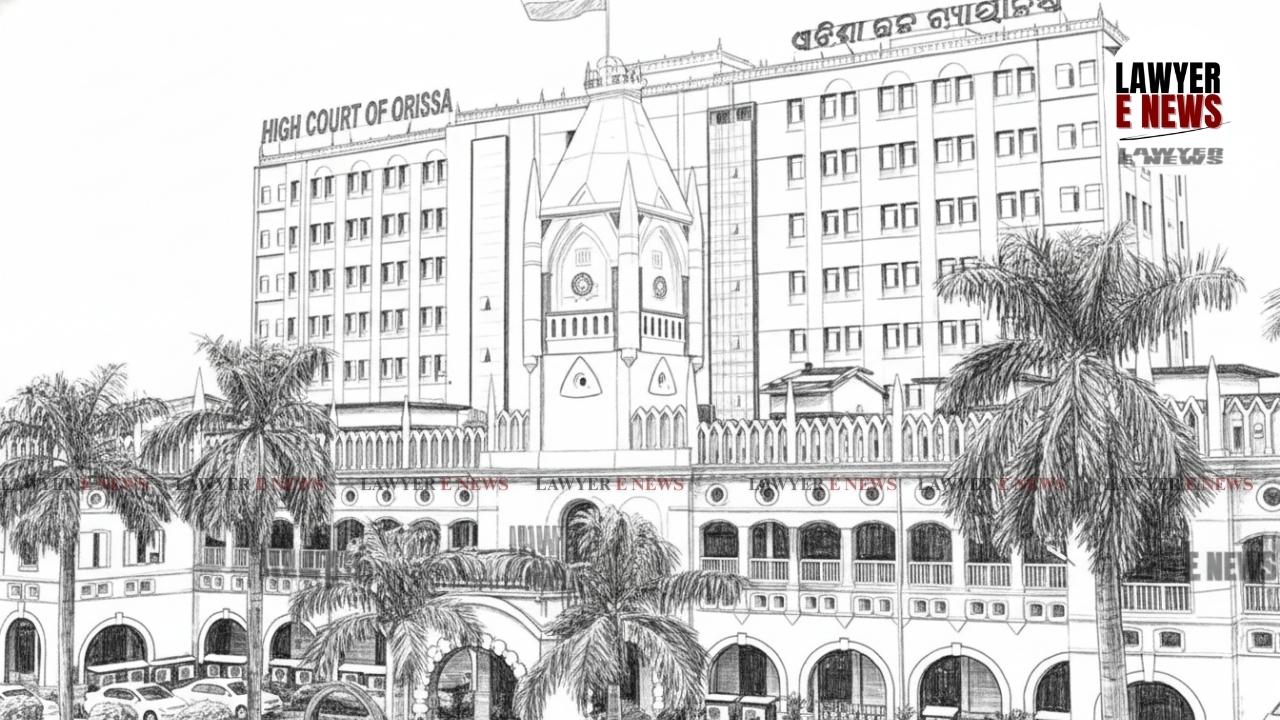
"Relying solely on unproven documentary evidence is legally insufficient and can render the enquiry findings as perverse," High Court of Orissa, in a significant judgment, held that dismissing a bank employee for negligence without proving misappropriation or direct financial loss is grossly disproportionate.
A single-judge bench of Justice R.K. Pattanaik observed that departmental inquiries must not be treated as an empty formality and must strictly adhere to the principles of natural justice and fair play.
The petitioner, who had served the bank for nearly 25 years, challenged his dismissal which was based on allegations of unauthorized absence, delayed inspections, and the creation of Non-Performing Assets (NPAs) through gold loans. The Court found that the internal inquiry was conducted in extreme haste and lacked the necessary evidentiary support to sustain the major penalty of removal from service.
The petitioner joined the Kalinga Gramya Bank (then Cuttack Gramin Bank) in 1978 and was later promoted to Field Supervisor. In 2003, he was served with a chargesheet alleging negligence in duties and unauthorized absence, leading to his dismissal from service in March 2003. This order was subsequently confirmed by the Appellate Authority in November 2003, prompting the petitioner to approach the High Court.
The primary question before the court was whether the disciplinary inquiry was conducted in accordance with the service regulations and principles of natural justice. The court was also called upon to determine if the penalty of dismissal was proportionate to the charges of negligence, especially when no management witnesses were examined to prove the documentary evidence.
The Court observed that the disciplinary proceedings were concluded with uncharacteristic haste, denying the petitioner a fair opportunity to defend himself. It noted that the petitioner was served with the list of witnesses and documents only on May 8, 2003, and the inquiry was concluded just four days later on May 12, 2003.
Inquiry Conducted In Haste Violates Principles Of Natural Justice
The bench emphasized that once a delinquent officer receives the relevant documents, they should be allowed at least fifteen days to submit a reply. In this case, the Enquiry Officer closed the proceedings citing a lack of response, even though the petitioner was on medical leave. The Court remarked that expecting a written defense within such a short timeframe was unreasonable and legally untenable.
Documents Must Be Proved Through Witnesses Even In Ex-Parte Inquiries
A critical legal point raised by the Court was the failure of the management to examine witnesses. The inquiry report revealed that eight documents were marked as exhibits by the Presenting Officer without any oral testimony from bank officials. The Court held that a document cannot be accepted as absolute proof unless its contents are corroborated through oral evidence, even in a departmental action.
"In a domestic enquiry, it is generally mandatory to examine Management witnesses to prove the charges if the delinquent employee denies the allegations levelled."
The Court further noted that the Disciplinary Authority adopted a casual and "lackadaisical" approach by claiming to have gone through oral evidence when none was actually adduced. It held that the authority must independently examine the materials on record and assign specific reasons for its findings on each charge rather than simply concurring with the Enquiry Officer.
Non-Application Of Mind By Disciplinary And Appellate Authorities
Regarding the financial allegations, the Court found that while the petitioner was accused of creating NPAs by accepting spurious gold, there was no evidence of misappropriation or direct loss caused to the bank. The bench noted that the charges pertained to negligence and carelessness rather than grievous financial irregularities or theft.
Dismissal Disproportionate For Negligence Without Misappropriation
The Court referred to the doctrine of proportionality, stating that punishment must commensurate with the gravity of the misconduct. It observed that the petitioner had a long service record of 25 years and had only been warned once before. The bench concluded that for the nature of the negligence alleged, the extreme penalty of dismissal was "hugely disproportionate."
"For the negligence of the petitioner without any such serious financial regularities committed by him, the punishment of dismissal from the service is hugely disproportionate."
The Court also addressed the petitioner's argument regarding the non-issuance of a second show-cause notice. Relying on Supreme Court precedents, the bench clarified that following the 42nd Constitutional Amendment, there is no mandatory requirement to issue a second show-cause notice at the punishment stage unless the specific service regulations of the organization require it.
In its final directions, the High Court set aside the dismissal orders passed by the Disciplinary and Appellate Authorities. It directed the bank to reinstate the petitioner with notional continuity of service up to the date of his superannuation. The Court further ordered the release of all pensionary and terminal benefits in favor of the petitioner as per the rules.
Date of Decision: 19 June 2026