-
by sayum
05 August 2026 3:07 PM







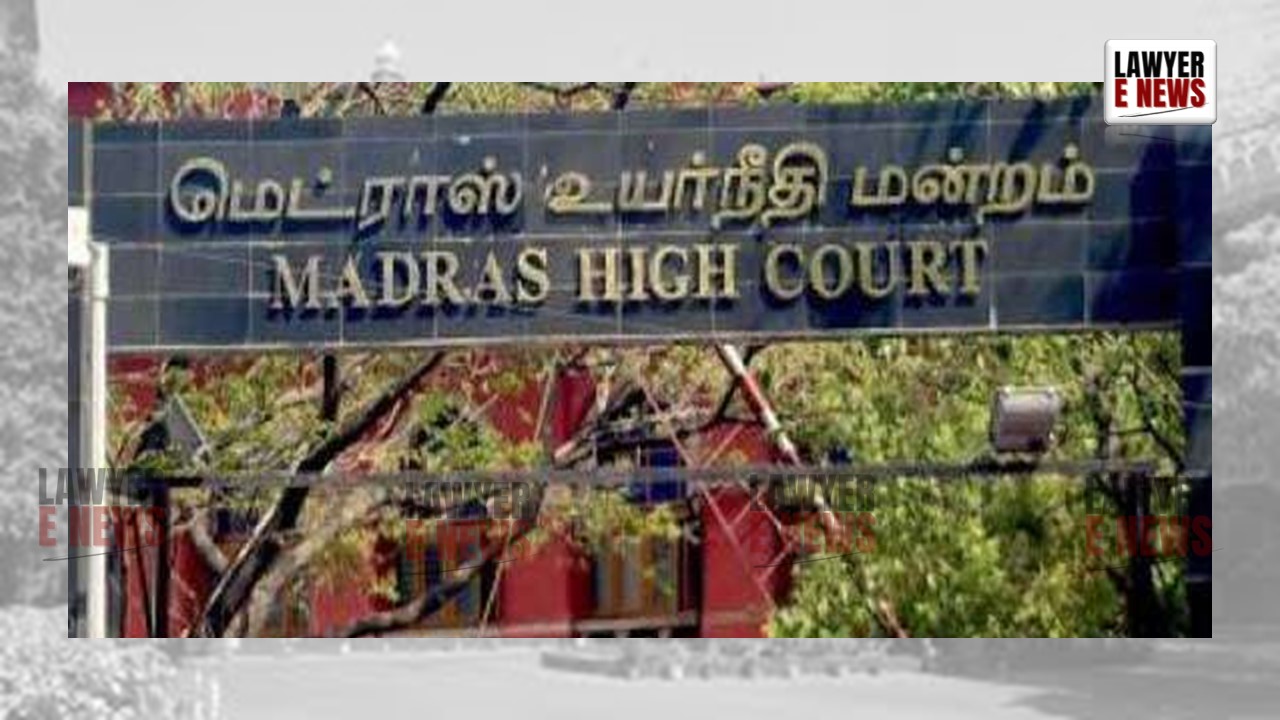
“A Holograph Will Written in the Hand of a Retired Sheristadar, Registered with Attesting Witnesses, Commands Strong Presumption of Validity” – Madurai Bench of the Madras High Court delivered a significant judgment reaffirming the evidentiary sanctity of registered holograph Wills, holding that disinheritance of legal heirs by itself does not create a suspicious circumstance. Dismissing Second Appeal , Justice G. Arul Murugan upheld the concurrent findings of the Trial Court and the First Appellate Court, which had decreed eviction against a son disinherited through a registered Will executed by his father.
The Court ruled that the Will executed by a retired Sheristadar of the District Court, written in his own hand, registered at Madurai and duly attested by independent witnesses, had been validly proved and was free from any legal infirmities.
Justice Arul Murugan observed: "Mere exclusion of natural heirs does not ipso facto render a Will suspicious. The Will in question is a registered holograph Will, executed in full consciousness and attested by trustworthy witnesses. No valid suspicious circumstances have been established."
“The Law Does Not Demand Equal Inheritance — The Testator’s Intention Is Supreme”
The litigation arose after the original plaintiff, R. Sankaralingam, filed a suit for eviction and damages against his first son, alleging unlawful occupation of a residential portion in Tirunelveli. Following his death during the pendency of the suit, his second wife and two daughters, impleaded as plaintiffs 2 to 4, continued the suit relying on a registered Will dated 18.09.2012, through which Sankaralingam excluded all eight children born through his first wife, and bequeathed the property exclusively to his second wife and their two daughters.
Challenging the Will, the first defendant argued that disinheritance of eight children without explanation was inherently suspicious. The Court disagreed, declaring:
“The very purpose of a Will is to alter the ordinary line of succession. If every disinheritance is to be treated as suspicious, no Will can survive legal scrutiny.”
Justice Arul Murugan cited the Supreme Court’s ruling in Dhanpat v. Sheo Ram [(2020) 16 SCC 209], noting: “So natural heirs would be debarred in every case of a Will; of course, it may be that in some cases they are fully debarred and in others only partially.”
He added: “Courts cannot apply Article 14 to private Wills. Equity and equality have no constitutional application in a testator’s personal choice.”
“A Handwritten, Registered Will by an Experienced Retired Officer Deserves High Presumption of Genuineness”
The Will in question was entirely written by the testator himself—what the law recognises as a holograph Will. It was signed and registered at the Sub-Registrar’s Office in Madurai in the presence of two attesting witnesses.
Dismissing the objection regarding execution at Madurai rather than Tirunelveli, the judge ruled:
“A testator is free to execute and register a Will at a place of his choosing. Registration at Madurai does not introduce any suspicion, especially when the execution and attestation are otherwise fully compliant with statutory requirements.”
Drawing from Joyce Primrose Prestor v. Vera Marie Vas [1996 (9) SCC 274], the Court highlighted that holograph Wills carry a higher presumption of authenticity:
“The mind of the testator in physically writing out his own Will is more apparent in a holograph Will than where his signature alone appears to a script typed or written by someone else.”
The Will was proved by two attesting witnesses, both of whom deposed that the testator had signed the Will in their presence and that they had signed it in his presence. One witness, PW-3, was a retired college principal, and the other, PW-4, was a brother-in-law of the second plaintiff. Despite the defence alleging that these witnesses were “interested,” the Court firmly held:
“Neither attestor was a beneficiary under the Will. Their testimony was consistent, credible, and supported by registration. No contradiction or bias was established.”
“Family Litigation, Strained Relationships, and Independent Witnesses – All Weigh in Favour of the Will’s Validity”
The Court noted that the testator had a long-standing strained relationship with the children from his first marriage, and this was evident from:
An earlier partition suit filed by his second wife’s daughters;
The fact that none of the other disinherited heirs contested the Will or even filed a written statement;
The ongoing eviction proceedings initiated by the testator himself during his lifetime against his own son.
Justice Murugan observed: “The testator’s decision to exclude those with whom he shared no cordiality, and to benefit those who lived with and cared for him, cannot be faulted. These facts explain the bequest—not invalidate it.”
He also rejected arguments that mere proximity of witnesses to the plaintiffs made their evidence suspect:
“It is customary for testators to call trusted friends or relatives as attesting witnesses. Unless there is evidence of undue influence or fraud, such relationships do not invalidate their testimony.”
“Concurrent Findings of Trial and Appellate Courts Stand – No Substantial Question of Law Arises”
Both the Trial Court and the III Additional District Court, Tirunelveli (First Appellate Court) had decreed eviction in favour of the plaintiffs, upholding the Will’s validity.
Justice G. Arul Murugan concluded that the lower courts had correctly appreciated both oral and documentary evidence, including judgments in prior litigation where the title of the first plaintiff was upheld. The High Court found no perversity or illegality in their reasoning:
“The courts below have rightly considered the evidence and held that the Will was proved in accordance with Sections 63 of the Indian Succession Act and 68 of the Indian Evidence Act. No substantial question of law arises.”
The Second Appeal was dismissed, and the eviction decree stood confirmed.
The judgment underscores a vital legal principle: Wills are instruments of personal volition, and so long as they are executed and attested in compliance with the law, courts must not impose their notions of fairness or equality upon the testator’s choices. A handwritten, registered Will, executed in the presence of credible attesting witnesses and backed by prior litigation history, will be sustained even when it deviates from traditional lines of inheritance.
Justice G. Arul Murugan's ruling reinforces that testamentary autonomy prevails over familial expectations, and that law protects intention over sentiment.
Date of Decision: 16 July 2025