-
by sayum
28 July 2026 7:02 AM







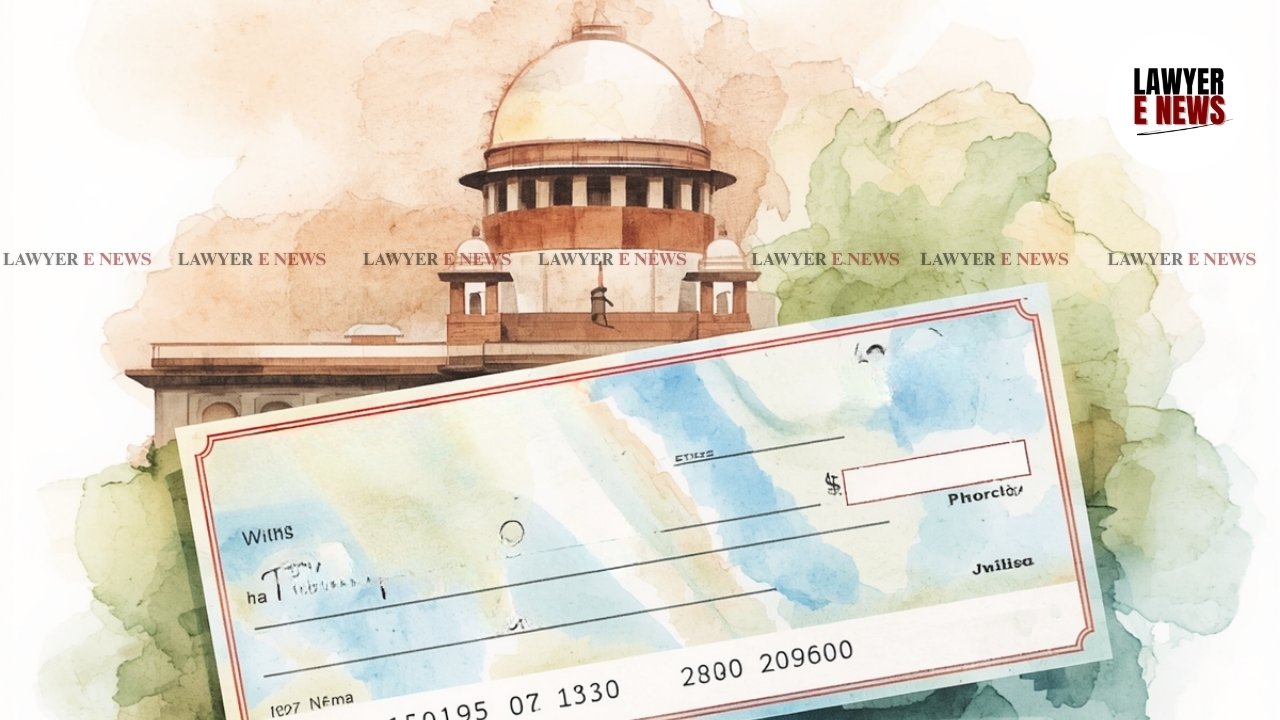
"Expression 'amount of money is insufficient' is a genus and dishonour for reasons such as 'signatures do not match' or 'image is not found' are only species of that genus," Supreme Court, in a landmark ruling, held that the dishonour of a cheque due to a mismatch of signatures or incomplete signatures constitutes an offence under Section 138 of the Negotiable Instruments Act (NI Act). A bench comprising Justice T.S. Thakur and Justice Gyan Sudha Misra observed that a narrow or literal interpretation of the statute would defeat the legislative object of ensuring credibility in banking operations. The Court clarified that any deliberate act of omission or commission by the drawer which results in the cheque being returned unpaid falls within the ambit of criminal liability.
The appellant, a proprietorship firm, supplied chemicals to the respondent-company and was owed approximately Rs. 4.91 crores. To discharge this liability, the respondent issued 117 post-dated cheques, which were subsequently dishonoured by the bank on the grounds that the signatures were "incomplete," "no image was found," or the "signatures did not match." The Gujarat High Court quashed 40 complaints filed by the appellant, relying on the Vinod Tanna precedent to hold that Section 138 is only attracted by insufficiency of funds or exceeding the arranged credit limit.
The primary question before the Court was whether the dishonour of a cheque for reasons other than the two contingencies expressly mentioned in Section 138 of the NI Act attracts criminal liability. The Court was also called upon to determine if a mismatch in signatures, often resulting from a change in the mandate of authorised signatories, falls within the statutory scope of "insufficiency of funds."
Purposive Interpretation Of Section 138 NI Act
The Court emphasised that Chapter XVII of the NI Act was intended to promote the efficacy of banking operations and the credibility of negotiable instruments. The bench noted that while Section 138 is a penal provision, it is also remedial in nature. Therefore, a construction that would render the law a "dead letter" or "otiose" must be avoided by the judiciary.
The bench relied on the principle that if more than one construction is possible, the Court must choose the one that preserves the workability of the statute. Quoting Lord Denning, the Court remarked that a judge must "iron out the creases" to give force and life to the intention of the legislature, rather than folding their hands when a defect in language appears.
"Insufficiency Of Funds" As A Genus Of Dishonour
Court Explains Scope Of Statutory Contingencies
The Court held that the expression "amount of money is insufficient" appearing in Section 138 is a genus, of which various reasons for dishonour are species. It observed that just as "account closed" or "stop payment" have been judicially recognized as offences under Section 138, a "signature mismatch" also implies a failure to honour the instrument.
The bench noted that there is no qualitative difference between a drawer closing an account and a drawer changing their specimen signature to ensure a cheque is returned. "So long as the change is brought about with a view to preventing the cheque being honoured, the dishonour would become an offence under Section 138," the Court observed.
Overruling Narrow Precedents and Clarifying Law
High Court’s Reliance On Vinod Tanna Held Misplaced
The Supreme Court found that the Gujarat High Court’s reliance on Vinod Tanna & Anr. v. Zaher Siddiqui was incorrect. That decision was based on a precedent that had already been overruled by a three-judge bench in Modi Cements Ltd. v. Kuchil Kumar Nandi. The bench clarified that the net effect of existing law is that dishonour on account of "stopped payment" or other technical failures caused by the drawer attracts Section 138.
The Court highlighted that the statute provides a safeguard in the form of a 15-day notice period. If a signature mismatch occurs due to an ordinary change in business mandate, the drawer has the opportunity to arrange payment after receiving the statutory notice. Failure to pay within this period, despite the opportunity, solidifies the criminal liability.
Liability Of Authorised Signatories Under Section 141
Signatories Cannot Escape Prosecution By Resigning
Regarding the respondents' argument that the signatories had resigned before the dishonour, the Court held that authorised signatories are clearly responsible for the incriminating act. Citing National Small Industries Corporation Ltd. v. Harmeet Singh Paintal, the bench affirmed that signatories of a dishonoured cheque are covered under Section 141(2) of the NI Act.
The bench noted that whether the cheques were issued for an amount in excess of what was payable or if fraud was involved are matters for trial. Such factual disputes cannot be investigated by a High Court under Section 482 of the CrPC. The statutory presumption under Section 139 remains that the cheque was issued for a valid consideration unless proven otherwise.
Concurring Opinion on Rebuttable Presumption
Harmonious Construction Of Sections 138 and 139
In her concurring opinion, Justice Gyan Sudha Misra highlighted that while "stop payment" or "signature mismatch" constitutes an offence, the presumption under Section 139 is rebuttable. She noted that the legislature intends to punish those who issue cheques knowing they lack funds—amounting to cheating—not those with bona fide disputes.
Justice Misra observed that in cases of "stop payment" where sufficient funds exist, the burden lies heavily on the accused to prove a valid cause, such as the absence of a legally enforceable debt. The standard of proof for such rebuttal is the "preponderance of probabilities," as established in the Rangappa v. Sri Mohan case.
The Supreme Court allowed the appeals, set aside the High Court's orders, and dismissed the applications for quashing the complaints. The trial court was directed to proceed with the cases expeditiously. The ruling cements the principle that technical discrepancies in signatures cannot be used as a shield to bypass the penal consequences of the Negotiable Instruments Act.
Date of Decision: 27 November 2012