
-
by sayum
26 October 2026 4:04 PM







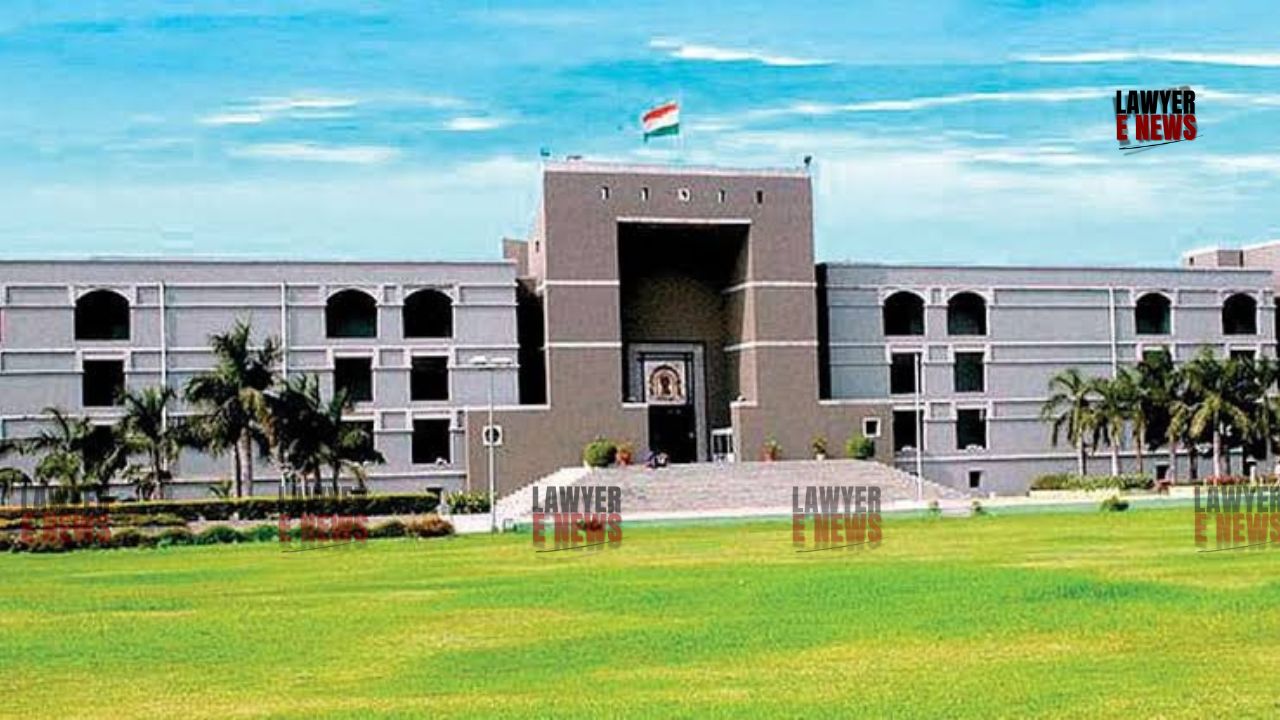
"The issue cannot be decided solely on the basis of deemed knowledge of the registration of the sale deeds, without first adjudicating the plaintiff's claim of co-ownership and entitlement to partition." Gujarat High Court, in a significant ruling, held that the doctrine of constructive notice under Section 3 of the Transfer of Property Act, 1882 (TPA)—which imputes deemed knowledge of a registered document—cannot be weaponised to non-suit an undivided co-owner seeking partition of ancestral property at the threshold under Order VII Rule 11(d) of the Code of Civil Procedure, 1908 (CPC).
Setting aside a trial court order that had thrown out a partition suit as time-barred, a single bench of Justice J. C. Doshi ruled that while constructive notice might operate against a direct challenge to a registered instrument simpliciter, it cannot extinguish an alleged co-sharer's recurring right to seek partition and separate possession without an adjudication on merits.
The appellant instituted Special Civil Suit No. 137 of 2012 before the 6th Additional Senior Civil Judge, Gandhinagar, seeking partition by metes and bounds and separate possession of his undivided one-half share in ancestral land bearing Survey No. 55 in Amiyapur, along with a declaration that registered sale deeds executed by a collateral branch in 2007 and 2008 were null, void, and not binding on his share. The defendants moved an application under Order VII Rule 11(d) CPC seeking rejection of the plaint, contending that registration constituted constructive notice under Section 3 TPA and that the suit, filed in 2012, was ex facie barred by the three-year limitation under Articles 58 and 59 of the Limitation Act, 1963. The Trial Court accepted the defendants' plea, invoking the maxim vigilantibus et non dormientibus jura subveniunt to hold that the plaintiff had slept over his rights, leading the appellant to challenge the dismissal under Section 96 CPC.
The primary question before the court was whether constructive notice and deemed knowledge of registered instruments under Section 3 of the Transfer of Property Act, 1882, can defeat a co-owner's ancestral partition claim at the threshold under Order VII Rule 11(d) CPC. The court was also called upon to determine whether the relief of partition in undivided ancestral property under Article 110 of the Limitation Act involves disputed questions of ouster and continuous cause of action that require adjudication through a full-fledged trial.
Constructive Notice Cannot Extinguish Co-Ownership Claim At Threshold
Addressing the defendants' heavy reliance on the doctrine of constructive notice under Section 3 TPA, the High Court clarified that the deeming fiction of registration cannot be imported at the Order VII Rule 11 stage to extinguish substantive co-ownership claims. The bench observed that while constructive knowledge applies where an instrument is challenged directly, an undivided co-owner's claim stands on an entirely different legal footing because succession opens by operation of law and is not subordinated to revenue alterations or unilateral alienations.
The court noted that the respondents' argument would carry weight only if the suit were confined to an isolated challenge against the sale deeds, but it loses traction where partition is the foundational grievance. Justice Doshi observed that the question of limitation cannot be resolved merely on the premise of registration without first adjudicating whether the plaintiff holds an undivided title as an heir under Section 15 of the Hindu Succession Act, 1956.
Primary Relief Of Partition Governs Limitation Over Consequential Prayers
Scrutinising the plaint as a whole, the High Court held that the trial court committed a fundamental error by treating the suit as one primarily seeking the cancellation of sale deeds. The bench emphasised that the plaintiff had fundamentally asserted a one-half undivided share and sought partition by metes and bounds, while the prayer for invalidating the registered instruments of 2007 and 2008 was purely consequential.
The court reiterated that the law of limitation must be applied to the primary relief claimed in the action, rather than being determined solely by ancillary or consequential prayers that merely flow from the main relief. Justice Doshi noted that if the plaintiff establishes his undivided title during trial, the consequential relief of holding the sale deeds non-binding to the extent of his share would naturally ensue as a matter of law.
Partition Involves A Recurring Cause Of Action Governed By Article 110
Examining the statutory framework of limitation in joint property disputes, the High Court underscored that a suit for partition is governed by Article 110 of the Limitation Act, which prescribes a twelve-year limitation period commencing from the date when the plaintiff’s exclusion or ouster from the joint property becomes known to him. The bench held that the cause of action to seek partition of undivided property is recurring and continuous, subsisting until the property is formally divided by metes and bounds.
The bench stressed that whether a co-owner was ousted, or when such exclusion first came to their knowledge, is a pure question of fact that requires evidence and cannot be decided summarily upon a preliminary application under Order VII Rule 11(d) CPC. Citing the Supreme Court’s decision in Chhotanben v. Kirtibhai Jalkrushnabhai Thakkar, the court held that limitation in such cases runs from actual knowledge of fraud and exclusion, which must be accepted as pleaded at the initial stage.
Pleadings Must Be Taken As Correct Without Roving Inquiries At Threshold
Revisiting the canonical principles governing Order VII Rule 11 CPC laid down in Sopan Sukhdeo Sable v. Assistant Charity Commissioner and Saleembhai v. State of Maharashtra, the High Court held that courts cannot compartmentalise or dissect the plaint, nor can they look into the defence or external documents at the threshold. The averments in the plaint, including specific allegations of fraud and collusion under Order VI Rule 4 CPC, must be presumed to be true until tested in trial.
The bench placed reliance on the recent Supreme Court judgment in B.S. Lalitha v. Bhuvanesh [2026 LiveLaw (SC) 506], which held that disputed questions of fact regarding joint family succession, oral partitions, and alleged relinquishment cannot be adjudicated under Order VII Rule 11 CPC. Justice Doshi noted that the trial court conducted an impermissible mini-trial by drawing adverse inferences against the plaintiff based on revenue entries.
"The real object of Order VII Rule 11 of the Code is to keep out of courts irresponsible lawsuits... but if the determination of an issue, particularly that of limitation, requires consideration of the defendant's defence or adjudication upon disputed questions of fact, the issue becomes triable and cannot be decided at the threshold stage."
Partial Rejection Of Plaint Is Wholly Impermissible Under Civil Procedure
The High Court reinforced the well-entrenched principle that a plaint cannot be rejected in part under Order VII Rule 11 CPC, citing the Supreme Court decisions in Central Bank of India v. Rambha Jain (2025) and Vinod Infra Developers Pvt. Ltd. v. Mahavir Builders [2025 LiveLaw (SC) 630]. The court highlighted that where multiple reliefs flow from distinct or continuous causes of action, the maintainability of even a single relief ensures that the entire suit survives for trial.
Applying this rule, Justice Doshi held that because the prayer for partition under paragraph 14(A) was demonstrably maintainable and disclosed triable issues regarding pedigree and title under Section 15 of the Hindu Succession Act, the trial court had no jurisdiction to throw out the plaint merely because the ancillary prayers challenging the sale deeds were perceived to be hit by the three-year limitation period.
Distinguishing Precedents On Delayed Challenges
Distinguishing the authorities relied upon by the defendants, including Umadevi v. Anand Kumar and Shri Mukund Bhavan Trust v. Shrimant Chhatrapati Udayan Raje Pratap Singh, the High Court observed that those rulings pertained to situations where partition had already been completed and acted upon, or where the suits were ex facie abusive and frivolous. Invoking the Supreme Court's pronouncement in Government of Karnataka v. Gowramma, the bench stressed that precedent cannot be applied mechanically without regard to circumstantial flexibility.
Allowing the First Appeal, the High Court quashed the trial court's order dated April 11, 2014, and restored Special Civil Suit No. 137 of 2012 to the file of the 6th Additional Senior Civil Judge, Gandhinagar. Directing the trial court to dispose of the twelve-year-old suit expeditiously within six months, the ruling firmly establishes that constructive notice under property statutes cannot truncate an ancestral co-owner's day in court when partition of undivided property is fundamentally claimed.
Date of Decision: 03 August 2026