-
by sayum
26 October 2026 4:04 PM







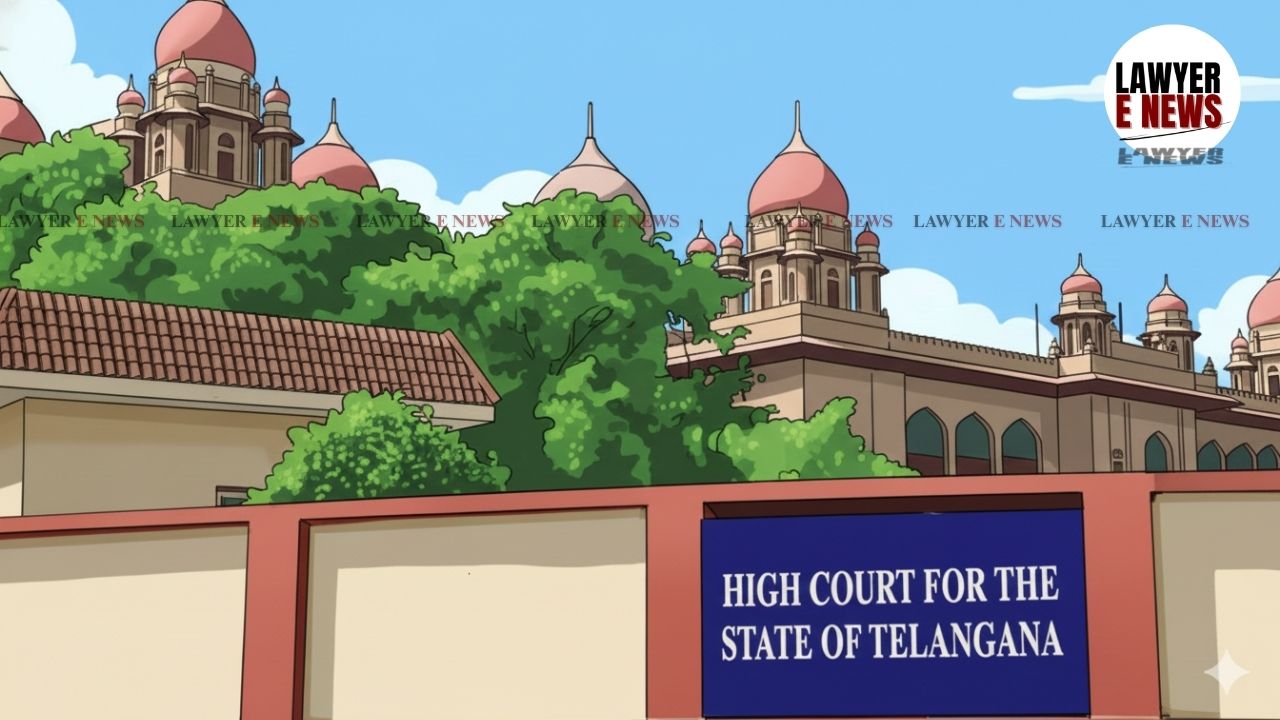
"The police have a statutory right and duty to investigate cognizable offences and that Courts should not interdict investigation at the threshold unless no cognizable offence is disclosed on a plain reading of the FIR." Telangana High Court, in a ruling dated 22 September 2026, held that criminal proceedings against an accused cannot be quashed at the nascent stage of investigation merely on the contention that the implication is based on the confession of a co-accused.
A bench of Justice J. Sreenivas Rao observed that the power to quash proceedings under Section 528 of the Bharatiya Nagarik Suraksha Sanhita (BNSS), 2023, must be exercised sparingly, as the FIR is not expected to be an encyclopedia of all facts.
The petitioner, arrayed as accused No. 7, sought to quash an FIR registered for offences under Sections 8(c), 20(b)(ii)(A), and 27(b) of the Narcotic Drugs and Psychotropic Substances Act, 1985 (NDPS Act). The petitioner contended that he was falsely implicated based solely on the confession of a co-accused, noting that no contraband was seized from his possession and he was not present at the scene of the alleged offence. The state argued that the investigation was ongoing and that telephonic records provided prima facie material linking the petitioner to a larger conspiracy.
The primary question before the court was whether the High Court should exercise its extraordinary jurisdiction to quash an FIR at the threshold when the petitioner challenges the admissibility and sufficiency of evidence, specifically the confession statement of a co-accused. The court was also called upon to determine if the proceedings constituted an abuse of the process of law.
Investigation at Nascent Stage
The court noted that the investigation into the crime, involving the recovery of dry ganja, was still in its early stages. It observed that whether the petitioner was implicated solely based on a co-accused's statement or whether independent incriminating material exists is a matter for the investigating agency to ascertain.
Court Assesses Evidentiary Sufficiency
The court emphasized that while the confession of a co-accused is a point of evidentiary debate, it is premature to stifle the investigation at this stage. The court held that the sufficiency of evidence to connect the petitioner to the alleged conspiracy must be evaluated through the investigative process rather than through a petition to quash the FIR.
"Whether the petitioner was implicated as accused No.7 solely basing upon the confession statement given by the co-accused or whether there is any incriminating material to connect the petitioner with the present crime, the same will be revealed during the course of investigation."
Limited Scope of Quashing Powers
Applying the principles laid down in State of Haryana v. Bhajan Lal, the court reiterated that the power to quash under Section 528 BNSS (analogous to Section 482 CrPC) is meant to be exercised only in exceptional cases. The court clarified that such power is reserved for instances where the allegations are inherently improbable or manifestly mala fide.
"The power to quash proceedings should be exercised sparingly, with circumspection, and only in the rarest of rare cases, where the allegations do not disclose any offence or are manifestly attended with mala fide."
Distinction from Precedents
The court distinguished the present matter from cases like Hari Charan Kurmi v. State of Bihar and Rakesh Kumar Raghuvanshi v. State of Madhya Pradesh, noting that those cases involved appeals against convictions rather than challenges to the initiation of an investigation. Consequently, the court found no ground to interdict the police proceedings, as the complaint disclosed a cognizable offence under the NDPS Act.
The High Court concluded that the matter did not fall into the "rarest of rare" category required to warrant judicial interference at the crime stage. The petition for quashing was accordingly dismissed, allowing the investigation to proceed in accordance with the law.
Date of Decision: 22 September 2026