-
by sayum
27 July 2026 3:39 PM







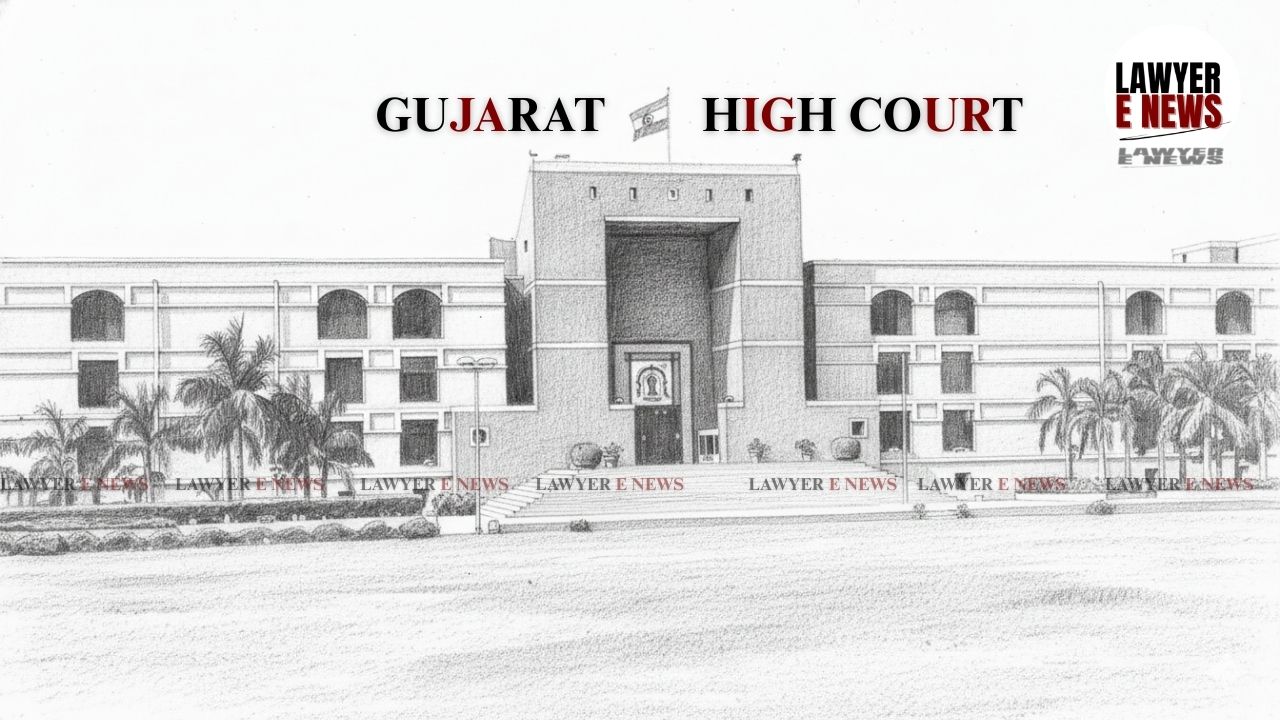
"It is abundantly clear that the complaint lodged on behalf of the partnership firm through its partner satisfies the requirement of Section 142 of the N.I Act," Gujarat High Court, in a significant ruling, held that a criminal complaint for cheque dishonour filed by a partner on behalf of a partnership firm is maintainable even in the absence of a specific authorization letter or resolution.
A bench of Justice Nisha M. Thakore observed that a partner is an active representative of the firm and possesses the inherent implied authority to initiate legal proceedings to realize the firm's dues.
The court further emphasized that the mandatory requirements of Section 142 of the Negotiable Instruments Act (NI Act) are satisfied if the complaint is filed in the name of the "payee" firm and is prosecuted by a person who has personal knowledge of the transaction.
The case arose from a criminal revision application filed by an accused challenging his conviction for an offence under Section 138 of the NI Act involving a cheque of Rs. 4 lakhs. The Judicial Magistrate First Class at Rajpipla had sentenced the applicant to one year of simple imprisonment, which was subsequently upheld by the Additional District Judge, Narmada. The applicant contended that the complaint, filed by a partner of 'Sri Laxmi Finance', was not maintainable as no authorization letter, partnership deed, or resolution was produced to prove his authority to represent the firm.
The primary question before the court was whether a complaint under Section 138 of the NI Act, filed by a partner on behalf of a firm without a specific authorization letter, is maintainable under Section 142 of the Act. The court was also called upon to determine whether the absence of a response to a legal notice and the failure to challenge signatures on the cheque would entitle the complainant to the statutory presumptions of a legally enforceable debt.
Court Explains Representative Capacity Under Section 142 NI Act
The court examined the scope of Section 142 of the NI Act, which mandates that a court can only take cognizance of an offence under Section 138 upon a written complaint made by the "payee" or the "holder in due course." Referring to recent Supreme Court precedents, the court noted that while an incorporated body or a firm is a legal entity, it must necessarily act through human agency.
Requirement Of Specific Authorization Not Mandatory For Partners
The bench observed that the requirement for a "specific assertion as to the knowledge of the power-of-attorney holder" cannot be applied in a straitjacket manner to partners of a firm. The court noted that unlike a mere employee or a third-party power-of-attorney holder, a partner is considered an agent of the firm for the purpose of its business under the Partnership Act, 1932.
"The position that would emerge when the complainant is a company or a corporate entity will have to be viewed from a different standpoint. All that is necessary is to demonstrate before the learned Magistrate that the complaint filed is in the name of the 'payee' and if the person who is prosecuting the complaint is different from the payee, the authorisation therefor and that the contents of the complaint are within his knowledge," the court observed.
Court Relies On Supreme Court Precedent In Naresh Potteries
The High Court placed heavy reliance on the Supreme Court decision in M/s. Naresh Potteries Vs. M/s. Aarti Industries (2025 INSC 1). It noted that the apex court had clarified that if the signatory of the complaint is a partner and is well-conversant with the transaction, the requirement of Section 142 is complied with. The bench found that in the present case, the licence issued to the firm (Exh. 7) clearly listed the complainant as an active partner.
Verification By Magistrate Cures Procedural Irregularities
The court highlighted that at the stage of verification under Section 200 of the CrPC, the partner had appeared before the Magistrate and endorsed his signature as a "partner of Sri Laxmi Finance." This verification, the court held, satisfied the Magistrate's duty to ensure the complaint was instituted by a competent person.
"With such material on record, the learned Magistrate has duly followed the procedure envisaged under Section 190 read with Section 200 of the Code of Criminal Procedure and having satisfied about the maintainability of the complaint at the instance of said person, has called upon the accused by issuing summons," the bench remarked.
Presumption Of Legally Enforceable Debt Remains Unrebutted
Regarding the applicant's defence that the cheque was for "security" and there was no legally enforceable debt, the court noted that the applicant failed to reply to the statutory legal notice. The court held that once the issuance of the cheque and the signatures thereon are not disputed, the statutory presumptions under Sections 118 and 139 of the NI Act are triggered.
Failure To Reply To Legal Notice Weighs Against Accused
The bench reiterated the principle laid down in Rangappa Vs. Sri Mohan, stating that the burden was on the accused to rebut the presumption by a preponderance of probabilities. Since no documentary evidence or statement of accounts was produced by the accused to challenge the debt, the concurrent findings of the lower courts did not warrant interference.
"Admittedly, there is no challenge to the foundational fact like issuance of cheque, contents of cheque and signature of the accused on the cheque. In view thereof, no error can be found with the approach of the Courts below in raising the presumption against the accused," the court held.
The High Court concluded that there was no illegality or perversity in the orders passed by the subordinate courts. Finding the revision application meritless, the court dismissed the petition and confirmed the conviction. However, it stayed the sentence for a further period of 30 days to allow the applicant to seek further legal remedies.
Date of Decision: 19 June 2026