
-
by sayum
26 August 2026 1:49 PM







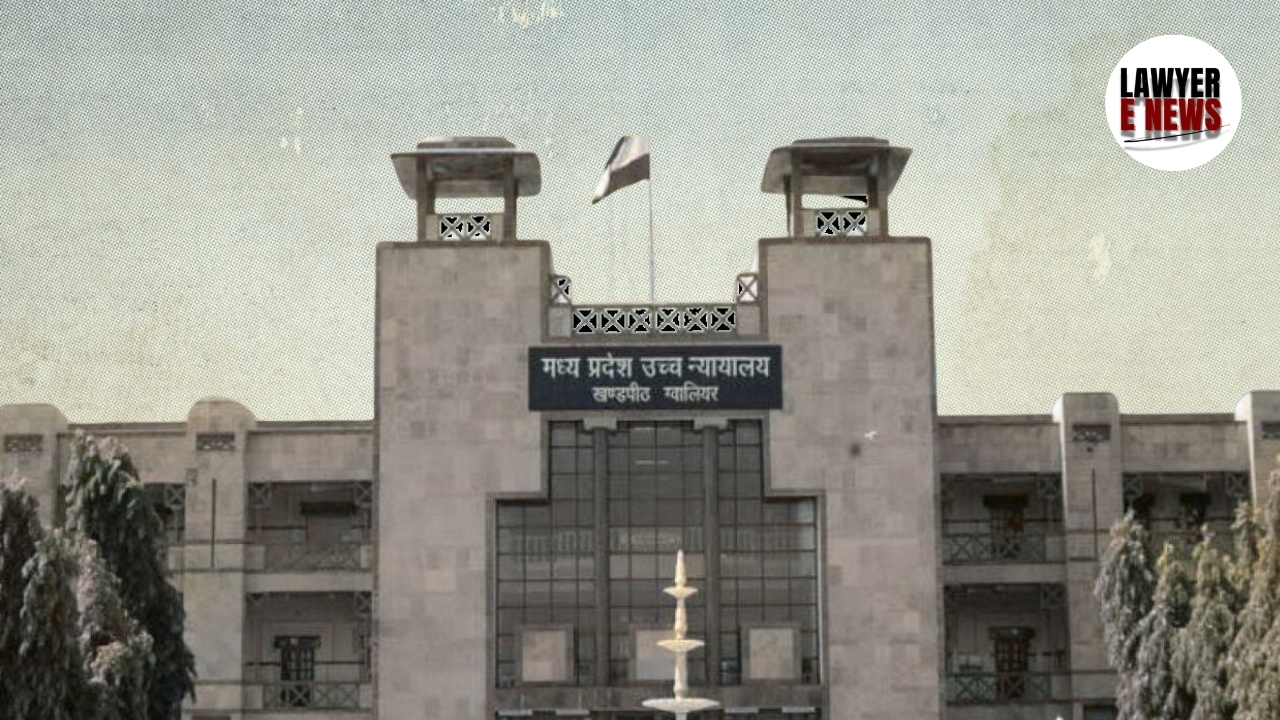
“Legislature Has Deliberately Barred Appeal by Children or Relatives—Courts Cannot Rewrite Statute to Create Rights Not Expressly Granted” - In a precedent-setting verdict that will have a wide impact on maintenance and eviction proceedings under the Maintenance and Welfare of Parents and Senior Citizens Act, 2007, the Madhya Pradesh High Court, ruled that an appeal under Section 16 of the Act can only be filed by a senior citizen or a parent.
Answering a significant question of law that had divided multiple benches, the Court overruled the contrary view adopted in Nitin Jaat v. State of M.P., and affirmed that children, relatives, or any other "aggrieved person" have no appellate right under Section 16.
“The language of Section 16(1) is clear and unequivocal—only a senior citizen or a parent can file an appeal. Children and relatives have no such right under the Act, and courts cannot judicially legislate such a right by reading words into the statute.” [Para C-2]
The Court held that t“Purpose of the Act Is to Protect Elders, Not to Provide Equal Adversarial Rights to Children”: Court Rejects Argument of Parity
he Maintenance and Welfare of Parents and Senior Citizens Act, 2007 is beneficial and exclusive social welfare legislation, intended to provide a summary and expeditious mechanism for aged parents and elders to claim maintenance, protection, and possession of property.
“The Act creates an exclusive protective mechanism for a vulnerable class—parents and senior citizens—not a reciprocal litigation forum for their children or relatives,” the Court observed. [Para A-2 to A-6]
Rejecting the respondent's argument that the proviso to Section 16 (which mandates children must continue paying maintenance during appeal) implied that children may also file appeals, the Court ruled:
“The proviso does not expand the appellate right. It simply ensures that maintenance to the senior citizen continues during the pendency of an appeal filed by the senior citizen or parent. It cannot be construed to allow appeals by children.” [Para A-13]
“Section 16 Uses Clear Words—‘Any Senior Citizen or Parent’—and Not ‘Any Aggrieved Person’”: No Ambiguity in Statutory Language
Centrally, the High Court held that Section 16(1) must be interpreted strictly as it clearly limits the right of appeal to “any senior citizen or parent”. Any attempt to read the term “any aggrieved person” into the provision would constitute judicial legislation, which is impermissible.
“Had Parliament intended to grant appeal rights to children or relatives, it would have simply used the term ‘any aggrieved person’. It has consciously not done so.” [Para A-11]
The Court found no ambiguity in the language of the statute and ruled that beneficial legislation must still be interpreted within its framework, citing the doctrine of casus omissus.
“The omission to grant appellate rights to children or relatives is deliberate and not an oversight. Courts cannot fill legislative gaps that do not exist.” [Para A-21]
“The Pending 2019 Amendment Bill Confirms Legislative Intent to Limit Current Appellate Rights”: Courts Cannot Preempt Parliament
The Court rejected arguments based on the 2019 Amendment Bill, which proposes to add “children or relatives” to Section 16 as persons entitled to file an appeal.
“The very existence of the proposed amendment confirms that the current law does not confer that right. Unless and until Parliament enacts this amendment, the courts cannot presume the change or act on legislative intention alone.” [Para A-15]
“Article 14 Not Violated—Classification Based on Legislative Purpose Is Constitutionally Valid”
Addressing concerns that excluding children or relatives from appellate remedy violates Article 14 of the Constitution, the Court held:
“There is a clear intelligible differentia between senior citizens/parents and children/relatives, and the classification bears a direct nexus with the object of the Act—protecting the elderly. Hence, Article 14 is not violated.” [Para P-5, A-6, A-17]
The Court further observed that if children or relatives were given full appellate rights, it would defeat the object of providing swift, simple, and inexpensive relief to the elderly.
“Children Not Left Without Remedy—They Can File Writ Petitions Under Article 226”: Writ Jurisdiction Still Open
In a pragmatic clarification, the Court noted that although children or relatives cannot file statutory appeals under Section 16, they are not entirely remediless.
“Remedy under Article 226 of the Constitution is always available to children or relatives to challenge orders passed by the Tribunal on grounds of jurisdictional error, mala fides, or violation of natural justice.” [Para A-24]
Hence, the exclusion from statutory appeal does not violate principles of natural justice, nor does it bar legitimate legal redress.
“Conflicting View in Paramjeet Saroya Case Overruled—Only Elderly Can Appeal”
In a categorical declaration, the Court overruled the view taken by the Punjab & Haryana High Court in Paramjeet Kumar Saroya v. Union of India [AIR 2014 P&H 121], which had allowed children and relatives to file appeals under Section 16.
“We respectfully disagree with the view taken by the Punjab and Haryana High Court in Paramjeet Saroya and hold that the view taken by this Court in Nitin Jaat is incorrect.” [Para C-1]
The Court instead affirmed its own Division Bench precedents in Anil Choupda, Smt. Shilpi, Dilip Marmat, and Smt. Anuradha Pathak, which all limited the scope of appeal to only senior citizens and parents.
Appeal Filed by Daughter Was Incompetent—Matter Sent Back to Single Judge for Further Adjudication
The Court ultimately held that respondent No. 1 (daughter) had no locus to file the appeal that overturned the order of the SDO under Rule 19 directing her to vacate the house. Accordingly, the Court answered the reference in the negative and directed that the writ petition be placed before a Single Judge Bench for disposal on the merits.
“We hereby answer the sole question of law that an appeal under Section 16… is maintainable only at the instance of any senior citizen or a parent, and it is not maintainable at the instance of any aggrieved person.” [Para C-2]
Date of Decision: 17 October 2025





