-
by sayum
10 August 2026 1:57 PM







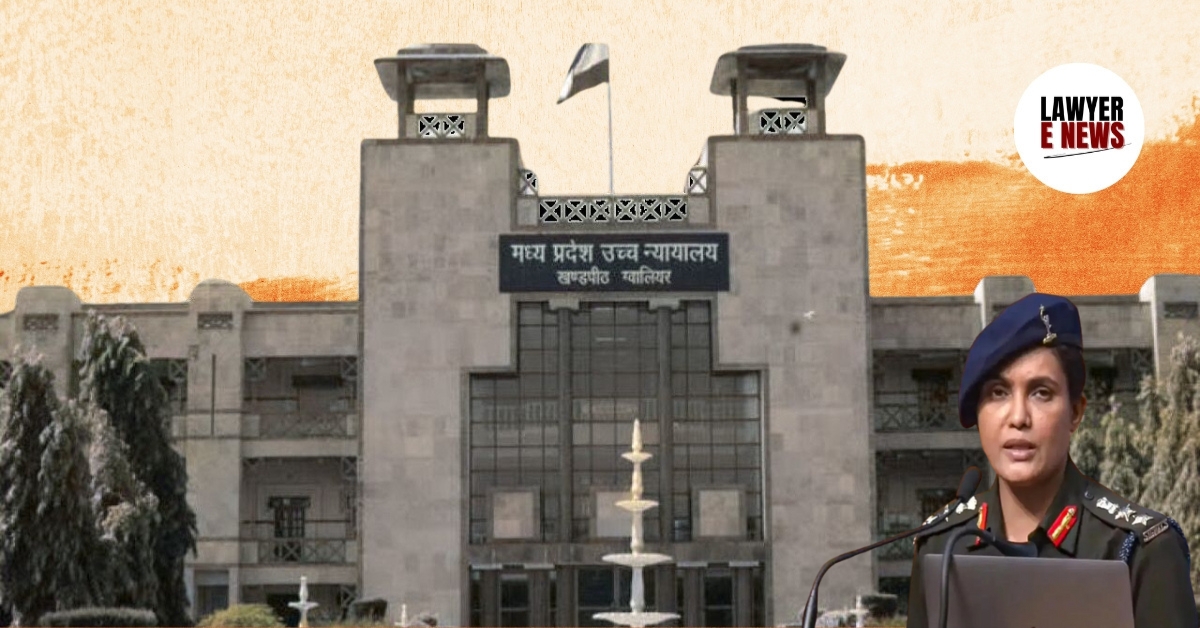
“The Armed Forces… the Last Institution Reflecting Integrity and Honour… Have Been Targeted”: High Court of Madhya Pradesh at Jabalpur, acting suo motu, delivered a scathing order following widespread outrage over communal and derogatory remarks made by a sitting State Cabinet Minister, Vijay Shah. The Court, deeply perturbed by his public speech at a function in Dr. Ambedkar Nagar, where he referred to decorated Army officer Col. Sofia Quraishi as "the sister of terrorists", found prima facie violations of multiple penal provisions under the new Bhartiya Nyaya Sanhita, 2023 (BNS).
Calling the comments “language of the gutters”, the Court underscored the severity of equating a loyal and decorated Muslim officer with terrorists, particularly while she was serving on the frontline of Operation Sindoor, a military operation against Pakistan. The High Court ordered immediate FIR registration under Sections 152, 196(1)(b), and 197(1)(c) of the BNS and warned the State's Director General of Police of contempt proceedings if the directive is not complied with.
“This Is Not Just an Insult to an Officer, But a Direct Threat to National Unity”
The Court began by acknowledging its suo motu cognizance based on reports in national newspapers and a viral video of the minister’s speech. Minister Vijay Shah's remarks were not merely offensive but posed a direct threat to communal harmony, national integrity, and the morale of the armed forces.
Describing the Army as “perhaps the last institution existing in this country, reflecting integrity, industry, discipline, sacrifice, selflessness, character, honour and indomitable courage,” the Court was unequivocal that any attempt to malign its officers, especially in a communal and inflammatory manner, deserves serious judicial scrutiny.
The minister had stated publicly that Prime Minister Narendra Modi “has sent the sister of the terrorists” to deal with the same terrorists — a comment unmistakably aimed at Col. Sofia Quraishi, one of the two faces of the armed forces briefing the nation about Operation Sindoor. The Court noted that such innuendo left “no ambiguity” about its target and amounted to inciting hatred and suspicion against Muslims in uniform.
Offences Under BNS Made Out: Section 152, Section 196(1)(b), and Section 197(1)(c)
The Bench of Justice Atul Sreedharan and Justice Anuradha Shukla meticulously dissected the statutory framework of the BNS to underline how the minister’s remarks satisfied the elements of multiple penal offences:
Section 152 (Endangering Sovereignty, Unity, and Integrity of India)
The Court held that by suggesting that a serving Muslim officer was aligned with terrorists, the minister’s statement “encourages feelings of separatist activities by imputing separatist feeling to anyone who is Muslim,” thereby endangering India’s unity. The provision carries a maximum punishment of life imprisonment.
Section 196(1)(b) (Acts Prejudicial to Maintenance of Harmony)
“Deriding her by referring to her as the sister of terrorists may be prejudicial to the maintenance of harmony between different religions,” said the Court. It stressed that despite her "selfless duties" toward the nation, Col. Quraishi was demonized merely due to her faith — a classic case of religious discrimination punishable under the BNS.
Section 197(1)(c) (Imputations Prejudicial to National Integration)
The Court also invoked this section for causing enmity by asserting that members of a particular religion cannot be trusted to bear true allegiance to the Constitution and the nation. “The statement made by Minister Vijay Shah prima facie has the propensity to cause disharmony and feelings of enmity or hatred or ill-will between the members of the Muslim faith and other persons,” it said.
“This Is Not Just Disparagement — It’s a Dangerous Undermining of Our Institutions”
The Court’s language was remarkably strong, calling the speech “disparaging and dangerous, not just to the officer in question but to the armed forces itself.” It described such acts as attempts to “fuel an impression” that one’s religious identity determines national loyalty, regardless of decades of service to the country.
By attempting to communalize the armed forces and associate a military officer with terrorists purely based on religious identity, the minister had undermined the constitutional ethos and attempted to polarize public perception.
Court Orders Immediate FIR, Warns DGP of Contempt
“The Court directs the Director General of Police of Madhya Pradesh to register forthwith an FIR against Minister Vijay Shah,” the order reads. It added that if this is not done by the evening of May 14, the Court will “contemplate proceeding against the Director General of Police for contempt.” The Court ordered its Registry to ensure that the order reaches the police immediately and listed the case for further hearing on May 15, 2025.
In an era where communal polarization frequently spills into public discourse, the Madhya Pradesh High Court has stood firm to safeguard the constitutional promise of equality, secularism, and respect for national institutions. By treating the denigration of a uniformed officer as an attack on India’s integrity and harmony, the Court has sent a powerful message — that communal slurs, even from high political offices, will not go unchecked.
Date of Decision: 14 May 2025