-
by sayum
27 August 2026 3:32 PM







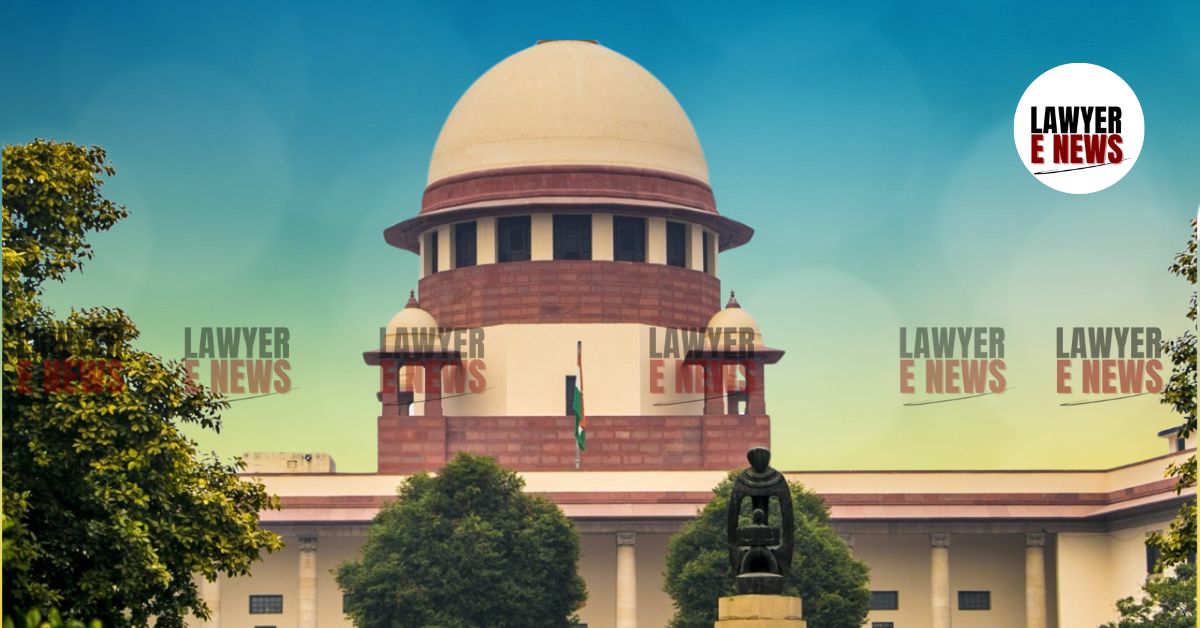
"The power and jurisdiction of the Court under Section 29A(5) is not impaired by the indiscretion of the arbitrator" — In a defining pronouncement for arbitration law in India, the Supreme Court on 3rd February 2026 ruled that courts can extend the mandate of an arbitrator under Section 29A(5) of the Arbitration and Conciliation Act, 1996, even after the arbitrator has rendered an award beyond the statutory time limit.
Justice Pamidighantam Sri Narasimha and Justice Atul S. Chandurkar categorically held that such an award, though passed after expiry of the arbitrator’s mandate, is not a nullity, but merely unenforceable until the Court decides on extension. The judgment displaces a growing judicial trend in High Courts where delayed awards were routinely struck down without giving parties an opportunity to regularise the timeline.
The Court set aside the order of the Madras High Court that had dismissed the appellant’s plea under Section 29A(5) as not maintainable and instead allowed a Section 34 petition by the respondent, declaring the award a nullity. The Supreme Court has now restored the extension application for fresh consideration by the High Court in light of its interpretation.
“Termination Under Section 29A Is Not Set in Stone”: Supreme Court Sends Strong Message to Uphold Party Autonomy and Arbitral Continuity
“There is no automatic invalidation of an award passed after mandate expiry — the Court’s discretion remains paramount”
The controversy stemmed from a common but critical scenario in Indian arbitrations. The arbitrator, after completing pleadings and receiving mutual extension from the parties till 20 February 2024, passed the award on 11 May 2024 — after the extended mandate had expired. The High Court rejected the Section 29A(5) application filed by the appellant in November 2024, holding that once an award is passed without mandate, there is nothing left to extend. The Supreme Court overruled this logic.
“The indiscretion of the arbitrator in delivering an award beyond the period of mandate does not denude the power of the Court to extend the mandate,” observed the bench.
The judgment explained that while such an award cannot be enforced under Section 36, it is not a nullity. Instead, it remains in a state of “legal limbo”, waiting for judicial scrutiny under Section 29A. The Court noted, “A better expression would be to hold that such an award would be unenforceable under Section 36, not that it is a nullity.”
Real-Life Arbitration Realities Demand Legal Flexibility, Not Procedural Extinction
Tracing the factual matrix, the Court acknowledged that parties themselves had contributed to delays. Despite the arbitrator initially reserving the award in September 2023, multiple adjournments followed due to ongoing settlement talks. A tripartite agreement was even entered into during the delay, yet not formally submitted to the tribunal. The Court observed: “Events that unfolded thereafter are indicative of myriad instances when real life fails to keep pace with human discipline for timelines.”
Importantly, the judgment highlighted that the mandate of the arbitrator ‘terminates’ under Section 29A(4), but such termination is conditional and not absolute. “Termination under Section 29A(4) is not set in stone or absolutistic in character,” the Court ruled, affirming that filing an application for extension revives the arbitral process.
Award Passed Without Mandate Can Be Cured: Court Recognises Legislative Intent to Preserve Finality, Not Frustrate Arbitration
The Court emphasised that Section 29A(5) is a curative provision, and its existence presumes that a breach of time can occur — and must be remedied through judicial discretion. Rejecting the High Court’s reliance on earlier Madras High Court decisions like Suryadev Alloys, the Supreme Court remarked:
“The Parliament has never intended that the act of an arbitrator in delivering an award when the mandate had expired would denude the power and jurisdiction vested in the Court.”
Referring to its earlier judgment in Rohan Builders v. Berger Paints, the Court approved the principle that extension under Section 29A can be granted even after expiry of the mandate, and further clarified that such extension can be granted even if the award has already been passed.
Comparative Jurisprudence Backs India’s Approach: Delay Should Not Destroy Arbitration
Aligning Indian arbitration law with international practice, the Court cited decisions from the UK, Singapore, Mauritius, and New York, where courts have retrospectively extended timelines or validated late awards in the interest of justice. The Privy Council’s ruling in Alphamix Ltd v. District Council of Rivière du Rempart was quoted to support the idea that minor delays should not render awards invalid when parties have tacitly permitted continuation.
The Court noted, “Courts of many countries would be reluctant to invalidate a late award… the emphasis is on preventing arbitration from being defeated by technical non-compliance.”
Section 29A: A Judicial Toolkit for Discipline and Continuity
Interpreting Section 29A as a cohesive framework, the Court reaffirmed its belief that judicial supervision is meant to enable timely awards, not destroy the process at its final stage. The Court explained that even after mandate expiry and award delivery, the Court retains discretion to:
“All these are tools to discipline the arbitral process while protecting the sanctity of final adjudication,” the Court added.
Award Is Not Void – It Just Awaits Validation Through Judicial Gatekeeping
In its concluding remarks, the Court provided a definitive answer to a recurring arbitration question:
“We hold that an application under Section 29A(5) for extension of the mandate of the arbitrator is maintainable even after the expiry of the time… and even after rendering of an award during that time. Such an award is ineffective and unenforceable. But the power of the court to consider extension is not impaired by such an indiscretion of the arbitrator.”
The Court further observed that judicial remedies must be “accessible, affordable, expeditious and cohesive”, and should not be denied on the altar of rigid statutory literalism.
High Court Directed to Reconsider Extension Application
Allowing the appeal, the Supreme Court set aside the Madras High Court’s order dated 24 January 2025, restored the Section 29A application, and directed the High Court to decide it afresh on merits, considering the legal principles settled by this judgment.
The decision is expected to bring much-needed clarity and certainty in the arbitral ecosystem, especially in cases where awards are passed in good faith but beyond strict timelines.
Date of Decision: February 3, 2026