
-
by sayum
26 August 2026 1:49 PM







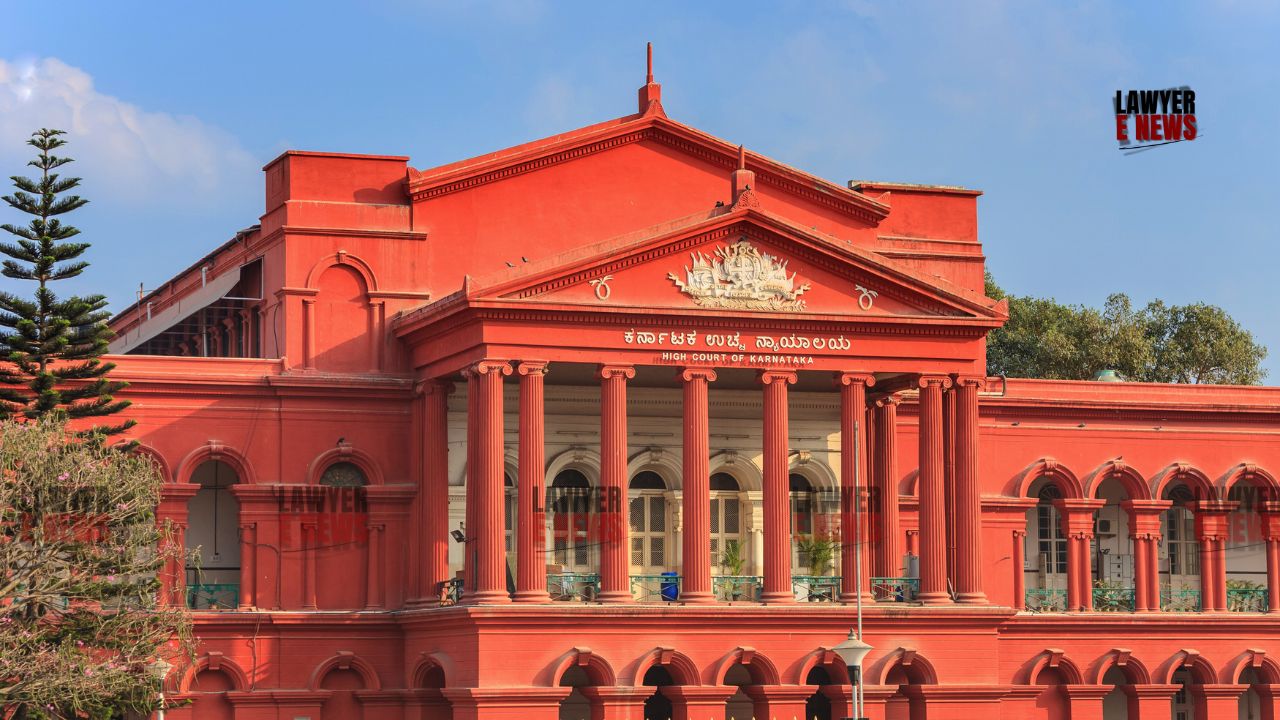
"Travel time required for production of accused before Magistrate needs to be excluded from computation of 24 hours", Karnataka High Court recently dismissed a challenge to a remand order where an accused arrested for murder attempted to secure release on the technical ground of alleged delayed production beyond 24 hours. The Court held that a marginal delay of 25 minutes in producing the accused before the Magistrate, when explained by administrative circumstances and travel time considerations, does not violate Article 22(2) of the Constitution and does not invalidate the remand.
Background of the Case
The petitioner, accused No. 2 in a murder case, was allegedly hired by accused No. 1 to kill her husband. After executing the murder on the night of May 23, 2025, the petitioner was apprehended at Kachinakatte Bus Stop, Shivamogga at 3:30 p.m. on May 25, 2025. He was taken to the police station and officially arrested at 5:00 p.m. the same day through a detailed arrest panchanama. The grounds and reasons for arrest were furnished to both the petitioner and his father. The petitioner was produced before the Magistrate the next day at 5:25 p.m. After the charge sheet was filed and his regular bail application was rejected on December 11, 2025, the petitioner approached the High Court challenging the remand order on the ground that he was not produced within the mandatory 24-hour period.
Legal Issues and Arguments
The petitioner argued that there was a delay of one hour and fifty-five minutes from the time he was apprehended, and twenty-five minutes from the time of official arrest, in producing him before the Magistrate. He contended this violated his fundamental rights under Article 22(2) of the Constitution, which mandates production before the nearest Magistrate within 24 hours of arrest, excluding travel time. The State countered that the jurisdictional Magistrate was on leave, requiring production before the in-charge Magistrate, which caused the delay. The prosecution emphasized that travel time must be excluded from the 24-hour computation and that the petitioner was seeking release on a technicality after his regular bail was rejected for the heinous crime of contract killing.
Court's Observations and Judgment
Justice M. Nagaprasanna carefully examined both the constitutional and statutory provisions governing the 24-hour rule. The Court noted that Article 22(2) of the Constitution mandates production before the Magistrate within 24 hours "excluding the time necessary for the journey from the place of arrest to the court of the magistrate." Similarly, Section 58 of the Bharatiya Nagarik Suraksha Sanhita, 2023 (corresponding to Section 57 of the CrPC) provides that detention shall not exceed 24 hours "exclusive of the time necessary for the journey from the place of arrest to the Magistrate's Court."
The Court traced the chronology of events with precision. The arrest panchanama clearly documented that the official arrest occurred at 5:00 p.m. on May 25, 2025, and production before the Magistrate occurred at 5:25 p.m. the following day—a delay of merely 25 minutes beyond the 24-hour mark. The Court observed that the petitioner was apprehended at 3:30 p.m., brought to the police station at approximately 4:45 p.m., and the arrest panchanama was prepared by 5:00 p.m. on the same day.
Drawing upon Supreme Court precedents, the Court emphasized several key principles. In Gouri Shankar Jha v. State of Bihar, the Supreme Court held that "the object of the section is two-fold, one that the law does not favour detention in police custody except in special cases and that also for reason to be stated by the Magistrate in writing, and secondly, to enable such a person to make a representation before a Magistrate." The purpose is to ensure that the accused is brought before a Magistrate with as little delay as possible.
In Manoj v. State of Madhya Pradesh, the Supreme Court clarified that "the only time permitted by Article 22 of the Constitution to be excluded from the said period of 24 hours is 'the time necessary for going from the place of arrest to the court of the Magistrate.'" This principle was reiterated in Arnesh Kumar v. State of Bihar, where the Court held that an accused has "the constitutional right under Article 22(2) of the Constitution of India and Section 57 CrPC to be produced before the Magistrate without unnecessary delay and in no circumstances beyond 24 hours excluding the time necessary for the journey."
The Karnataka High Court also relied on decisions from the Bombay High Court. In Anil Jaisinghani v. State of Maharashtra, the Bombay High Court held that "24 hours is calculated from the time of arrest and the time taken to travel to reach the Magistrate can be excluded from the period of 24 hours." Similarly, in Anuj @ Babu Malhari Chavan v. State of Maharashtra, the Bombay High Court observed that "there cannot be dispute with regard to the position of law that the travel time required for production of the accused before the Magistrate needs to be excluded from the computation of 24 hours."
Applying these principles to the present case, Justice Nagaprasanna held that "the delay of 25 minutes in producing the petitioner before the learned Magistrate is not fatal in the case at hand, as it is adequately explained by the prosecution." The Court found that the delay was justified by the confusion regarding which Magistrate had jurisdiction, as the regular jurisdictional Magistrate was on leave and the accused had to be produced before the in-charge Magistrate.
The Court further observed that "non-production of the accused within the mandatory time in certain circumstances would not vitiate the proceedings." The petitioner had been officially arrested at 5:00 p.m. on May 25, 2025, and produced at 5:25 p.m. the next day. "In the peculiar facts of this case, the delay is explained and the explanation is acceptable, as it is the travel time or the obfuscation with regard to the Court before whom the petitioner was to be produced," the Court stated.
Addressing the petitioner's attempt to use Google Maps to calculate distances and travel times, the Court noted that the Sessions Court had already analyzed these submissions and rejected the regular bail application on December 11, 2025. The Court held that there was "no warrant to have a re-look to what the Court of Session has held, particularly in a petition under Section 528 of the BNSS."
The Court also contextualized the nature of the offense. The case involved serious allegations of contract killing—accused No. 1 had allegedly given "supari" (contract money) to the petitioner to murder her husband, and the petitioner had executed the murder. The Court implicitly recognized that procedural technicalities cannot override the substantive prosecution case in such serious matters, particularly when the delay is marginal and properly explained.
The Karnataka High Court dismissed the criminal petition, upholding the remand order. The Court held that the 25-minute delay in production beyond 24 hours did not constitute a violation of Article 22(2) of the Constitution, as the delay was adequately explained by administrative circumstances and travel time considerations. The judgment reinforces that while the 24-hour rule is a fundamental constitutional safeguard, minor deviations supported by reasonable explanations and exclusion of necessary travel time do not automatically vitiate detention or justify release on technical grounds.
Date of Decision: March 13, 2026





