
-
by sayum
26 August 2026 1:49 PM







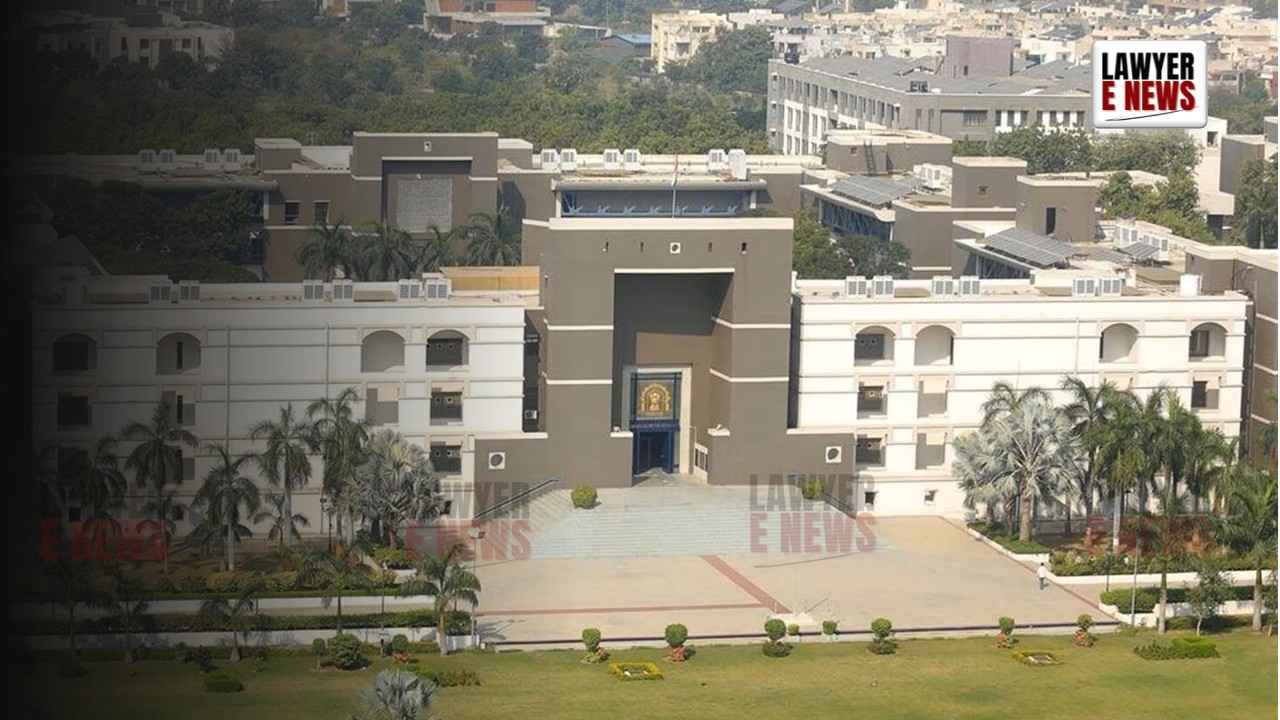
" State Cannot Invoke Forfeiture for Delay It Caused — The State Cannot Take Advantage of Its Own Inaction to Defeat Accrued Rights"- Gujarat High Court has held that the statutory forfeiture clause under Rule 8(4) of the Minerals Concession Rules, 2016 cannot be invoked against a mining lease applicant whose inability to execute the lease deed within the cut-off date of 11 January 2017 was entirely attributable to the State's own delay in issuing the grant order and the Central Government's admitted non-compliance with a binding Supreme Court direction.
A Division Bench of Chief Justice Sunita Agarwal and Justice D.N. Ray, allowing the writ petition filed by Vadraj Cement Limited (formerly ABG Cement Limited), quashed the Union of India's communication dated 17 November 2017 declaring the mining lease application ineligible, and directed the State of Gujarat to complete the execution and registration of the mining lease deed for 300.6957 hectares of limestone-bearing land at Village Naniber, District Kachchh, within three months.
A Mining Lease That Waited 26 Years
The roots of the case go back to 1997. The Central Government granted in-principle approval for a limestone mining lease over 730.60 hectares at Village Naniber, Taluka Abdasa, District Kachchh. On 26 March 1998, the Government of Gujarat issued a Letter of Intent in favour of the then ABG Cement Limited for the same area.
The land, however, straddled a complex forest classification dispute. A portion of 364.22 hectares of the leased area had been notified under Section 4 of the Indian Forest Act, 1927 — a notification that had been partly overturned by the Forest Settlement Officer's award of 1995, which had recorded that the land was a village settlement and should not be declared reserved forest. Despite this, the question of whether the Forest (Conservation) Act, 1980 required a separate clearance before mining could begin on the deleted land kept the matter pending for years before the Supreme Court, the Central Empowered Committee, and the Ministry of Environment, Forest and Climate Change.
A mining lease for Phase-I comprising 336.18 hectares was executed on 4 December 2012. The remaining 300.6957 hectares — the subject of the present petition — remained in limbo because of the unresolved forest classification question.
The Supreme Court's Direction That Was Never Complied With
On 8 September 2016, the Supreme Court, while disposing of the petitioner's interlocutory application in the T.N. Godavarman Thirumulpad matter, issued a categorical direction that the competent authority of the Ministry of Environment, Forest and Climate Change must determine the nomenclature of the deleted land — revenue or forest — within two months, and pass a final decision on the petitioner's application dated 20 August 2011 under Section 3 of the Forest (Conservation) Act. The Court further held that if the land was found to be originally revenue land and not forest land, no forest clearance would be required at all.
The MoEF&CC never complied with this direction. By the time the matter came before the Gujarat High Court, the Ministry's own affidavit dated 1 November 2025 — filed nine years after the Supreme Court's order — admitted that no decision whatsoever had been taken on the application dated 20 August 2011.
Two Days to Execute — With Officials at the Global Investors Summit
With the Supreme Court's order in hand, the petitioner wrote to the State Government in September 2016 requesting the grant order for the balance area. On 3 January 2017, the State Geologist proposed the grant. The State Government issued the grant order on 8 January 2017 — and communicated it to the petitioner on 9 January 2017.
The statutory cut-off for execution and registration of the lease deed was 11 January 2017 — two days later.
The petitioner's representatives rushed to the concerned officials on 10 and 11 January 2017 to complete the formalities. They found all relevant officials engaged at the Global Investors Summit being held at Gandhinagar between 9 and 13 January 2017 and at other programmes at Kachchh. The petitioner wrote on 11 January 2017 seeking details of stamp duty and registration charges, submitted maps and documents, and deposited Rs. 10,000 as security. Crucially, neither the State Government nor its own Geologist had informed the petitioner how to calculate performance security — a prerequisite for executing the lease — because the quantum depended on an assessment of mineral resources in Phase-II land, an exercise that only the State authorities could conduct.
The State nonetheless took the position that the grant stood automatically forfeited under Rule 8(4) once 11 January 2017 had passed without the lease deed being executed. The Union of India's Ministry of Mines confirmed this view in its communication dated 17 November 2017, holding the application ineligible.
"Shall Be Forfeited" Means "Liable to Be Forfeited" — Not Automatic
The Court undertook a detailed analysis of the expression "shall be forfeited" occurring in Rule 8(4) and held that it does not operate as an absolute, automatic forfeiture in all circumstances.
Drawing on the Supreme Court's authoritative exposition of the concept of "forfeiture" in STO v. Ajit Mills Ltd., which in turn drew on Black's Law Dictionary and Lord Porter's observations in Attorney General v. Parsons, the Court held that "the words 'shall be forfeited' may bear the meaning 'liable to be forfeited' depending on the setting and sense of the statute."
The forfeiture clause in Rule 8(4) operates upon a breach of obligation or neglect of duty by the applicant. Where the inability to execute the lease deed is not attributable to any breach by the applicant but flows entirely from the State's own delay, the forfeiture clause simply cannot be attracted. "The forfeiture of the right for grant of mining lease would not be attracted in view of the facts and circumstances of the present case, where there is no breach of obligation or neglect of duty on the part of the petitioner," the Court held.
The State Cannot Profit From Its Own Wrong
The Court applied the Latin maxim commodum ex injuria sua nemo habere debet — no party can take undue advantage of its own wrong — which the Supreme Court had articulated in Kusheshwar Prasad Singh v. State of Bihar: "He who prevents a thing from being done shall not avail himself of the non-performance he has occasioned."
The Court catalogued the chain of State inaction with precision. The MoEF&CC failed to decide the petitioner's application dated 20 August 2011 for nearly five years, compelling the petitioner to approach the Supreme Court again in 2016. The Supreme Court issued a categorical direction in September 2016 to decide within two months — which the MoEF&CC admittedly never complied with even by 2025. The State of Gujarat issued the grant order on 8 January 2017 — on the verge of the two-year deadline — and communicated it only on 9 January 2017. Government officials were at the Global Investors Summit during the two days remaining. The performance security quantum — a necessary precondition — was never computed or communicated to the petitioner by the State.
"11.01.2017 Cannot Be Treated as Sacrosanct in These Facts"
The respondents pressed hard that the cut-off date was a sacrosanct statutory command and no court could direct execution of a lease deed after it had passed. The Court disagreed, finding support in the Supreme Court's observations in Bhushan Power & Steel Ltd. v. State of Odisha, which had noted that Section 10A(2)(c) was enacted specifically to protect applicants who had done everything required under the pre-amendment law and for whom only formal execution remained. "Some kind of right, in law, came to be vested in these categories of cases which led Parliament to make such a provision saving those rights," the Supreme Court had held.
The Court also noted that other High Courts and the Supreme Court itself had issued appropriate directions for consideration of pending mining lease applications even after the cut-off date, depending on the facts of each case.
The impugned communication of the Ministry of Mines dated 17 November 2017 was found to be a product of "misreading of the statutory provision and complete ignorance of the effect of the forfeiture clause" under Rule 8(4). The Ministry had conflated the requirement of execution and registration with the requirement of grant — treating them as one and the same — when the statutory scheme clearly distinguished between a grant order (which had been issued before 11 January 2017) and execution/registration (which followed the grant).
The writ petition was allowed. The communication dated 17 November 2017 of the Under Secretary, Ministry of Mines was quashed. The State of Gujarat was directed to take all necessary steps to execute and register the mining lease deed over 300.6957 hectares at Village Naniber, District Kachchh in terms of the grant order dated 8 January 2017, subject to the petitioner fulfilling all conditions of the grant order strictly in accordance with Rule 8(3) of the MCR Rules, 2016. The entire exercise was directed to be completed within three months. In case of any non-fulfillment of conditions, the State was granted liberty to pass a reasoned revocation order in accordance with law.
Date of Decision: 18 March 2026





