-
by sayum
04 August 2026 1:39 PM







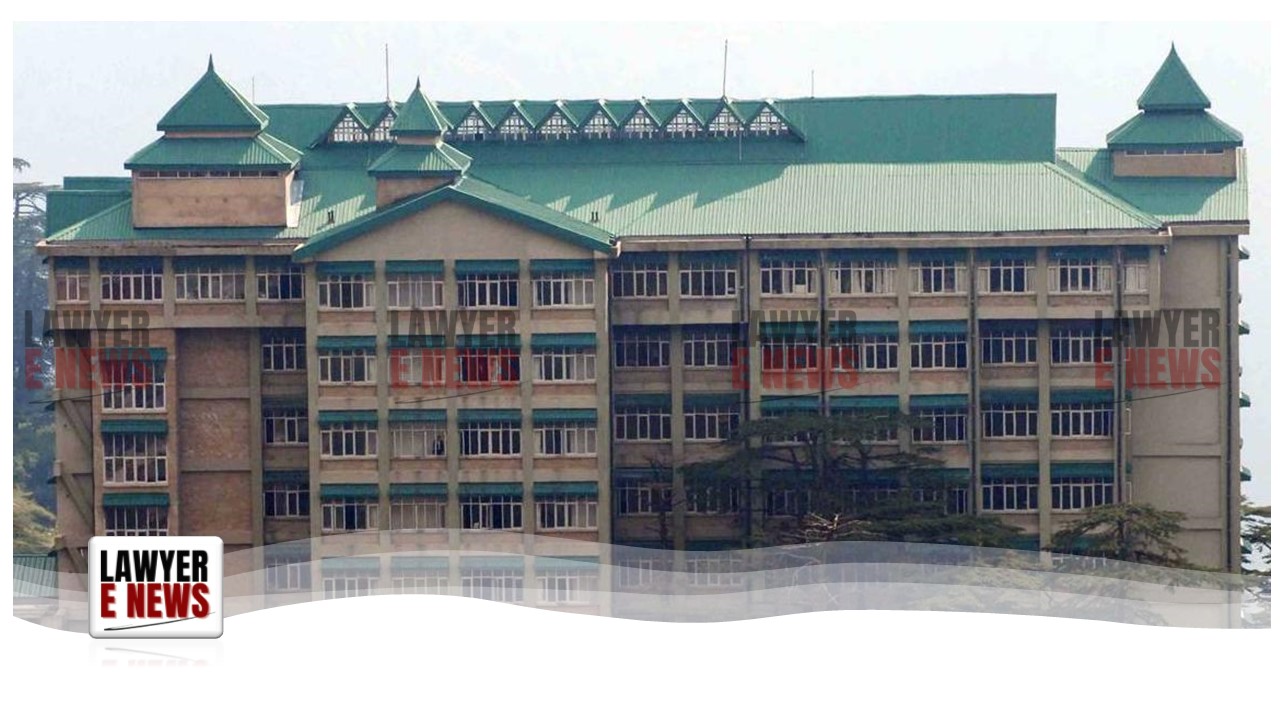
“When the police version suffers from serious contradictions, lacks photographic proof, and is unsupported by independent witnesses, the trial court’s acquittal cannot be disturbed” - In a strongly worded decision reinforcing the fundamental principle that criminal convictions must rest on clear, cogent, and credible evidence, the Himachal Pradesh High Court on 3rd November 2025, dismissed the State’s appeal against the acquittal of Sunil Bharti Rana in a case alleging illegal transportation of 55 cartons of country liquor under Section 61(1)(a) of the Punjab Excise Act, 1914, as applicable to Himachal Pradesh.
Justice Rakesh Kainthla held that the Trial Court's acquittal was based on a plausible and legally sustainable view, and serious procedural lapses, contradictions in police testimony, and absence of corroborative evidence, rendered the prosecution case highly suspect.
“A Motorcycle Cannot Carry Four Officers—Basic Inconsistencies Make Prosecution’s Version Unreliable”
“SI Som Nath (PW5), Constable Ashok Kumar, HHC Dilbag and HHG Lekh Raj could not have followed the Bolero in a motorcycle… this made the prosecution’s case highly suspect”
One of the most glaring inconsistencies that shook the foundation of the prosecution’s narrative was the implausible version regarding the police chase. According to the rukka and testimony of PW5, four officers followed the Bolero vehicle on a motorcycle—a physical impossibility, as observed by the Court:
“The rukka (Ex.PW5/B) reads that Constable Ashok Kumar, HHC Dilbag Singh and HHC Lekh Raj had chased the Bolero. A motorcycle is meant for two people. This made the prosecution’s case highly suspect.”
This contradiction between documents and oral testimony, coupled with the lack of any clear explanation, seriously undermined the reliability of the police's version of the events.
“Photographer Present, Yet No Photos of Search or Seizure? Court Questions Prosecution's Credibility”
“The photographer was called, yet did not witness or capture the search, sealing or recovery of liquor bottles… absence of such evidence raises serious doubt”
Despite the presence of a photographer at the alleged site of seizure, no photographs were taken of the search, opening of cartons, or sealing of liquor bottles—which, in the Court’s view, was a critical lapse. PW3, the photographer, admitted that he did not know the contents of the boxes and was not told what they were.
“It is nobody's case that Jitender Kumar had left the spot. The fact that he has not deposed about the checking of the contents of the cardboard boxes… casts a doubt regarding the prosecution’s case.”
The Court found it implausible that the prosecution failed to document the alleged seizure process when the means to do so were readily available. This omission, especially in a criminal case relying solely on police testimony, was held to be fatal to the prosecution’s case.
“Independent Witness Turned Hostile; Police Failed to Associate Any Neutral Person Despite Public Location”
“Non-association of independent witnesses when the seizure occurred at a public bus stand casts doubt on the fairness of the investigation”
The only independent witness, Jagdish Singh (PW1), clearly did not support the prosecution's case and was declared hostile. He categorically denied having seen the seizure or the recovery of liquor from the Bolero. He stated that he signed the documents merely on police request.
“This witness has not supported the prosecution’s case, and no advantage can be derived from his testimony.”
Further, PW2, a police witness, admitted that the location of seizure—Behri Chowk—had a bus stand where people normally gather. Despite this, no other independent witness was associated with the recovery, which the Court viewed as a serious procedural lapse:
“Learned Trial Court rightly held that non-association of independent witnesses in such a situation would cast a doubt regarding the prosecution’s case.”
“In Appeals Against Acquittal, High Threshold for Reversal: Trial Court's View Reasonable, Interference Unwarranted”
“If two reasonable conclusions are possible on the basis of the evidence, the appellate court should not disturb the finding of acquittal”
In its analysis of the State’s appeal, the High Court reiterated the settled principles of law governing interference with acquittals, as articulated in Surendra Singh v. State of Uttarakhand (2025) and Babu Sahebagouda Rudragoudar v. State of Karnataka (2024).
Justice Kainthla quoted from the Supreme Court rulings: “There is a double presumption in favour of the accused... the appellate court can interfere only if the acquittal suffers from patent perversity, is based on misreading or omission of material evidence, and only one conclusion—of guilt—is possible.”
Applying these principles, the Court held:“The learned Trial Court had taken a reasonable view of the matter while acquitting the accused, and this Court will not interfere with the reasonable view of the learned Trial Court, even if another view is possible.”
Appeal Dismissed, Acquittal Affirmed, State Fails to Prove Case Beyond Reasonable Doubt
The High Court upheld the acquittal of Sunil Bharti Rana, finding that the chain of events presented by the prosecution was riddled with contradictions, and the absence of independent corroboration, photographic evidence, or credible witness testimony rendered the entire case doubtful.
Justice Rakesh Kainthla summed up the Court’s stance clearly: “In view of the above, the judgment passed by the learned Trial Court is sustainable. Hence, the present appeal fails, and the same is dismissed.”
This case underscores the indispensability of procedural integrity and evidentiary rigor in criminal prosecutions, particularly where liberty of an individual is at stake.
Date of Decision: 3 November 2025