-
by sayum
24 August 2026 3:22 PM







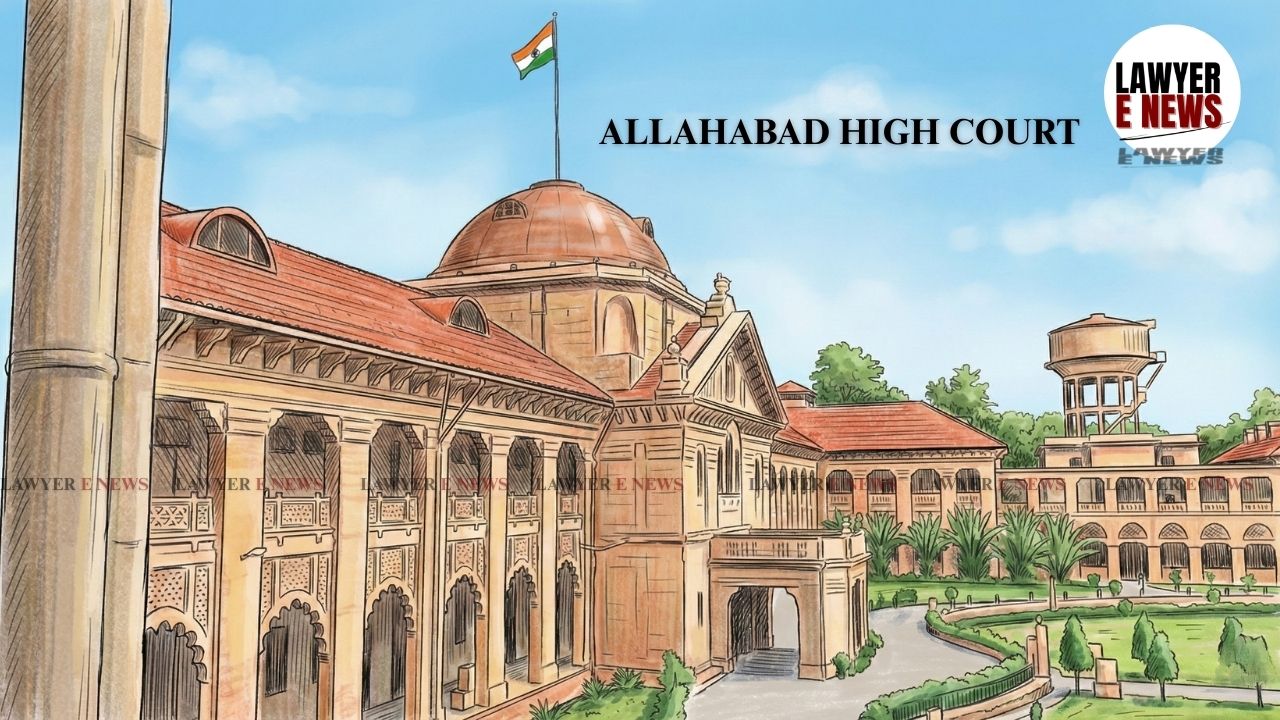
“Once Cognizance Is Taken, A Judicial Order Intervenes – Remedy Lies Under Section 528 BNSS, Not Article 226” – In a significant ruling Allahabad High Court (Lucknow Bench), comprising Justice Chandra Dhari Singh and Justice Lakshmi Kant Shukla, dismissed a criminal writ petition filed by businessman Sanjay Wahi, challenging the FIR, charge-sheet, and cognizance order arising out of allegations of cheating and forgery in a commercial land development transaction. The Court held that a criminal writ petition under Article 226 of the Constitution becomes non-maintainable once the Magistrate takes cognizance upon a charge-sheet, as a judicial order then intervenes. It clarified that such orders can be challenged only before the appropriate forum under Section 528 of the Bharatiya Nagarik Suraksha Sanhita, 2023 (corresponding to Section 482 CrPC), and not through Article 226.
The Bench observed:
“Once cognizance has been taken by the Court concerned, a writ petition under Article 226 simplicitor cannot survive against a judicial order. The legal remedy lies before a court competent to hear a petition under Section 528 BNSS.”
“Article 226 Cannot Be Used as a Backdoor to Challenge Judicial Orders – Roster Jurisdiction is Sacrosanct” – Court Refuses to Entertain Challenge Without Proper Assignment
The petition arose out of FIR No. 311 of 2024, registered at Police Station Beta 2, Greater Noida, under Sections 420, 406, 467, 468, 471, 120-B, 504 and 507 IPC, based on a complaint alleging fraudulent conduct in a land partnership deal. During pendency of the writ petition, the investigation was completed, charge-sheet filed, and cognizance taken on 26.08.2025 by the Magistrate. The petitioner thereafter amended the writ petition to challenge the charge-sheet and cognizance order.
However, the High Court categorically refused to entertain this challenge under Article 226, citing constitutional limitations and strict adherence to roster norms laid down by the Chief Justice. The Court stressed:
“This Court is not exercising dual jurisdiction under Articles 226 and 227 or Section 528 BNSS. Therefore, it cannot entertain prayers which fall outside the purview of Article 226.”
In doing so, the Bench drew heavily from the Supreme Court’s recent judgments in Neeta Singh v. State of U.P., 2024 SCC OnLine SC 5761 and Pradnya Pranjal Kulkarni v. State of Maharashtra, 2025 SCC OnLine SC 1948.
“Merely Labeling a Dispute as Civil Does Not Preclude Criminality – Allegations Must Be Tested at Trial” – Court Declines to Enter Merits
Senior Advocates Mr. Gopal Swaroop Chaturvedi and Mr. Dinesh Kumar Goswami, appearing for the petitioner, had argued that the FIR and ensuing proceedings stemmed from a purely civil-commercial dispute arising out of a partnership deed, governed by an arbitration clause. They emphasized that the dispute was about profit sharing in a real estate venture, and the criminal justice system was being misused as a tool to pressurize the petitioner.
Relying on Sharif Ahmed v. State of U.P., (2024) 14 SCC 122 and Vesa Holdings v. State of Kerala, (2015) 8 SCC 293, the petitioner contended that breach of contract does not automatically attract criminal liability unless fraudulent intent existed at inception.
The Court, however, refused to enter the factual arena or examine whether the dispute was civil or criminal in nature, precisely because cognizance had already been taken. The Bench reiterated:
“The merits of allegations must be examined by the appropriate criminal court in a petition under Section 528 BNSS. This Court, exercising writ jurisdiction under Article 226, cannot adjudicate the correctness of a judicial order post-cognizance.”
“High Court Cannot Overstep the Roster—Judicial Discipline Requires Strict Adherence to Allocation by Chief Justice” – Bench Cites Constitutional Structure
Importantly, the Court underscored that roster discipline is not merely a procedural formality but part of constitutional convention and judicial hierarchy. A judge or bench assigned matters under Article 226 cannot assume jurisdiction under Article 227 or Section 528 BNSS, unless specifically assigned by the Chief Justice.
Quoting from State of Rajasthan v. Prakash Chand, (1998) 1 SCC 1, the Court observed:
“The Chief Justice is the master of the roster. He alone has the prerogative to constitute benches and allocate cases. No judge or bench can assume a different jurisdiction than what is assigned.”
Thus, since applications under Section 528 BNSS (or Section 482 CrPC) are required to be placed before a Single Judge Bench, and the present matter was listed before a Division Bench under Article 226, the Court refused to overstep its assigned jurisdiction.
“Twin Jurisdiction Permissible Only When Pleadings and Roster Both Permit” – Clarifies Impact of Supreme Court Ruling in Pradnya Kulkarni Case
The Division Bench referred to the Supreme Court’s clarification in Pradnya Pranjal Kulkarni v. State of Maharashtra, where it was held that the High Court retains jurisdiction to quash even post-cognizance, but only if the petition explicitly invokes both Article 226 and Section 528 BNSS, and if the bench is assigned such twin jurisdiction.
In the present case, the High Court noted:
“The petition was filed purely under Article 226. Neither the pleadings nor the assignment permitted invocation of Section 528 BNSS. Hence, the prayers to quash the cognizance order are outside the jurisdiction of this Bench.”
Writ Dismissed as Not Maintainable, Liberty Granted to Move Section 528 BNSS Application
Concluding the matter, the Court dismissed the writ petition as not maintainable, without entering into the factual or legal merits of the criminal case. It left open the door for the petitioner to move the appropriate forum:
“Accordingly, the instant writ petition is dismissed as not maintainable. The petitioner is at liberty to move an appropriate application or petition before the appropriate court to quash the cognizance order.”
This judgment serves as a crucial precedent on jurisdictional discipline, post-cognizance remedy pathways, and the boundaries of Article 226 writ jurisdiction in criminal proceedings, especially in the wake of the newly enacted Bharatiya Nagarik Suraksha Sanhita, 2023.
Date of Decision: 13 January 2026