-
by sayum
28 August 2026 2:11 PM







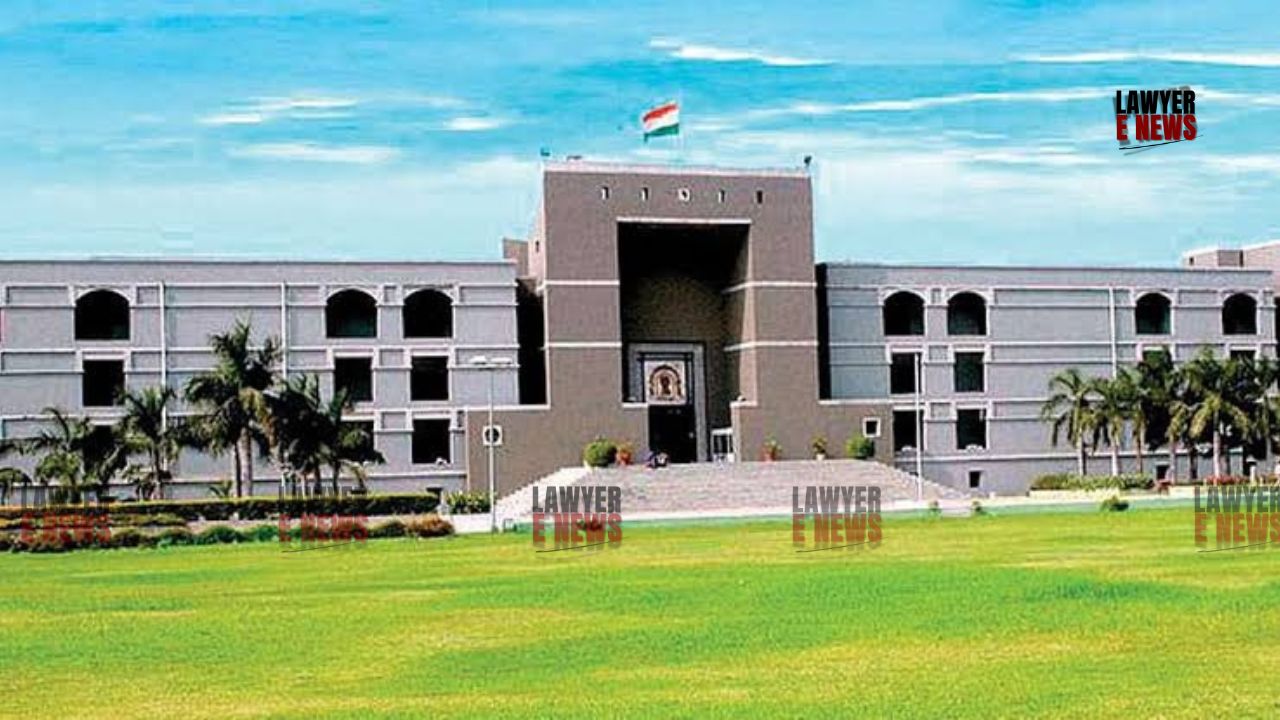
"High Court notes that the petitioner, while inside jail, has been threatening the witnesses and there is likelihood that, in case, he is released on bail, he would further tamper with and threaten the witnesses," Gujarat High Court, in a significant ruling, held that judicial observations regarding a convict's conduct—specifically the propensity to threaten witnesses while in custody—are critical factors that justify the refusal to suspend a sentence.
A bench of Justice Vimal K. Vyas observed that when superior courts have already noted a reasonable apprehension of witness tampering, the discretionary power to grant bail under Section 389 of the CrPC must be exercised with extreme caution.
The case involved a petitioner, Ramanbhai Bholidas Patel, who was convicted by the Additional Chief Judicial Magistrate, Sanand, for orchestrating a land-grabbing conspiracy involving forged revenue orders and the illegal transfer of restricted tenure lands to 52 companies. The petitioner moved the High Court under Articles 226 and 227 of the Constitution after the Sessions Court rejected his application for suspension of sentence and bail pending his criminal appeal.
The petitioner was sentenced to four years of simple imprisonment for offenses under Sections 465, 467, 468, 471, and 120B of the IPC. He was accused of forging a Mamlatdar’s order to show the conversion of new tenure agricultural land into old tenure, thereby facilitating the illegal execution of sale deeds in favour of companies controlled by his family. Despite being a senior citizen who had undergone over two years of incarceration, the Sessions Court refused to release him on bail, citing the gravity of the offense and his criminal antecedents.
The primary question before the court was whether the Sessions Court committed a manifest error or perversity in declining to suspend the petitioner’s sentence. The court was also called upon to determine the weight to be given to prior observations made by the Supreme Court regarding the petitioner’s conduct of threatening witnesses while in judicial custody.
Impact Of Prior Judicial Observations On Witness Threats
The Court placed heavy reliance on the conduct of the petitioner as previously scrutinized by both a Coordinate Bench of the High Court and the Supreme Court in earlier bail proceedings. Justice Vyas noted that in SLP (Crl.) No. 761 of 2025, the Supreme Court had specifically recorded that the petitioner was threatening witnesses from within the jail. The court observed that such findings by superior courts create a "reasonable apprehension" that the petitioner, if released, would use his financial resources and influence to win over or further intimidate prosecution witnesses.
Court Emphasizes Gravity Of Witness Tampering
The Court held that the integrity of the judicial process is paramount, and any conduct that undermines the safety of witnesses is a ground to deny relief. It noted that the prosecution’s contention regarding the likelihood of evidence tampering was not a mere allegation but was backed by judicial record. The bench emphasized that the "judicial conscience" dictates that bail be denied where a gross failure of justice might occur through the intimidation of the "star witnesses" of the case.
Habitual Nature Of Offenses And Criminal Antecedents
Convict’s History Of Forgery And Deception Precludes Relief
The Court scrutinized a list of 11 serious criminal cases registered against the petitioner, involving similar allegations of creating false death certificates, forged powers of attorney, and concocted revenue records. It found that in five such matters, crucial original documents could not be recovered despite sincere efforts by the Investigating Officer. The bench observed that the petitioner appeared to be a "habitual offender" involved in well-orchestrated conspiracies to usurp valuable agricultural lands.
No Manifest Error In Sessions Court’s Discretionary Order
Writ Jurisdiction Cannot Substitute Wisdom Of Lower Courts
While analyzing the scope of Article 227, the Court reiterated that its supervisory jurisdiction is not an "appeal in disguise" and cannot be used to re-appreciate evidence or substitute the lower court's discretion with its own. Citing the Supreme Court’s ruling in Omprakash Sahni vs. Jai Shankar Chaudhary, the bench held that for a sentence to be suspended, there must be something "apparent or gross on the face of the record" to show the conviction might not be sustainable. In this case, the court found the trial court's judgment to be well-reasoned and free from palpable error.
Title Does Not Pass Through Forged Documents
Execution Of Sale Deeds On Fictitious Orders Constitutes Forgery
The Court rejected the defence argument that no "wrongful gain" occurred because possession had not changed hands. It held that the act of registering sale deeds based on a fictitious Mamlatdar’s order itself constitutes the making of a false document with fraudulent intent. The bench noted that the law on "wrongful gain" includes intended and potential consequences, and the assertion of a right based on forged documents reinforces the fraudulent intent behind the conspiracy.
Dismissing the petition, the High Court concluded that given the petitioner’s conduct and the ongoing crucial stages of other trials against him, the Sessions Judge had exercised discretion legally and properly. However, considering the petitioner’s age and the period already served, the court directed the Sessions Court to hear and dispose of the main criminal appeal expeditiously within six months.
Date of Decision: 12 June 2026