-
by sayum
25 August 2026 4:32 AM







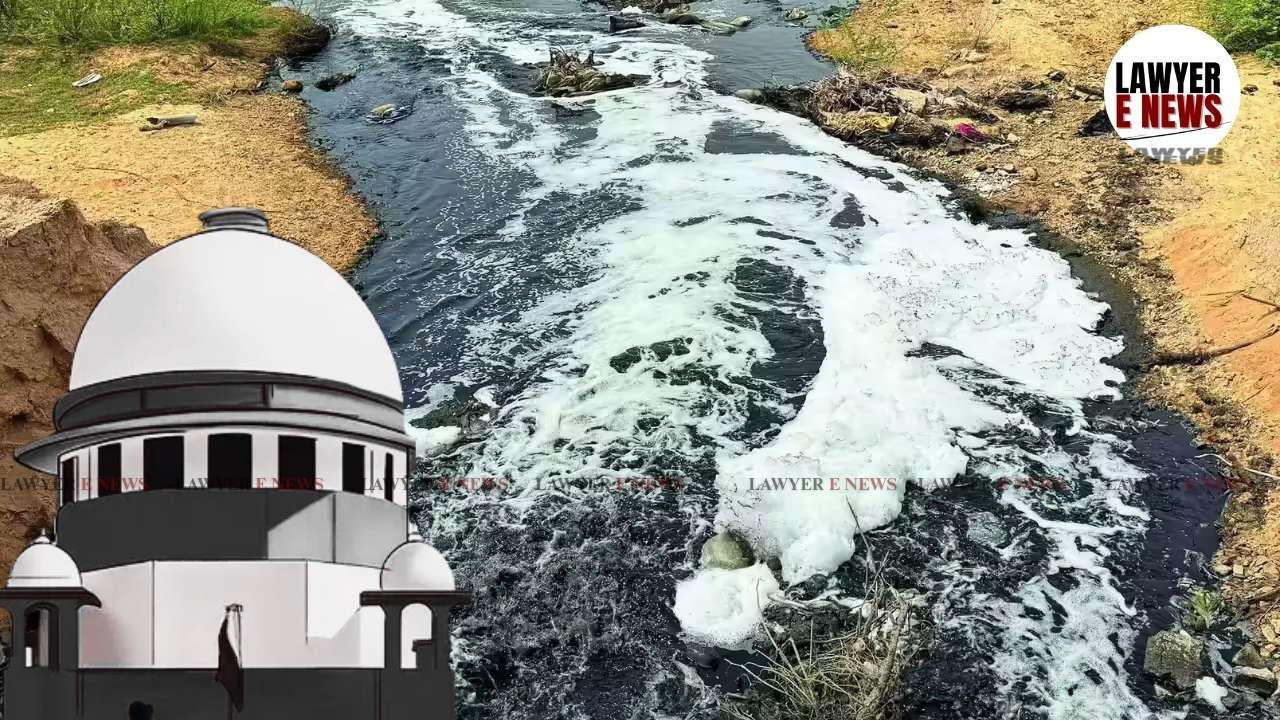
“Environmental injury of this magnitude cannot be reversed by knee-jerk reactions, incremental compliances or symbolic enforcement. It requires a coordinated and scientifically informed response grounded in the precautionary principle, sustainable development and the inter-generational equity doctrine.”, Supreme Court of India, in a landmark judgment in Suo Motu Writ Petition (Civil) No. 8 of 2025, delivered by a Bench comprising Justices Vikram Nath and Sandeep Mehta, undertook judicial intervention in the chronic environmental emergency caused by the decades-long contamination of Jojari, Bandi, and Luni rivers in Rajasthan.
Taking suo motu cognizance of a documentary titled “2 Million Lives at Risk | India’s Deadliest River”, the Court revived regulatory directions of the National Green Tribunal (NGT) that had been under interim stay, constituted a High-Level Ecosystem Oversight Committee, and held the State of Rajasthan accountable for gross dereliction of its constitutional obligations under Articles 21, 47, 48A, and 51A(g).
“The Right to Life Includes the Right to Safe Water and a Healthy Environment”
Court Finds Constitutional Violation in State’s Inaction
The Supreme Court observed that the pollution of rivers Jojari, Bandi and Luni constituted not merely an environmental catastrophe but a constitutional injury. Tracing the roots of this doctrine to cases like Subhash Kumar v. State of Bihar and Virender Gaur v. State of Haryana, the Court reiterated:
“The right to life under Article 21 includes the right of enjoyment of pollution-free water and air for full enjoyment of life. If anything endangers or impairs that quality of life in derogation of laws, a citizen has a right to have recourse to Article 32.”
The Court did not mince words in condemning the State Government’s apathy, stating that it had “woken up from its slumber” only after the Court's suo motu intervention. The environmental devastation, ongoing for nearly two decades, was described as a “systemic collapse of regulatory vigilance”, where “the injury transcends the ecological realm and becomes a direct constitutional injury.”
Origin of the Case: A Crisis Decades in the Making
The proceedings were triggered by the Supreme Court’s order dated 16th September 2025, upon viewing a documentary exposing the toxic state of the Jojari river, a tributary to the Luni river, which along with Bandi, flows through industrial hubs like Jodhpur, Pali and Balotra. These rivers, once seasonal lifelines for agriculture and village ecosystems, had turned into toxic drains, contaminated by textile and steel industry effluents, municipal waste, and untreated sewage.
Multiple writ petitions filed before the Rajasthan High Court and the National Green Tribunal (NGT) culminated in the Justice P.C. Tatia Monitoring Committee reports and the NGT’s final order dated 25th February 2022, which prescribed a comprehensive action plan. However, a series of statutory appeals by RIICO, municipal councils and local bodies led to an interim stay on the NGT’s order by the Supreme Court, which, as the Court later found, had been misused as an excuse for complete inaction.
The legal issues spanned constitutional, statutory, and environmental law domains:
On these issues, the Court held:
“Polluted rivers, contaminated groundwater, and the resulting impairment of health and livelihood dilute the very substance of the right to life as enshrined under Article 21... reducing it from a living guarantee into a fragile abstraction.”
Regulatory Collapse and Systemic Failure
The Court conducted a meticulous analysis of the State’s 95-page status report and concluded:
Revival of NGT’s Order and Modification of Stay
In a significant legal development, the Supreme Court modified its earlier stay on the NGT’s final order dated 25.02.2022, holding:
“The stay on the National Green Tribunal’s directions has, in effect, been misinterpreted to freeze the implementation of the remedial framework… allowing the stay to persist would defeat the very purpose of the statutory mechanism.”
Thus, the Court revived all substantive and regulatory directions issued by the NGT, while continuing the stay only in respect of remarks made against RIICO and the imposition of Rs. 2 crore environmental compensation—which the Court held shall be revisited based on future compliance.
Constitution of High-Level Ecosystem Oversight Committee
Recognising the need for scientific and sustained supervision, the Court constituted a High-Level Ecosystem Oversight Committee chaired by Justice Sangeet Lodha (Retd.), with members from:
The Committee has been vested with wide powers, including:
The Court directed that the first report of the Committee be submitted by 27th February 2026, with recurring updates every 8 weeks thereafter.
Financial and Logistical Support
The State of Rajasthan was directed to provide full infrastructural, logistical and financial support, including:
“Expenditure incurred... shall be recoverable from the erring officials or departments and from the industries or industrial units found responsible.”
Operative Directions of the Court
Among its comprehensive directions, the Court ordered:
The judgment concludes with a solemn reminder:
“The directions issued herein are not merely administrative but arise from the constitutional duty of this Court to safeguard the fundamental right to life… It is therefore imperative that the remedial framework is implemented with urgency, fidelity and resolve.”
The Supreme Court’s judgment in the Jojari River pollution case stands as one of the most comprehensive environmental rulings in recent years. It combines constitutional jurisprudence, environmental justice, statutory enforcement and institutional innovation, serving as a blueprint for ecological restoration.
By transforming a public documentary into judicial action, the Court has re-affirmed its role as the sentinel on the qui vive for environmental and human rights. As the rivers of western Rajasthan struggle to breathe, the judgment ensures that the State can no longer wash its hands of responsibility.
Date of Decision: 21st November 2025