-
by sayum
24 August 2026 3:22 PM







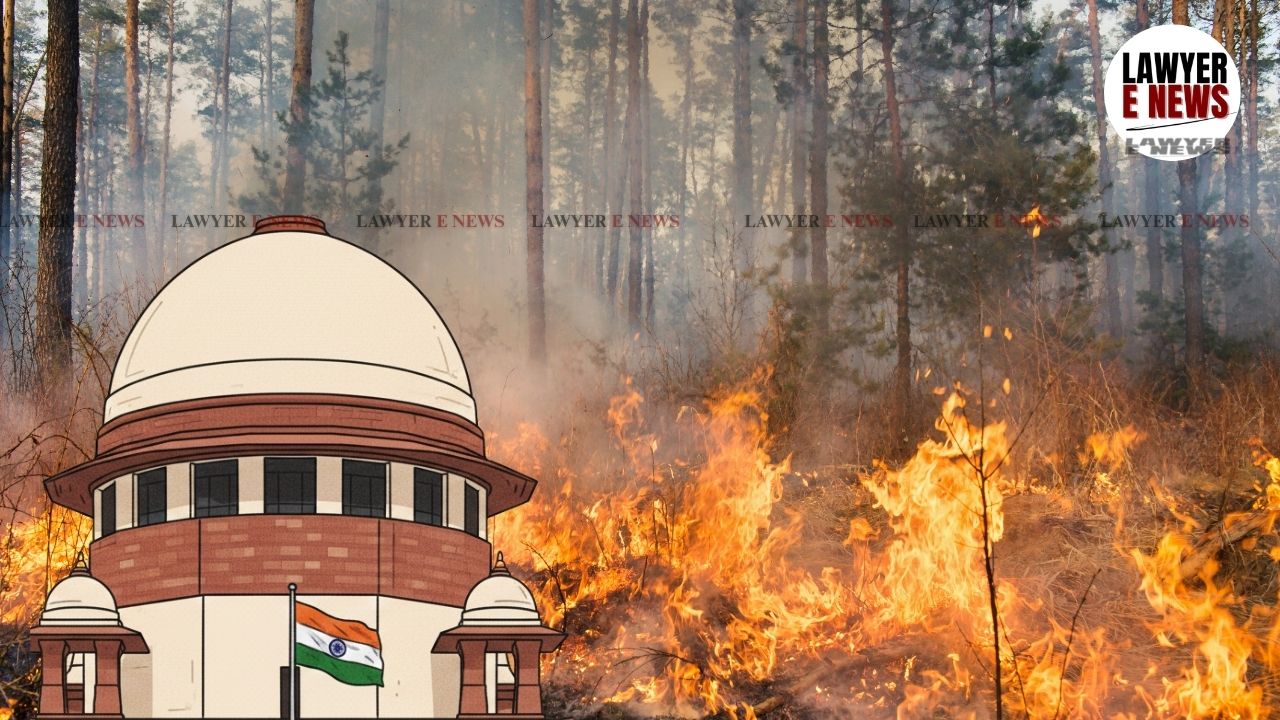
No Criminal Liability in Acts of Vis Major, In a significant judgment Supreme Court of India discharged a Forest Officer accused of causing the deaths of several trekkers during the infamous Kurangani forest fire incident in 2018. The Court held that the tragedy, which resulted in multiple fatalities due to a sudden forest fire, constituted an act of vis major (an unforeseeable natural calamity), and that there was no evidence of criminal intent, knowledge, rashness or negligence on part of the appellant to justify charges under Sections 304 (Part II), 304A, 326 or 338 of the Indian Penal Code.
Setting aside the earlier orders of the Sessions Court (dated 28.10.2024) and the High Court (dated 03.06.2025), a Bench comprising Justice B.V. Nagarathna and Justice R. Mahadevan held:
"The deaths occurred owing to a forest fire which is in the nature of a vis majeure; therefore, the said Sections [304 Part II and 326 IPC] do not apply to the facts of the case.”
“Facilitation of Trekking is Not a Crime”: Court Applies Parity With Earlier Order Quashing Charges Against Co-Accused
The Supreme Court drew a clear parallel between the appellant and a co-accused, Peter Van Geit, an organiser of the trek, whose prosecution had already been quashed by the Court in Criminal Appeal No. 369 of 2024 on January 23, 2024. In that judgment, the Court had ruled that no offence under Sections 304A or 338 IPC could be made out in absence of negligence or intent, since the fire was sudden and unforeseeable.
The same logic, the Court held, applied equally to Jeyasingh, a government servant who merely facilitated trekking activities in his official capacity:
“We are persuaded to follow our earlier order... the reasoning therein would squarely apply in the instant case also.”
“We fail to understand as to how the said Section [326 IPC] applies in the instant case... We reiterate that the deaths occurred owing to the forest fire, not due to any voluntary act of the appellant.”
The Court sharply criticised the invocation of grave penal provisions without proper factual foundation:
“Courts ought to discharge the accused instead of compelling trial merely on the basis of official position.”
Tragedy During Women’s Day Trek Becomes Legal Quagmire
On March 11, 2018, two trekking groups — one led by the Chennai Trekking Club and another group from Erode — entered the Kurangani forest area in Theni District, Tamil Nadu. Both had obtained trekking passes from the Forest Department. At around 2 p.m., a massive forest fire engulfed the region. Several trekkers were injured or killed, mostly due to burn injuries and smoke inhalation.
Jeyasingh, a Forest Officer, was accused of permitting the trek, receiving the trekking fees, and deploying a guide (Ranjith) to accompany the group. The prosecution alleged that he facilitated entry into a prohibited forest route and failed to warn about the fire risk.
Initially registered under Section 174 CrPC, the FIR was later altered to invoke Sections 338, 304A, 304 (Part II), and 326 IPC. A chargesheet was filed against Jeyasingh and two others, including Peter Van Geit.
While Van Geit succeeded in getting the case against him quashed in 2024, Jeyasingh’s plea for discharge under Section 227 CrPC was rejected by the Sessions Court and the Madras High Court, both of which opined that “sufficient material” existed to proceed against him. They also tried to distinguish his case from that of the organiser by citing the invocation of more serious offences like Section 304 (Part II) and 326 IPC.
Supreme Court Rebuts High Court’s Reasoning on Applicability of Offences
The Apex Court rejected the High Court’s reasoning that Section 227 CrPC (discharge) and Section 482 CrPC (quashing) were too distinct to import the same legal logic. It clarified that substantive parity in facts must override technical procedural differences, especially when the underlying basis of criminal liability is absent.
“We find that the Sessions Court as well as the High Court ought to have discharged the appellant herein rather than holding that the appellant had to face the trial merely because he was employed as a Forester.”
Specifically addressing the ingredients of Section 304 Part II IPC, the Court ruled:
“There is no material to show that the appellant acted with the knowledge that his act was likely to cause death... The forest fire is not attributable to any act of the appellant.”
Similarly, with respect to Section 326 IPC (grievous hurt by dangerous means), the Court observed:
“We fail to understand as to how the said Section applies... injuries were caused not by any act of the appellant, but by the fire itself.”
Discharge Under Section 227 CrPC Upheld: No Prima Facie Case Made Out
Referring to the well-settled principle of discharge under Section 227 CrPC, the Court reiterated that where the basic ingredients of an offence are not disclosed even on admitted facts, the accused must be discharged to prevent abuse of process.
“The appellant is discharged from the offences alleged against him,” the Court concluded.
Implications of the Ruling: Forest Officials and Force Majeure
The judgment reiterates a critical principle in criminal law: culpability requires not just consequence, but also intention, knowledge, or negligence. Forest fires — unless directly caused or exacerbated by human action — fall within the realm of vis major, where criminal liability cannot be readily imputed.
The ruling also sends a strong message against the over-criminalisation of public servants merely because they occupy positions of responsibility.
It further clarifies that mere official acts (like issuing trekking passes or deploying guides) do not constitute criminal conduct unless they are shown to be reckless or malicious.
A Judicious Discharge of a Public Servant in Absence of Criminal Elements
In summing up, the Court has not only vindicated the appellant but also reaffirmed key doctrines that govern criminal jurisprudence — particularly in cases involving accidents and natural calamities. The discharge of the Forest Officer reflects the Court’s consistent stance that criminal trials cannot be sustained on mere conjecture or misplaced public expectations.
“Criminal liability cannot be fastened in the absence of rashness, negligence, intention or knowledge” — the Court observed, putting to rest a prolonged and painful criminal prosecution.
Date of Decision: 18/11/2025