-
by sayum
25 August 2026 12:32 PM







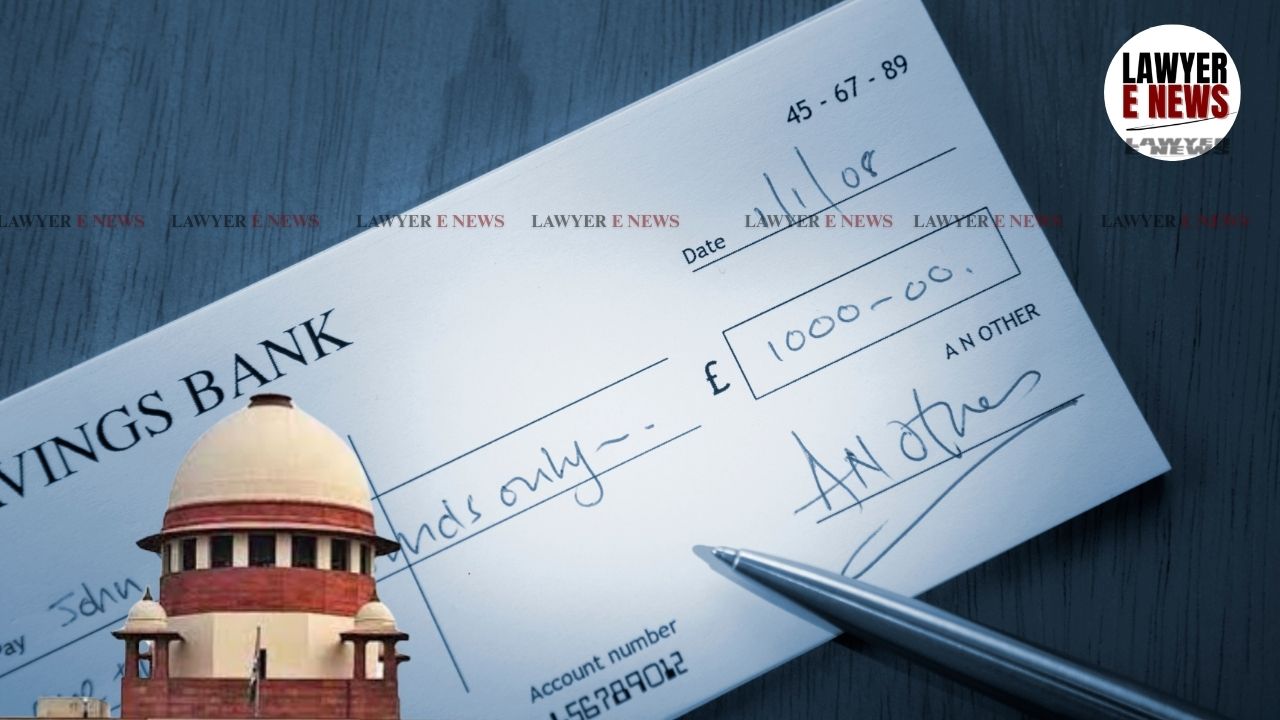
"Breach of Section 269SS IT Act invites only penalty, not invalidation of debt under NI Act" – In a major ruling that settles the clash between income tax compliance and cheque bounce prosecutions, the Supreme Court set aside a judgment of the Kerala High Court that had acquitted an accused in a Section 138 NI Act case solely on the ground that the loan of ₹9,00,000 was given in cash, allegedly violating Section 269SS of the Income Tax Act, 1961.
Bench comprising Justice Prashant Kumar Mishra and Justice Vipul M. Pancholi ruled that violation of Section 269SS of the Income Tax Act does not render a loan legally unenforceable, nor does it rebut the statutory presumptions under Sections 118 and 139 of the Negotiable Instruments Act, 1881.
The High Court, relying on its own judgment in P.C. Hari v. Shine Varghese, had quashed the conviction of the accused under Section 138 NI Act on the logic that a cash loan exceeding ₹20,000 was per se invalid under income tax laws, and hence not a "legally enforceable debt". The Supreme Court emphatically rejected this premise and held:
“Any breach of Section 269SS of the IT Act, 1961 is subject to a penalty only under Section 271D. Neither provision renders such a transaction void, illegal, or unenforceable under the NI Act.”
High Court’s Legal Foundation “Does Not Survive”: Supreme Court Invokes Sanjabij Tari Judgment
The apex court referred to its earlier judgment in Sanjabij Tari v. Kishore S. Borcar, where it had laid down that mere violation of tax norms cannot alter the criminal liability under the NI Act. Citing with approval Paras 19 and 20 of that judgment, the Bench declared:
“A transaction in violation of Section 269SS of the IT Act would not rebut the presumptions under Sections 118 and 139 of the NI Act. Such a person may be penalised under the IT Act, but the debt remains legally enforceable for purposes of Section 138.”
Accordingly, the conclusion of law in P.C. Hari — that a debt arising from a cash transaction over ₹20,000 would not attract the presumption under Section 139 — was explicitly overruled.
Cash Transaction May Be Improper, But It’s Still Enforceable Under NI Act
The Supreme Court's ruling clarifies a vital legal position: A cheque issued in discharge of a loan advanced in violation of income tax law does not lose its enforceability unless the statute itself declares it void. In this case, the loan of ₹9,00,000 had been advanced in cash, but the accused had issued a cheque which bounced. The trial court had convicted the accused, awarding one year’s imprisonment and compensation under Section 357(3) CrPC, and the Sessions Court had upheld the conviction.
However, the High Court reversed both findings, accepting the argument that violation of Section 269SS IT Act defeats the “legally enforceable debt” requirement under Section 138 NI Act. This interpretation, the Supreme Court has now held, was erroneous:
“Section 269SS does not declare transactions above ₹20,000 in cash as void. It only subjects the parties to penalty under Section 271D of the IT Act.”
Supreme Court Sends Case Back to High Court for Fresh Consideration
While setting aside the High Court’s order, the Supreme Court did not restore the conviction but remitted the matter back to the Kerala High Court for fresh consideration on merits, explicitly stating that the legal foundation on which the High Court judgment was based no longer exists.
“The very foundation of the impugned judgment rendered by the Kerala High Court does not survive,” the Court said. “We set aside the judgment and remit the matter back to the High Court for fresh consideration as permissible under revisional jurisdiction.”
The parties were directed to appear before the High Court on 17 February 2026, with the appeal standing disposed of in these terms.
Impact of the Judgment: NI Act Remains Autonomous of IT Act Violations
This ruling sends a clear message to both lower courts and litigants: The legality of a financial transaction under tax law does not determine its enforceability under the Negotiable Instruments Act. Section 138, which criminalises cheque dishonour for a legally enforceable debt or liability, cannot be nullified on the ground of cash being used for the initial loan.
It also reaffirms the robust statutory presumptions under Sections 118 and 139 NI Act, shielding genuine cheque-based liabilities from being trivialised through technical violations of parallel laws.
As the apex court clarified:
“Any person assuming himself to be the payee or holder in due course cannot be denied the benefit of presumption under Section 139 merely because the transaction was in cash. To say otherwise would be to rewrite the law.”
The Supreme Court's judgment not only protects the core integrity of the cheque bounce jurisprudence under Section 138 NI Act, but also harmonises its application with tax laws by drawing a clear boundary — penalty under the IT Act does not invalidate enforceability under the NI Act. The verdict is a strong rebuke to judicial interpretations that seek to mix criminal tax compliance with the realm of negotiable instruments.
Date of Decision: December 8, 2025