-
by kapil
03 November 2026 9:17 AM







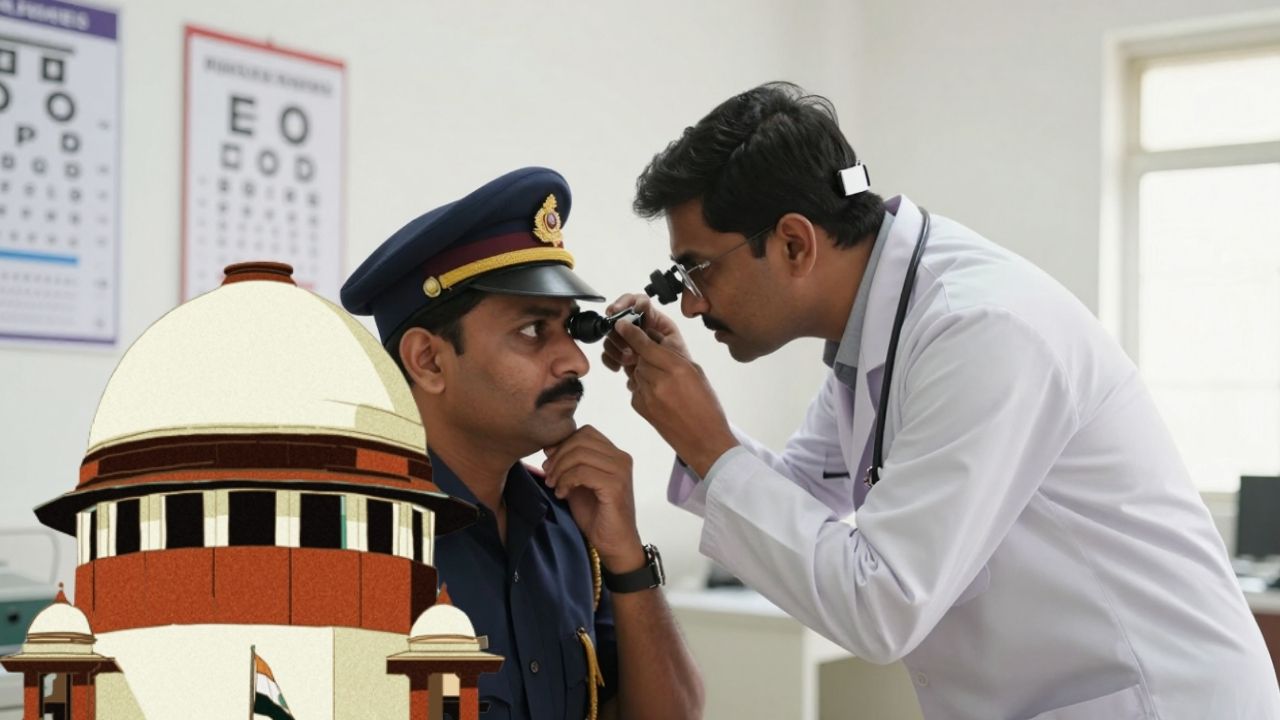
"The aforesaid Report would persuade us to accept the plea of the Appellant of having been deprived of her legitimate right for being appointed to the post of Police Constable Civil Police after having successfully cleared all the tests." Setting aside the rejection of a candidate on the ground of an alleged ophthalmic defect, the Supreme Court bench of Justice Aravind Kumar and Justice Vipul M. Pancholi on November 2, 2026, held that a candidate declared medically unfit due to an alleged squint cannot be denied public employment when an independent expert medical board constituted under judicial directions certifies her vision to be proper and normal.
The appellant applied for the post of Constable Civil Police under the U.P. Police Constable Civil Direct Recruitment, 2023, and cleared the Document Verification and Physical Standard Test. However, the departmental Medical Board and subsequent Divisional Medical Board under Rule 15(6)(d) of the UP Police Constable and Head Constable Service Rules, 2015 declared her unfit due to an alleged squint eye without furnishing a written rejection order. After independent evaluations from government medical college specialists confirmed her vision was normal, she approached the High Court seeking a fresh medical examination, which came to be dismissed solely on the ground that the selection process had concluded.
Whether the High Court was justified in rejecting the plea for an independent medical re-examination merely on the ground of conclusion of the selection process when conflicting medical opinions raised serious doubts over the initial disqualification.
Whether a meritorious recruitment candidate wrongfully declared medically unfit for an ocular defect is entitled to an appointment order pursuant to a confirmatory medical opinion issued by an independent apex medical institution.
The Supreme Court took judicial notice of the fact that the candidate was excluded from public employment despite clearing all recruitment phases and securing contrary opinions from two independent, qualified government specialists casting serious doubts on the initial assessment.
Supreme Court exercises powers to secure impartial medical determination
To ascertain the definitive medical fitness of the candidate, the Court invoked its jurisdiction and directed King George’s Medical University, Lucknow, to constitute an expert medical board in ophthalmology specifically to examine the alleged defect.
The Court observed that under similar circumstances, an independent medical board had previously been constituted to prevent candidates from being arbitrarily shut out from the recruitment process.
Expert report conclusively establishes normal vision and ocular health
The four-member expert medical board from King George’s Medical University placed its clinical examination report on record, finding the appellant's visual acuity to be 6/6 in both eyes, with ocular movements, pupillary reactions, fundus, and anterior segment digitally within normal limits.
The bench closely scrutinized the clinical findings and observed that the specialized ophthalmic evaluation decisively confirmed normal ocular health, directly contradicting the summary oral rejection by the departmental board.
Arbitrary medical exclusion violates legitimate right to appointment
The bench emphasized that the appellant had established a legitimate right to recruitment after clearing all document verifications and physical tests, and could not be deprived of public employment on unsubstantiated medical premises.
The Court held that in the peculiar facts of the case, and particularly in the teeth of the certification issued by the independent medical board of King George’s Medical University, the adverse findings arrived at by the departmental authorities stood superseded.
Allowing the appeal, the Supreme Court set aside the High Court's dismissal order and directed the respondent authorities to issue an appointment order or call letter to the appellant for the post of Constable Civil Police, provided she is otherwise qualified. The bench clarified that the appellant shall not be entitled to claim seniority over candidates who have already been appointed up to the date of the decision.
Date of Decision: November 2, 2026