-
by sayum
24 August 2026 3:22 PM







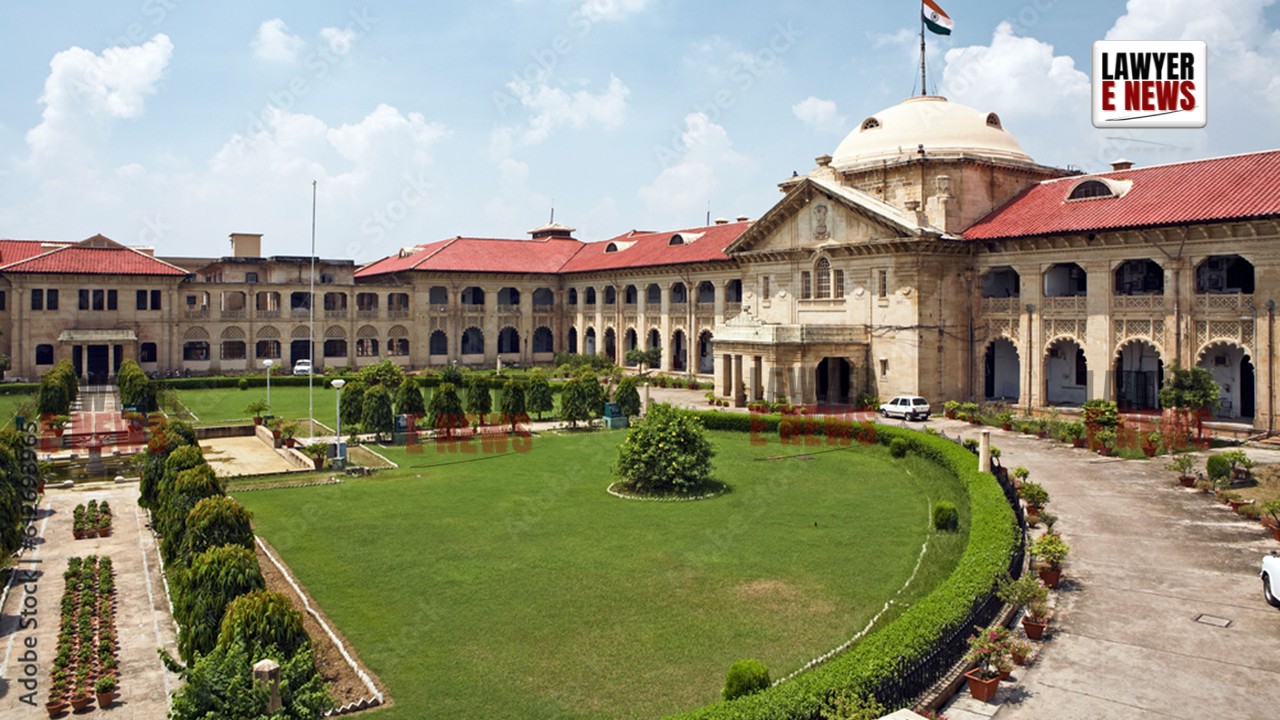
“No legally enforceable rights flow from an MOU not signed by all owners, not registered, and not duly stamped,” Allahabad High Court upheld the rejection of an ad-interim injunction sought by M/s Sai Dham Apartments and another against Ravi Kumar Mehrotra and others, firmly reiterating that “an unstamped and unregistered MOU does not create enforceable legal rights, and a suit for injunction simpliciter cannot lie without seeking specific performance.”
Justice Sandeep Jain concluded that the plaintiffs—claiming rights over a multi-crore residential project based on an unregistered Memorandum of Understanding (MOU)—had no prima facie enforceable right, nor were they in lawful possession, and thus could not seek to restrain the true landowners from entering into a fresh development agreement with a third party.
“Injunction Is Not a Weapon to Enforce a Disputed, Inadmissible MOU Without Seeking Specific Relief”
The central legal question in this appeal under Order 43 Rule 1(r) CPC was whether a developer could maintain a suit for permanent injunction based solely on an unregistered, unstamped MOU, without claiming either specific performance or a declaration, and whether the trial court’s rejection of temporary injunction under Order 39 Rules 1 and 2 CPC warranted interference.
Justice Jain answered emphatically in the negative, ruling:
“The MOU, having not been signed by all co-owners, and being neither stamped nor registered, is inadmissible in evidence and incapable of conferring any enforceable right in favour of the plaintiffs.”
Further, the Court emphasized that even the MOU itself acknowledged it required registration and payment of stamp duty—an obligation placed squarely on the builder—but the plaintiffs failed to comply with this.
“Suit for Injunction Barred When Specific Performance Is Equally Efficacious Remedy”
Referring to Section 41(h) of the Specific Relief Act, 1963, the Court held that the plaintiffs could not seek injunctive relief when they deliberately chose not to claim specific performance of the MOU, despite alleging breaches by the landowners.
“When an equally efficacious remedy in the form of a suit for specific performance is available and not availed, the bar under Section 41(h) squarely applies. Injunction cannot be used to indirectly enforce an agreement that is not specifically sought to be enforced.”
Justice Jain relied on the Supreme Court’s landmark ruling in Anathula Sudhakar v. P. Buchi Reddy (2008) 4 SCC 594, reiterating the principle that where title is disputed and the plaintiff is not in possession, a suit for injunction without declaration or possession is not maintainable.
“No Possession, No Right: Builder’s Licence to Construct Not Equivalent to Legal Possession”
Despite claiming possession, the builder’s claim was found hollow in light of Clause 8 of the MOU, which expressly stated that handing over of the site was “merely a license to commence construction activity and does not in any manner whatsoever, confer any right, title or interest of any sort in favour of the builder.”
Accordingly, the Court held: “Such a permissive licence does not amount to settled or lawful possession… and certainly cannot be the basis to restrain the true owners.”
“MOU Creating Ownership Rights Over Immovable Property Must Be Registered and Stamped”
The Court exhaustively examined Sections 17 and 49 of the Registration Act, and Sections 33 and 35 of the Stamp Act, concluding that the MOU was compulsorily registrable.
Clause 9 of the MOU sought to allocate 42% ownership in the land and superstructure to the builder, amounting to a relinquishment of rights in immovable property.
Justice Jain cited the Supreme Court in Yellapu Uma Maheshwari v. Buddha Jagadheeswararao (2015) 16 SCC 787 and Sita Ram Bhama v. Ramvatar Bhama (2018) 15 SCC 130, holding that:
“A document which creates or extinguishes rights in immovable property cannot be relied upon unless it is registered and duly stamped.”
Thus, the MOU was held to be inadmissible in evidence, and the plaintiffs, having not taken steps to cure the defect, could not claim any interim or permanent relief on its basis.
“Arbitration Clause Doesn’t Oust Civil Court Jurisdiction When No Application Under Section 8 Is Made”
Interestingly, while the trial court had held that it lacked jurisdiction due to the arbitration clause in the MOU, Justice Jain found this conclusion perverse.
“Mere presence of an arbitration clause does not oust the jurisdiction of the civil court. No application under Section 8 of the Arbitration and Conciliation Act, 1996 was filed. Hence, the parties must be deemed to have waived arbitration.”
The Court clarified that a finding of lack of jurisdiction was erroneous, but did not impact the outcome since the suit remained pending and the trial court had not rejected the plaint.
“Relief of Injunction Is Discretionary – Monetary Compensation Is Sufficient Remedy”
The Court also noted that the MOU itself contained penal clauses providing for compensation in case of delay or breach by either party. Thus, the plaintiffs could be adequately compensated by damages, and no case of irreparable injury was made out.
“It is well settled that when damages are an adequate remedy, the relief of injunction cannot be granted. Injunction is an equitable, discretionary remedy—not a tool to pressure true owners into compliance with an unenforceable agreement.”
“Appellate Court Won’t Interfere Unless Trial Court Order Is Perverse or Arbitrary”
In line with the principles laid down by the Supreme Court in Wander Ltd. v. Antox India (1990 Supp SCC 727) and reaffirmed in Ramakant Ambalal Choksi v. Harish Ambalal Choksi (2024 INSC 913), Justice Jain emphasized that appellate interference under Order 43 Rule 1(r) CPC is limited:
“The view taken by the trial court is a possible view. Even if another view is possible, the appellate court cannot substitute its own unless the original order is shown to be arbitrary, capricious, or perverse.”
Finding no such perversity, the Court dismissed the appeal with costs.
Appeal Dismissed – Builder Must Seek Specific Performance or Damages, Not Backdoor Injunction
The Allahabad High Court made it clear that plaintiffs cannot enforce an invalid, disputed MOU through interim orders. The Court upheld that legal process and remedies must be properly invoked—a builder seeking protection under an MOU must file a suit for specific performance, not resort to injunctions to stall lawful actions by the property owners.
“Relief must be founded on lawfully established rights. Mere investment and promotional activities, without legal title or enforceable agreement, cannot give rise to an injunction against the true owners.”
Accordingly, the status quo order was vacated, and the trial court was directed to decide the suit on merits within six months. All observations of the High Court were expressly confined to the appeal and would not bind the trial court in the main suit.
Date of Decision: 22 January 2026