
-
by sayum
26 August 2026 1:49 PM







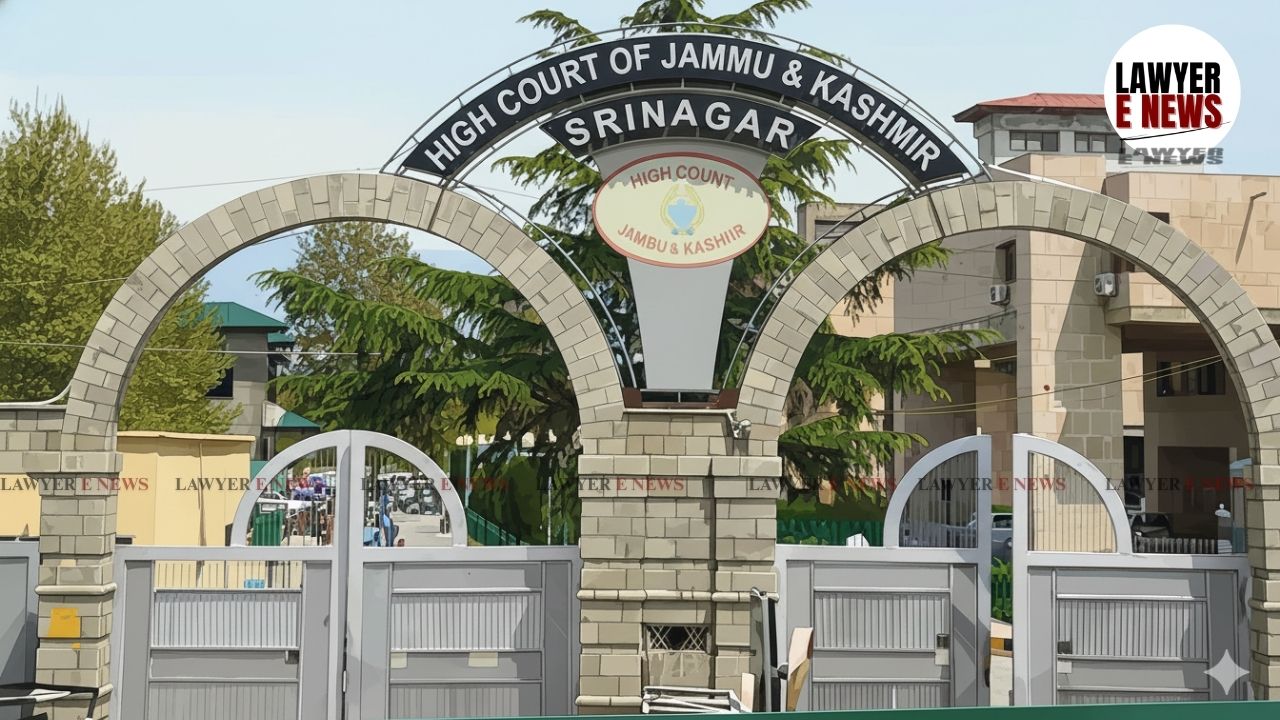
"Process Of Declaring A Building Unsafe Cannot Be Misused As A Tool To Dispossess Tenants Or To Scuttle Their Lawful Occupation", In a significant ruling protecting the livelihood rights of commercial tenants, the High Court of Jammu & Kashmir and Ladakh at Jammu has held that a Municipal Commissioner cannot ignore or override the findings of a court-constituted expert engineering committee by directing a fresh safety audit through a private empanelled agency, and that declaring a building "unsafe" as a pretext to evict tenants — without resorting to lawful civil ejectment proceedings — amounts to fraud on power, vitiating all consequential administrative actions.
Justice Wasim Sadiq Nargal quashed an order of the Commissioner, Jammu Municipal Corporation, which had directed yet another safety audit of the subject building despite a subsisting and unchallenged report by a court-supervised Engineering Wing declaring the shops structurally safe. The Court further directed the Chief Secretary, Union Territory of Jammu & Kashmir, to constitute an independent inquiry committee within two weeks to examine whether the initial "unsafe" report was engineered at the instance of the landlord with a mala fide intent to dispossess lawful tenants.
Can Administrative Authority Re-Agitate Issues Concluded By Court-Appointed Expert Committee?
The central legal question was whether the Municipal Commissioner could override the findings of a court-constituted expert committee by ordering a parallel inquiry through another agency.
The Court answered with a categorical no. "It is trite that once a competent court issues a direction requiring reconsideration strictly in light of a specified report, the scope of such reconsideration stands circumscribed by the judicial mandate itself. The authority is bound to act within the contours of the directions issued and cannot reopen or re-agitate the foundational issue which stood concluded by virtue of the expert determination obtained pursuant to the orders of this Court," the Court held.
The Court elaborated that reconsideration "in light of the report" imposed a binary obligation on the authority — either to accept the findings of the expert body or, in the alternative, to record cogent, legally sustainable and reasoned grounds for departing from such findings. "In absence of any such recorded reasons, the direction for a fresh safety audit through another agency amounts to abdication of the duty cast upon respondent No. 1 and cannot be sustained in law," it stated.
Critically, the Court found the Commissioner had acted "in the most contemptuous manner" and "as super authority, over and above this Court and in flagrant violation of the direction passed by this Court." The impugned order was found to be "non-speaking, devoid of any reasoning, finding, or reference to the report submitted by PWD (R&B) dated 26.05.2025."
Applying the Supreme Court's ruling in State of Tamil Nadu and Others v. K. Shyam Sunder and Others (2011 AIR SC 3470), the Court reiterated that in matters involving technical and expert determination, courts and administrative bodies should ordinarily defer to the opinion of expert bodies and refrain from substituting their own views. Relying further on the Bombay High Court's decision in Anahita Pandole v. State of Maharashtra (2004), the Court held that where a statutory expert body is vested with authority to render technical recommendations, the administrative head is bound to act in accordance with such expert opinion and cannot substitute it with his personal view.
"Once a competent expert body has rendered its findings pursuant to judicial directions, the administrative authority cannot sit in appeal over such findings, nor can it arrogate to itself the power to order a fresh inquiry through another agency," the Court declared.
Structural Safety Falls Within Exclusive Domain Of Technical Experts
The Court observed that determination of structural safety is exclusively within the domain of competent engineering authorities. Courts of law do not possess the technical expertise to independently assess structural safety, nor are they expected to substitute expert opinion with judicial assessment. Once a competent engineering authority conducts an extensive technical exercise under Magisterial supervision and submits its report, there remains no legal justification for courts or administrative authorities to doubt the findings, unless the same is shown to be perverse, mala fide, or subject matter of challenge before an appropriate forum.
Municipal Commissioner Cannot Act As Super Authority Over Judicial Directions
The Court invoked the Supreme Court's emphatic declaration in Maninderjit Singh Bitta v. Union of India (2012) 1 SCC 273, which held that orders of constitutional courts are binding on all authorities and must be complied with in letter and spirit. The Court quoted: "Flagrant violation of the court's orders would reflect the attitude of the party concerned to undermine the authority of the courts, its dignity and the administration of justice."
"The Initial Unsafe Report May Have Been Engineered At The Instance Of The Landlord, With An Oblique Motive To Oust The Lawful Tenants By Bypassing The Legally Prescribed Civil Process For Ejectment"
Court Prima Facie Finds Fraud On Power; Orders Inquiry By Chief Secretary
In perhaps the most striking part of the judgment, the Court went beyond merely quashing the impugned order and made prima facie findings that the initial report declaring the building unsafe may have been procured through collusion and engineered misrepresentation to achieve an indirect eviction of tenants — without following the legally prescribed civil process for ejectment.
"The circumstances prima facie suggest that the initial report declaring the building unsafe was obtained with the oblique intention of dispossessing the petitioners from the shops in question without resorting to lawful eviction proceedings. If an official report is procured or influenced to achieve such a collateral purpose, the same would amount to fraud on power and would vitiate all consequential actions founded thereon," the Court observed.
Applying the doctrine of fraud on power as explained by the Supreme Court in Express Newspapers Pvt. Ltd. v. Union of India (AIR 1986 SC 872), the Court reiterated that where statutory power is exercised for a purpose other than that for which it is conferred — including to serve private interests — such action stands vitiated in law. The Court also drew on State of Punjab v. Gurdial Singh (1980 AIR SC 319), which explained that "fraud on power voids the order if it is not exercised bona fide for the end designed... The action is bad where the true object is to reach an end different from the one for which the power is entrusted."
The Court forcefully held that "the law does not permit adoption of indirect methods to achieve what cannot be done directly. If the intention is to seek eviction of tenants, the only lawful course available is to initiate appropriate civil proceedings for ejectment in accordance with law. The process of declaring a building unsafe cannot be misused as a tool to dispossess tenants or to scuttle their lawful occupation."
Relying on the Supreme Court's decision in NOIDA Entrepreneurs Association v. NOIDA (2011) 6 SCC 508, the Court reiterated the settled principle "quando aliquid prohibetur, prohibetur at omne per quod devenitur ad illud" — that whatever is prohibited by law to be done directly cannot be achieved indirectly through circuitous contrivances. "One cannot adopt a different mechanism to achieve a nefarious design by scuttling the process envisaged under law, i.e., filing of a civil suit for ejectment instead of adopting the indirect method of throwing the tenants outside by getting the building declared as unsafe," the Court stated.
Right To Livelihood Under Article 21 Violated
The Court expressed deep concern for the plight of the petitioners, who are petty shopkeepers dependent exclusively on their shops for survival. "It pains this Court to note that how these poor shopkeepers would have survived during the intervening period when the shops in question were their sole source of livelihood. They have remained entangled in avoidable and uncalled-for litigation, for no fault attributable to them for such a long time."
Holding that closure of shops declared safe by a duly constituted technical committee fails the test of proportionality, the Court declared such action "constitutionally impermissible." Any arbitrary administrative action resulting in closure of shops despite a clear engineering finding of structural safety would amount to "a direct infringement of the petitioners' fundamental right to livelihood guaranteed under Article 21 of the Constitution of India," the Court held.
Citing Gauri Shanker and Others v. Union of India (AIR 1995 SC 55), the Court underscored that commercial tenancy is "much more valuable and precious than residential tenancy" since business carried on in commercial premises is often the tenant's only occupation and the source of livelihood for the entire family. Unlike residential eviction, when a tenant is thrown out of commercial premises, the very business that enables sustenance comes to a standstill.
The Court quashed the impugned order dated 26.07.2025 passed by the Commissioner, JMC, finding it "palpably bad in the eyes of law, being arbitrary and contrary to the binding directions issued by this Court." It directed that the petitioners shall be permitted to use and occupy the shops declared structurally safe forthwith, so that they may resume their business activities. For Shop No. 5, the landlords were directed to carry out the minor technical rectification — removal of the wooden plank roof and laying of an RCC slab — expeditiously.
Most significantly, the Court directed the Chief Secretary, Union Territory of Jammu & Kashmir, to constitute an independent inquiry committee within two weeks to examine whether any collusion, undue influence, procedural violation or mala fide intent was involved in the issuance of the initial unsafe report. If any officer of PWD (R&B) or JMC is found responsible for issuing or endorsing the misleading "unsafe" report, such officer shall be personally liable to pay costs of Rs. 10,000/- to each of the seven petitioners (total Rs. 70,000/-), to be recovered from their salaries. If the inquiry discloses that the Commissioner himself acted in derogation of the Court's binding directions, the entire cost liability shall be borne by the Commissioner personally.
The contempt petition (CCP(S) No. 382/2025) was also closed in view of the disposal of the main writ petition.
Date of Decision: 05.03.2026





