-
by sayum
27 August 2026 5:16 AM







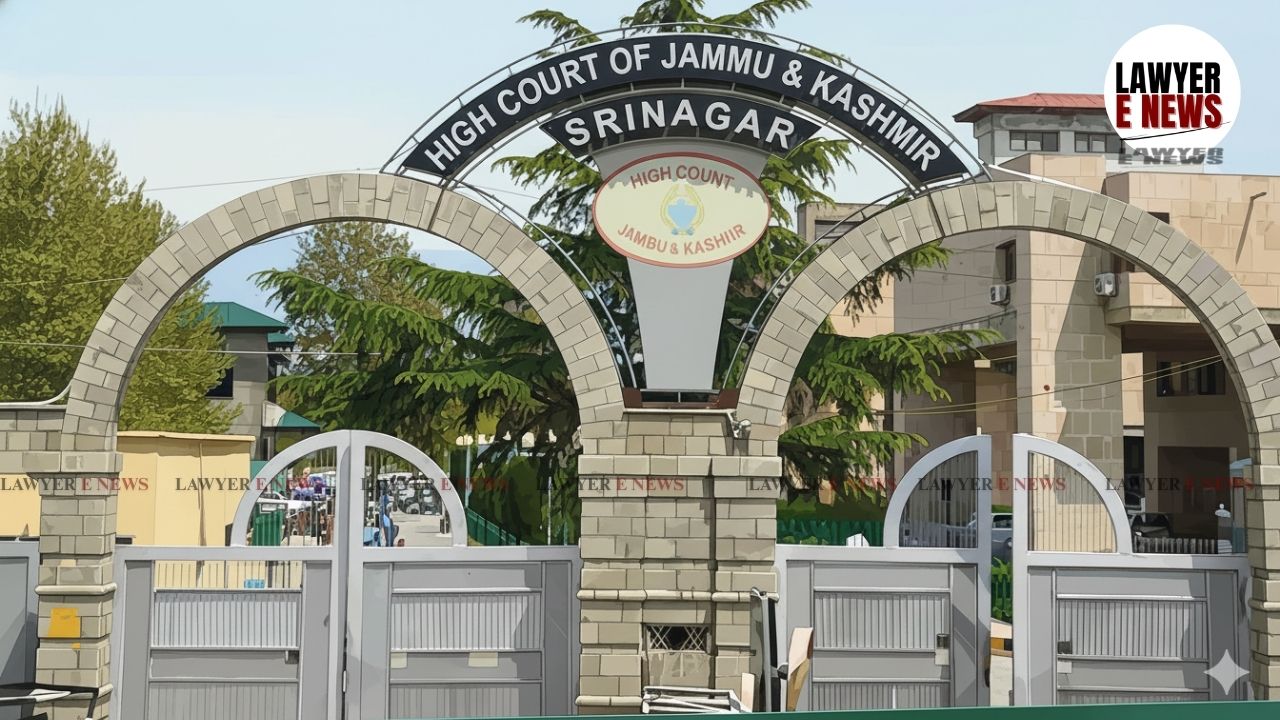
"The doctrine of contributory negligence, which may sometimes apply to adults, cannot ordinarily be invoked against children of tender age." High Court of Jammu & Kashmir and Ladakh at Jammu, in a significant ruling, held that the State bears strict liability for the loss of life caused by unsecured hazardous installations and cannot shift the blame onto parents by alleging contributory negligence when minor children are involved. While dealing with a tragic case where three young children drowned in an inadequately fenced hydel project reservoir, a bench of Justice Wasim Sadiq Nargal observed that the authorities responsible for maintaining hazardous installations owe a duty of care to the public at large to ensure that effective precautions are taken to prevent foreseeable harm.
BACKGROUND OF THE CASE
The petitioner, an agricultural worker, approached the High Court seeking compensation after his three minor children drowned in the forebay tank of the Chenani Hydel Project in June 2008. The petitioner alleged that the reservoir, which possessed steep plastered slopes and deep water, was left dangerously unfenced, posing a constant threat to local inhabitants. The respondent authorities opposed the petition, claiming that the tank was protected by a two-foot parapet wall and arguing that the tragedy resulted from the parents' failure to properly supervise their children.
LEGAL ISSUES
The primary question before the court was whether a writ petition under Article 226 of the Constitution is maintainable for claiming compensation in cases of accidental death involving disputed questions of State negligence. The court was also called upon to determine whether the doctrine of contributory negligence can be applied against children of tender age, and whether the multiplier method is appropriate for calculating public law compensation for the death of minors having no independent income.
COURT'S OBSERVATIONS
Addressing the preliminary objection regarding the maintainability of the writ petition, the court emphatically rejected the State's contention that the petitioner must be relegated to a civil court to resolve disputed questions of fact. Relying on the Supreme Court's landmark decision in Nilabati Behera v. State of Orissa and the Delhi High Court's ruling in Ram Kishore v. Municipal Corporation of Delhi, the bench noted that constitutional courts are not powerless to grant relief where the negligence of State authorities results in the deprivation of life. The court observed that the State's own admission regarding the existence of a mere two-foot parapet wall eliminated any disputed questions of fact requiring a civil trial, rendering the writ jurisdiction fully applicable.
"The availability of an alternative remedy in the form of a civil suit cannot operate as a bar in a case where the violation of the fundamental right to life is prima facie established."
Delving into the merits of the negligence claim, the court applied the doctrine of res ipsa loquitur (the thing speaks for itself), referencing the Delhi High Court's application of the principle in Darshan v. Union of India. The bench expressed astonishment at the State's defence that a two-foot wall constituted an adequate safety measure around a deep-water reservoir with steep plastered slopes. The court noted that such a minimal structure could easily be crossed by any person, defeating the very purpose of a protective barrier, and shifting the burden onto the respondents to prove they had taken reasonable precautions, which they failed to do.
"The drowning of three minor children in a reservoir maintained by the respondents is not an occurrence which would ordinarily take place if adequate safeguards had been in place. The incident, therefore, speaks for itself and raises a presumption of negligence against the authorities."
The court came down heavily on the respondent authorities for attempting to attribute the tragedy to a lack of supervision by the grieving parents. Citing judgments from the Delhi High Court in Subramanium v. Delhi Metro Rail Corporation Ltd. and Gopalpur Victim Association v. Delhi Jal Board, as well as the Madras High Court in Kanagaraj v. District Collector, the bench reiterated that children do not possess the discretion or foresight to appreciate the risks posed by dangerous structures. The court held that when hazardous installations are located in areas accessible to the public, the law expects a higher degree of care from the authorities, as the presence of children is reasonably foreseeable. "The respondents cannot escape liability by attempting to attribute contributory negligence to the deceased children, who were incapable of appreciating the risk posed by the forebay tank maintained by the authorities."
"A parapet wall of merely two feet in height, by no reasonable standard, can be regarded as an adequate safety measure to prevent access to a hazardous water reservoir."
Elevating the issue to a constitutional dimension, the court examined the State's duty under Article 21, read harmoniously with the Directive Principles of State Policy under Articles 38, 39(e), 39(f), and 47 of the Constitution. Relying on the Supreme Court's strict liability jurisprudence in Municipal Corporation of Delhi v. Uphaar Tragedy Victims Association, the bench held that the State and its instrumentalities bear an absolute and non-delegable duty to ensure public safety when operating hazardous utilities. The court observed that the failure to secure the forebay tank with proper protective measures was not merely an administrative lapse but a direct violation of the fundamental right to life.
"Any failure on the part of the State to discharge this obligation, resulting in loss of life, cannot be treated as a mere lapse but amounts to a breach of its constitutional duty, thereby attracting liability to compensate the victims or their families."
Finally, the court adjudicated on the appropriate method for calculating compensation in public law remedies involving the death of minors. The bench consciously departed from the traditional multiplier method often used in motor accident claims, finding it inappropriate for children of tender age who have no independent source of income. Agreeing with the Madras High Court's reasoning in Rajakumar v. The State of Tamil Nadu, the court noted that assessing future earnings for infants would be wholly speculative and would lead to unequal compensation for similarly placed claimants, whereas the pain and suffering of the parents remains uniform. The court resolved to award a fixed, reasonable sum as a public law remedy to provide solace and acknowledge the wrong committed by the State.
"The loss of a child is incapable of being measured in terms of money, and any mathematical formula would fail to capture the magnitude of such loss."
Allowing the writ petition, the High Court directed the respondents to pay a uniform compensation of Rs. 2,00,000 per deceased child, totalling Rs. 6,00,000, within a period of eight weeks. Taking a broader administrative view to prevent future tragedies, the Court issued a mandatory direction to the Chief Secretary of the Union Territory to formulate a comprehensive policy ensuring the proper fencing, installation of warning signboards, and adequate safeguarding of all hazardous water bodies and installations across the region.
Date of Decision: 24 March 2026