-
by sayum
25 August 2026 4:32 AM







“Investigation Cannot Become an Endless Ordeal…..Delay in investigation constitutes violation of right under Article 21; investigation cannot continue endlessly without justification” – Supreme Court asserts right to certainty in criminal process
In a resounding endorsement of the right to a speedy trial as a facet of Article 21 of the Constitution, the Supreme Court of India quashed the chargesheet and entire criminal prosecution against IAS officer Robert Lalchungnunga Chongthu, citing an unexplained delay of over 11 years in completing the investigation. The Court held that such delay, absent any fresh material or cogent justification, was not only unreasonable but constitutionally impermissible, violating the accused’s right to a fair and timely legal process.
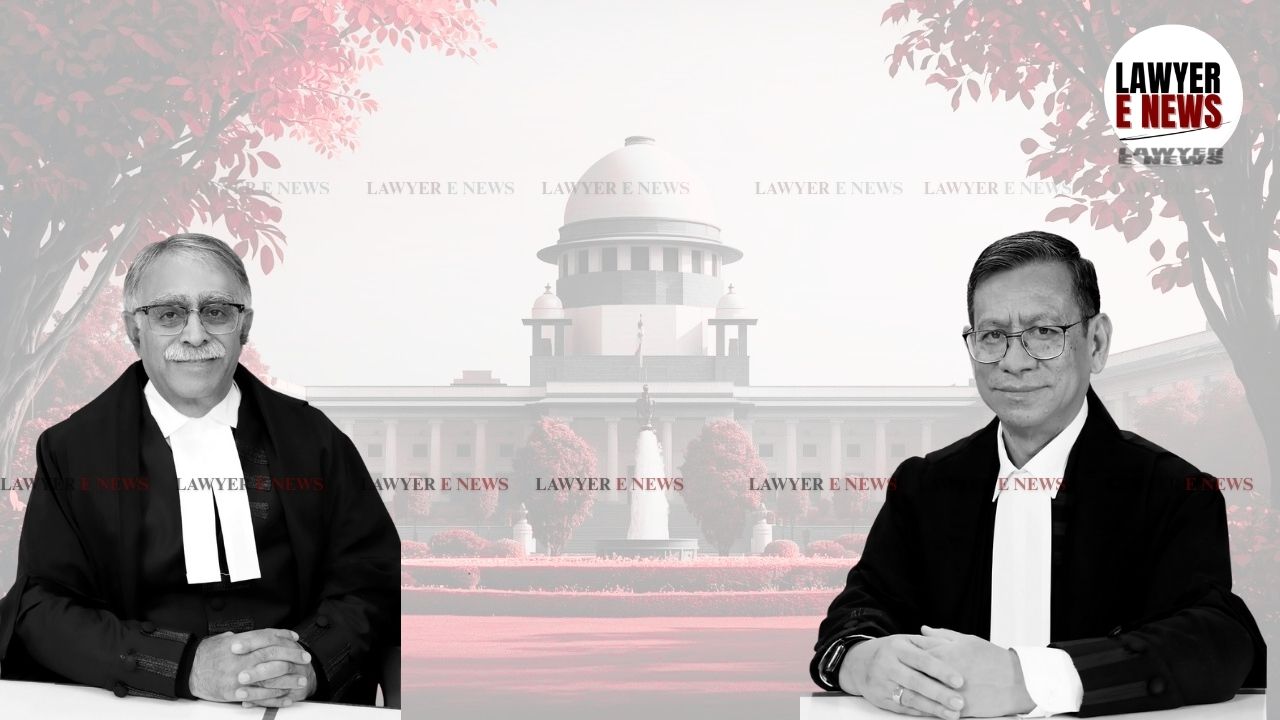
“Investigation cannot continue endlessly without justification. The accused cannot be left under a cloud of criminal proceedings for decades with no end in sight. This violates Article 21,” observed a bench of Justice Sanjay Karol and Justice Nongmeikapam Kotiswar Singh.
The case, which arose from an FIR lodged in 2005, pertained to alleged irregularities in the issuance of arms licences during the appellant's tenure as District Magistrate, Saharsa. A supplementary chargesheet in 2006 had already exonerated the appellant, terming the allegations as “false”. Yet, in 2009, a request for further investigation was allowed — but the next chargesheet was filed only in August 2020, 11 years later, and with no explanation on record.
“How long can an accused be expected to wait? Justice delayed is not just denied — it is destroyed”
Expressing concern over the prolonged silence of the State after taking permission for further investigation, the Court noted that no reasons whatsoever were recorded either in the chargesheet or in court orders to justify the delay.
“When only the actions of the appellant were subject matter of investigation... 11 years is quite obviously a timeline afflicted by delay. No reason is forthcoming for this extended period,” the Court remarked.
Emphasising the constitutional obligation of timely prosecution, the Court recalled the principle that the right to speedy trial encompasses all stages — from investigation to appeal — as laid down in Abdul Rehman Antulay v. R.S. Nayak and P. Ramachandra Rao v. State of Karnataka.
“The accused is entitled to certainty — not perpetual suspense”
The Court categorically held that delayed investigation cannot be rationalised by institutional lethargy or administrative lapses. The consequences of such delay are not merely procedural but substantive, striking at the very heart of fair trial protections under Article 21.
“It is not just the physical incarceration, but the psychological burden, professional harm, reputational injury and the irreparable erosion of personal dignity that result from pending criminal cases,” the Court stated.
The appellant had endured the looming threat of prosecution for over 20 years since the FIR, despite having been discharged in departmental proceedings in 2016, and despite a prior closure report that had cleared him.
Court Slams Institutional Complacency; Issues Directions for Judicial Oversight of Delayed Investigations
The Court lamented that delays of this nature are not uncommon, and issued specific directions to ensure judicial control over prolonged investigations:
“If there is a large gap between the FIR and the chargesheet, the Court must seek an explanation from the investigating agency and satisfy itself of the propriety of the delay.”
It further directed that:
“If investigation into an offence has continued for a period that appears unduly long, without adequate justification, the accused or complainant may approach the High Court under Section 482 CrPC or Section 528 BNSS seeking either an update or quashing.”
Reinforcing that investigative delay is not a neutral inconvenience, but a violation of constitutional rights, the Court declared:
“Delay without justification has consequences — and one of them is the invalidation of the prosecution.”
From Colonial Investigations to Constitutional Accountability
In a comprehensive historical analysis, the Court traced how investigative timelines were once absent in colonial codes like the CrPC of 1861 and 1872, where police operated independently and without time-bound duties. But with the evolution of judicial oversight through the CrPC of 1973 and now the BNSS, 2023, the expectation of timely investigation has become normative and binding.
Quoting CBI v. Mir Usman and Sovaran Singh Prajapati v. State of U.P., the Court held:
“Justice in slow motion is justice in suspension. The right to a timely trial is no longer aspirational — it is enforceable.”
A Warning Against Perpetual Prosecution: “Let not justice become a waiting room with no exits”
The Court did not mince words in condemning systemic inertia. It held that failure to conclude investigations within a reasonable time, without exceptional justification, destroys the presumption of fairness.
“It is not the role of the judiciary to tolerate never-ending investigation. It is the duty of the Court to draw the line when delay transforms process into punishment.”
Chargesheet and Prosecution Quashed
Concluding that the delay alone was enough to vitiate the prosecution, the Court allowed the appeal, quashed the chargesheet filed in 2020, the cognizance order of 2022, and all consequential criminal proceedings.
“The law does not authorise the prosecution of a person merely to test their endurance over decades,” the Court warned, setting a strong precedent for future cases where delay masquerades as investigation.
Date of Decision: 20 November 2025