-
by sayum
02 November 2026 1:47 PM







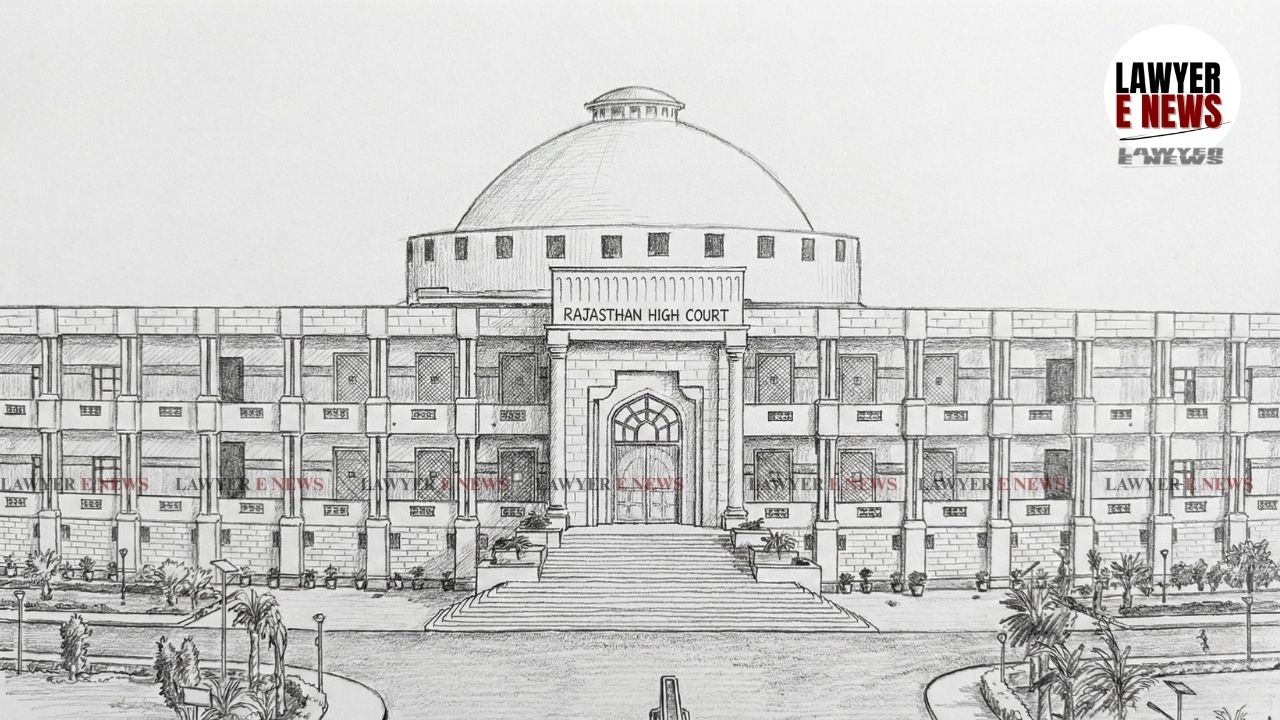
"In the absence of any satisfactory explanation for the extraordinary delay in recording their statements, coupled with the unnatural conduct of witnesses in withholding such a vital fact despite repeated opportunities to disclose it, the possibility of subsequent embellishment or improvement cannot be ruled out." Rajasthan High Court at Jodhpur, in a significant judgment, set aside the death penalty and acquitted a man accused of murdering his wife, emphasizing that unexplained delays in recording witness statements severely undermine the credibility of the prosecution.
A division bench comprising Justice Vinit Kumar Mathur and Justice Chandra Shekhar Sharma observed that in cases resting entirely on circumstantial evidence, any significant gap in the investigative process, particularly regarding the "last seen" theory, creates a gaping hole in the chain of events.
The accused-appellant, Premlal, was convicted by the Trial Court for the murder of his wife, Nima, and was sentenced to death under Section 302 IPC. The prosecution alleged that Premlal, aggrieved by matrimonial discord following his second marriage, deceitfully called the deceased to an isolated location and murdered her by inflicting stone blows to her head. The case reached the High Court through a Murder Reference for confirmation of the capital punishment and a criminal appeal filed by the accused.
The primary question before the court was whether the prosecution had established a complete and unbroken chain of circumstantial evidence to prove the guilt of the accused beyond a reasonable doubt. The court was also called upon to determine the evidentiary value of "last seen together" testimonies when such statements were recorded after an inordinate and unexplained delay of nearly twenty days.
Delayed Recording Of Statements Vitiates 'Last Seen' Theory
The Court meticulously examined the testimonies of the principal witnesses who claimed to have seen the deceased in the company of the accused before her death. The bench noted that the statements of these crucial witnesses were recorded by the Investigating Officer after a delay of fifteen to twenty days without any plausible explanation.
The Court observed that such an inordinate delay in recording statements under Section 161 CrPC, especially when the witnesses were available and present during the initial investigation, makes the evidence highly suspect. The bench emphasized that the failure of the investigating agency to provide a reason for this delay in the case diary reinforces the possibility of the evidence being an afterthought or an embellishment.
Court Highlights Unnatural Conduct Of Material Witnesses
Regarding the credibility of the witnesses, the High Court found their conduct to be "wholly unnatural" and inconsistent with human behavior. One witness claimed to have seen the deceased leaving with the accused on a motorcycle but did not disclose this vital information to the police or the family even when the woman was reported missing and later found dead.
The bench noted that despite multiple visits to the police station for other formalities, the witness remained silent about the "last seen" circumstance for nearly three weeks. The Court held that such silence, when a close relative is missing or dead, strikes at the very root of the witness's reliability and renders the testimony unsafe for a conviction in a capital case.
"The testimony of a witness who remains silent for an inordinate period without a valid reason cannot inspire the confidence of the Court to sustain a conviction."
Lapses In Investigation And Lack Of Independent Witnesses
The Court further critiqued the investigation for failing to associate independent witnesses during the recovery of incriminating articles like the alleged weapon of offence and blood-stained clothing. It was observed that the recoveries were witnessed only by subordinate police officials, even though the sites were accessible to the public and local authorities.
The bench remarked that the procedure adopted while recording disclosure statements under Section 27 of the Evidence Act was flawed, as the statements were typed by the police officer in the absence of independent persons. The Court held that such procedural irregularities diminish the evidentiary value of the recoveries and fail to provide the "extra layer of assurance" required in cases of circumstantial evidence.
Medical And Forensic Evidence Viewed As Merely Corroborative
While acknowledging the DNA and FSL reports which showed a match with the deceased’s blood, the Court held that scientific evidence cannot be evaluated in isolation from the circumstances of the recovery. Since the foundational facts regarding the seizure of these articles were shrouded in doubt due to contradictions between the two Investigating Officers, the forensic results could not cure the fundamental defects in the prosecution's case.
The Court also noted that the medical evidence did not conclusively point to homicidal death to the exclusion of all other possibilities, as the doctors admitted that the injuries could have resulted from an accidental fall upon rocks. The absence of defensive injuries or marks of struggle on both the deceased and the accused further weakened the theory of a brutal physical assault.
"Forensic evidence is merely corroborative and cannot independently establish guilt unless the foundational facts of the recovery are proved by reliable and legally admissible evidence."
Circumstantial Evidence Must Exclude Every Hypothesis Of Innocence
Applying the settled principles of Sharad Birdhichand Sarda v. State of Maharashtra, the Court reiterated that in cases of circumstantial evidence, the circumstances must be of a conclusive nature and must exclude every hypothesis except the guilt of the accused. In the present case, the bench found that the motive remained unproved and the "last seen" theory was unreliable.
The High Court concluded that the Trial Court had erred by placing undue emphasis on the brutal nature of the crime and moral indignation rather than legal proof. The bench held that however strong the suspicion might be, it cannot take the place of legal proof, and the benefit of every reasonable doubt must necessarily go to the accused.
The High Court allowed the criminal appeal, set aside the conviction and death sentence, and acquitted the appellant of all charges. The Court directed his immediate release, observing that the prosecution had failed to establish a complete and unbroken chain of incriminating circumstances leading only to the hypothesis of the guilt of the accused.
Date of Decision: 14 July 2026